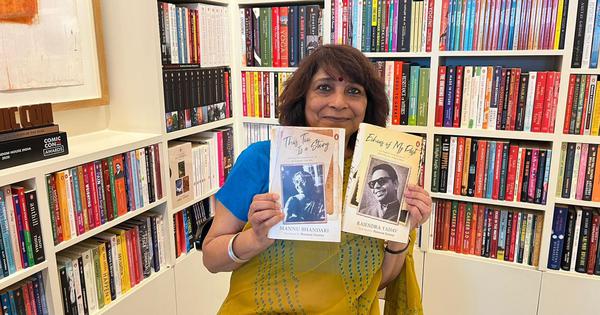
Works that have shaped generations of readers in North India have often travelled slowly, sometimes reluctantly, into the global circuits of literature. In this long transition, the translator becomes more than a mediator; they are an archivist of memory, a curator of literary history, and at times, an agent of restitution.Poonam Saxena’s work sits at the heart of this moment. Best known for translating Dharamvir Bharati’s Gunahon Ka Devta as Chander and Sudha, she has gifted English-language readers the works of Rahi Masoom Raza, Mannu Bhandari, and Udayan Vajpeyi, among others. Her anthology The Greatest Hindi Stories Ever Told attempts something even more ambitious: to sketch a living lineage of Hindi fiction across generations.In a conversation with Scroll, she reflects on the craft of translation, the problem of the “untranslatable”, and the evolving place of Hindi literature in the global imagination.You began your career as a journalist. How did your early engagement with English-language writing shape your sensitivity to Hindi literary expression?I studied in English-medium educational institutions all through – first in a convent school in Delhi and then in St Stephen’s College. I was always a voracious reader since I was a child. Obviously, the books I read in the beginning were all English-language books. I started writing short stories for Children’s World magazine when I was about 11 years old. For me, reading and writing in English were the most natural things to do. I always knew I wanted to be a journalist and work in a newspaper or magazine.I became a more conscious reader once I was in college. I grew up in a family where reading and writing were deeply valued (my parents were from Kanpur, but my father was posted in Delhi when I was very small, so for all practical purposes, I am a Dilliwali). We had Hindi magazines and books at home; my aunt wrote poetry in Hindi. I began gravitating towards Hindi novels and short stories and began reading them avidly. So my reading encompassed two languages, though I wrote in English. I discovered the joy and beauty of being bilingual. Each language fed into the other, so to speak. I found reading fiction in Hindi affected me powerfully. I enjoyed it even more than I enjoyed reading in English, or let me put it another way, I felt much closer to what I was reading.Do you remember your first encounter with Gunahon Ka Devta? At what point did admiration turn into the desire to translate it?I read Gunahon Ka Devta long ago. I was smitten. I couldn’t get the novel out of my head. I read it again and again. I wanted to share the book with friends, talk about it, discuss it with them, but none of my friends read in Hindi. So that was that… till one day, when I was complaining about this to a friend, she said, why don’t you translate it? And suddenly, the idea hit me with full force. I immediately sat down with the novel and translated two chapters – just to see if it was for me. I found I loved it. I loved the process of translation. That’s how the journey began. I loved the idea that I could share Hindi books with readers who wouldn’t have read them otherwise.Looking back, do you see your entry into translation as accidental, or did it emerge from a deeper recognition of a historical gap?Well, it was accidental. But I think it was an accident waiting to happen. If it hadn’t happened then, I’m sure it would have happened in some other way later. Because as I continued reading and translating, I realised why I loved translating. One, of course, it was pure joy, a nasha if you like. But it was also a strong desire for others to read these wonderful works and a feeling: why don’t more people know about these books and writers? Why don’t English readers know about them? They should. There is a huge gap in their reading.When you translated Gunahon Ka Devta, nearly six decades after its publication, did it feel like you were addressing a long-standing absence in Indian literary circulation?Yes, it did. I couldn’t believe that Hindi fiction’s biggest bestseller Dharamvir Bharati’s iconic novel wasn’t available for English readers. I couldn’t wait for readers to discover its magic. And I do want to tell you that more than ten years after it was published in English, the novel is still finding readers and many of them are people in their 20s and 30s. That a novel published in 1949 still speaks to them says a lot about the power of the book. They write on social media about how the novel blew them away – its intensity, its passion, the characters, the love story.Why do you think such a widely read Hindi novel remained untranslated for so long? Does this reflect a larger imbalance in how Indian literatures have been valued?I really don’t know why it remained untranslated. One reason could be that it is so different from Bharati’s other works, like his novel Suraj ka Saatwan Ghoda, or his play, Andha Yug, both of which are brilliant and widely respected in Hindi literary circles. Gunahon Ka Devta was written when Bharati was in his early 20s. It was seen as a love story meant to be read by young people. Its very popularity meant it was not viewed with the same seriousness as his other works. You were supposed to progress from Gunahon Ka Devta to more “literary” books. I find this whole thing deeply problematic. If a novel is popular, it is not “serious” enough. If it is a love story about two young people, it can’t be taken seriously. If it has a compelling emotional appeal, that somehow makes it less significant. I find this ridiculous.Did you approach the text primarily as a translator, or as a reader trying to recover the emotional and social world of its time?I approached it as a reader who loved the book and was trying to tell the story in English, keeping its emotional depth and potency intact. I wanted readers in English to feel the intensity of Chander and Sudha’s doomed love. Chander is a flawed, conflicted hero who can frustrate you. Sudha is steadfast, tragic in her unwavering love. I wanted readers to feel their torment and passion. And of course, along with the love story, Gunahon Ka Devta takes a keen, sharp look at the society of the time with its suffocating rules and conventions. It is also a heartfelt ode to the city of Allahabad.You have spoken about certain words resisting translation. How do you deal with expressions that carry cultural or sensory meanings that English cannot easily accommodate?This used to exercise me a lot in the beginning and yes, I have spoken about it too. But now, I have made peace with it. Yes, there are expressions that carry cultural meanings that cannot be translated into English with the same feeling, nuance, or accuracy. And that’s all right. What is important is that readers get a feel of the time and place, the mahaul, the characters. A translator can attempt to do that, and with success. That is the wonderful thing about translation. Without knowing the language, you can be transported into a different milieu altogether.Do you think translation is ultimately an act of approximation, or can it come close to equivalence?I don’t like to get too theoretical about translation. I am, if you like, an “instinctive translator.” It’s like this – I may not know the intricacies of English grammar, I may have forgotten my Wren and Martin long ago, but I know instinctively when a sentence is grammatically wrong. I mean, I know that English is subject-verb-object and in Hindi it’s subject-object-verb but this is not something I think about while translating. I strive to get the meaning and feeling across. Yes, if there’s a particular word that’s confounding me, I explore all the various options I have for that word and finally go with the one that’s closest to the original and that also sounds right. But that’s it. I don’t – and it would be foolish to try – do some kind of word-for-word translation. If the original text is, for example, trying to convey a character’s grief, the reader should feel the grief the way the author intended. Obviously, one tries to stay faithful to the words and sentences, but that’s about it.Where do you locate the inevitable “loss” in translation, at the level of language, culture, or reader experience?I think culture is the toughest, but as I explained earlier, it’s all right. Also, I firmly believe, let the reader also do a bit of work. We’ve been reading English books set in England or America all our lives. We missed so much of the cultural context but it didn’t matter; it didn’t affect our enjoyment of the book. I’m still puzzled sometimes by sentences or words in American or English novels which make sense only if you know a particular pop culture reference. So I try and find out. I look it up online. I like Japanese crime fiction. I keep coming across words like “kotatsu” and “hakama” which are not explained. So I take the trouble to find out. At least now we have Google. As a child, when I read Enid Blyton, I didn’t understand so much of the food in the books, for example. What was treacle? And don’t even get me started on tongue sandwiches. But it didn’t affect my reading pleasure at all.In The Greatest Hindi Stories Ever Told, you bring together writers across generations. How did you conceptualise this literary arc?This was really challenging. Before I began translating, I read Hindi short stories for about three years and took notes (I’m a compulsive note-taker). Then I drew up many longlists, then a final longlist, then a shortlist and so on. I had to regretfully leave out many authors because of a lack of space. There were many filters I used in the selection process but I think I took my main guiding principle from Premchand’s presidential address to the All India Progressive Writers’ Association in 1936, where he basically said that literature should be the mirror of its age. I think it doesn’t matter what the style or form is; it should shine a light on the times, directly or obliquely. You can write a full-fledged fantasy novel but that too should say something about us, our world, our times. The Greatest Hindi Stories Ever Told was a literary selection, so one had to go with appropriate literary yardsticks to select the stories.Do you see Hindi literature as a continuous tradition, or as something shaped by historical ruptures, such as Partition, modernity, and changing readerships?Any great literature changes and evolves over time. Hindi literature too has gone through – and continues to go through – its phases, defined by language, themes and so on. And these are shaped by history, events, individuals, social forces and upheavals. Premchand wrote stories and novels in simple, everyday Hindi around the freedom movement, the agrarian unrest in the United Provinces (present-day Uttar Pradesh), the peasantry squeezed by moneylenders and zamindars, about social practices like dowry and more. The post-Independence generation of writers had different concerns; they wrote of Partition, they wrote urban stories about the changing family, about relationships between men and women, individual struggles and alienation. So to answer your question, more of the latter, I’d say.Was there a writer in the anthology whose work posed a particular challenge, not just linguistically but in terms of worldview?I think Phanishwarnath Renu’s “Maare Gaye Gulfam” was particularly challenging because of his liberal use of Bihari colloquialisms.Translators often play an unacknowledged role in shaping literary canons. Do you think translation determines what becomes visible as “Indian literature” to a wider audience?Yes, I think so. You can only read in the language in which you can read. So whatever is published in English will get noticed. You can see this internationally too – Murakami and Marquez became global sensations, became stars of world literature, only after they were translated into English.How do you decide which works deserve to be translated now, canonical texts, contemporary writing, or overlooked voices?There is a very long list of works which I think deserve to be translated, for all of the reasons you have mentioned above. For example, I think all of Premchand’s novels need to be translated, from the best-known ones like Rangbhoomi and Karmabhoomi to lesser-known works like Prema and Pratigya, even his unfinished novel Mangalsutra. I am very glad Penguin India did his collected short fiction. I think it’s time for a publishing house to begin an ambitious project to translate all his novels, with solid Introductions and Notes. And while we are on Premchand, I just want to say this – apart from everything else, his novels are fabulous reads. No wonder he was so popular.There are many other wonderful Hindi writers who have not been translated at all or not translated enough. Short stories by Kamleshwar, Rajendra Yadav and Mohan Rakesh. Later writers, such as Ravindra Kalia, Doodhnath Singh, Gyanranjan, and Kashinath Singh. Amarkant’s short stories. Badiuzzaman’s works. Stories and novels by Mannu Bhandari, Krishna Sobti, Mridula Gar, and Mamta Kalia. The short stories of Usha Priyamvada, Shivani. There’s Kamtanath, Akhilesh, and Neelakshi Singh. The novel Kala Jal by Shani. So many memoirs. I think some of Omparakash Valmiki’s short stories have been translated, but not all. Other Dalit writers, like Mohandas Naimishray. There are books that have been translated before but need fresh translations – such as Mohan Rakesh’s novel Andhere Band Kamre. And so many contemporary writers! I also feel we should be translating Hindi commercial and pulp fiction.This is by no means an exhaustive list. I have left out dozens of names. There are too many writers to list. There is a world waiting to be found in translation.Speaking for myself, I translate books I fall in love with. Because I am going to live with the book for months if not years, it would be impossible for me to translate a book I didn’t enjoy reading.When translating writers like Rahi Masoom Raza, do you also see yourself as translating a specific socio-political history?I have translated only one of his novels, Scene 75. It is set in the Hindi film industry of the 1970s and is about a young scriptwriter from Banaras, Ali Amjad, who comes to try his luck in Bombay. It is a brilliant, darkly funny, surreal novel. I fell in love with it as soon as I read it. If you look at his greatest novel, Adha Gaon, it is definitely socio-political history. It is about the Shia community in Gangauli and how the community was impacted by Partition. It is at once hugely entertaining and deeply moving. It’s a classic. I also love Topi Shukla.What does your translation process look like in practice? Do you work with a fixed routine, or does each text demand its own rhythm?I believe in multiple drafts and multiple readings of the text. The more I read the text, the more familiar I become with the voice of the writer. Ambiguous passages suddenly open up, unclear sentences become crystal clear.While translating, I try and work every day for a few hours in the morning and then again in the evening (with a lot of Darjeeling tea to keep me company and a notebook and pen always by my side). I translated all of Gunahon Ka Devta while working late at night because I had a full-time job then, but now I don’t work nights. I keep that for reading.In your work, do you prioritise fidelity to the original sentence, or to the emotional cadence of the text?I think more emotional cadence of the text. But also the former. I try to be as close to the original as possible, but as I said earlier, it’s impossible to do a word-for-word. But the meaning, the feel, the emotion, the thought should come across.At what point does a translation begin to feel like a fully realised work in English rather than a rendering of another language?The last and final draft. I never look at the original then. The book should read smoothly in English by then.For a long time, translators in India remained largely invisible. Do you think this is changingOh, yes. Translators have their names on the covers now. There is a lot of discussion around translation. There are translation categories in book awards. It is definitely changing.How do you negotiate the question of visibility, through introductions, notes, or annotations, without overwhelming the text?I am a big fan of introductions and notes. (Maybe it’s my training as a historian – I did an MPhil on women and the freedom movement). I also feel that an English reader usually doesn’t know much about Hindi writers. In some cases, they haven’t even heard of the writers, even if they are famous names. I have faced this. I tell people I’m translating, say, Rahi Masoom Raza. They’re blank. Then I say he was the man who wrote the dialogues for BR Chopra’s TV serial Mahabharata, he wrote the dialogues for Hrishikesh Mukherjee’s Golmaal and other films. Then the penny drops. I tell people I’m translating Rajendra Yadav and it’s the same. Then I ask them if they’ve seen Basu Chatterjee’s film, Sara Akash. That they know. What I’m saying is that English readers are often clueless. So if you give a concise Introduction, they at least get to know a little bit about the writer and can place them in context, that oh, he or she was a major writer of the 60’s and 70’s or whatever. I like giving Notes wherever needed for context, especially while translating memoirs or autobiographies. For example, when I was translating Rajendra Yadav’s memoir Mud Mud Ke Dekhta Hoon (Echoes of My Past), I found he mentioned all sorts of people without giving the reader any idea as to who they were. Now, his Hindi audience would have been aware of most of those people, but not an English reader of 2026. So I gave brief Notes at the end of the book.How do you respond to readers who judge translations as if they were originally written in English?I feel that ideally translated books should read fluently in English, as if they were written in English. Otherwise, if the translation is clunky or stilted, you’re putting a burden on the reader and robbing them of reading pleasure. But a translation should also give the reader a feel of the place and people and the culture in which the book is set. It adds richness to the reading experience. It gives the reader a window into a world they may not know much or anything about. I am the biggest proponent of reading for pleasure. While reading for pleasure, if you learn something, that’s fantastic. But first and foremost is the pleasure to be derived from reading a book.There is currently a renewed interest in Indian language writing in translation. Do you see this as a passing phase or a more lasting shift?I think it’s here to stay. Because we still have a huge treasure trove waiting to be discovered. We have so many languages and these languages have rich literary traditions. That said, there is a wealth of wonderful commercial and genre fiction in Indian languages, which should not be overlooked. There are young contemporary writers writing interesting new books. I feel we have to look at the entire gamut – from classics to literary works to racy commercial fiction to pulp, everything.What changes in publishing and readership have made this moment possible?I think many brave and far-seeing editors in some publishing houses pushed translations with intent, almost with a mission. Their hard work over the years has helped us arrive at this point. Also, specific moments, such as translations winning the JCB Prize for Literature, translations from Hindi and Kannada winning the International Booker Prize.Would you describe this as a kind of renaissance for regional literatures?Well, a renaissance in the sense that works in Indian languages are becoming available to a wider readership. I also notice that many Hindi writers are keen to get translated into English and I’m sure this is the case in other languages too.You have described translation as an ethical act. What responsibilities does a translator carry toward the original text and its author?I approach every text I have to translate with a lot of respect. It is my duty to make sure that I remain truthful to the text, to what the writer is trying to convey; you cannot alter the meaning. But it is also my duty to do that in a readable way. That’s the crux.Can translation ever be neutral, or is it always shaped by the translator’s own historical and cultural position?I think the translator has to put aside their own thoughts and views and instead approach the text without judgment, but with understanding and compassion. That is what I aim to do.What would you say to younger translators working between Hindi and English?Read read read. Both in Hindi and in English. Speaking for myself, I am deeply interested in Hindi sahitya and I read in Hindi, mostly fiction or memoirs, all the time. It is one of the great joys of my life. I read not just to try to find novels or stories I would like to translate, but also for enjoyment and to add to my knowledge of Hindi literature. I approach every unread book with a lot of excitement and anticipation. Reading is vital. It keeps the writer and translator in you alive. I don’t understand writers or translators who don’t read. I don’t know how they do their work. I am actually a little obsessive about reading. When I’m translating a particular writer, I like to read all their works. When I was translating Mannu Bhandari and Rajendra Yadav’s memoirs, I read all their short stories and novels. When you read an author’s entire works, you get a feel of their language, style, tone, their pet themes and concerns and so on. I sometimes feel a sense of almost feverish urgency when it comes to reading – I still haven’t read so many writers, there’s so much more of Hindi literature I have to read!How would you like your own work to be situated in the longer history of Indian literature?As part of a process of discovery of Indian literature and its beauty.If translation is a way of carrying one world into another, what, in your view, is still waiting to be carried across?After carrying one world into another, after discovering a world, let the process also shape you, open your mind and heart, widen your horizons. Understand people who live in a place you don’t know, who have a way of life you are not familiar with. Understand that there are people who might be different, but you know what, they too, like you, feel pain and sorrow. They too love and cherish. There is a common humanity that binds us. In a world torn by hatred and intolerance, this is so important. We have never needed understanding and empathy more than we need them today.
‘Commercial and genre fiction in Indian languages shouldn’t be overlooked’: Translator Poonam Saxena
An interview with the Hindi-to-English translator.
3,906 words~18 min read