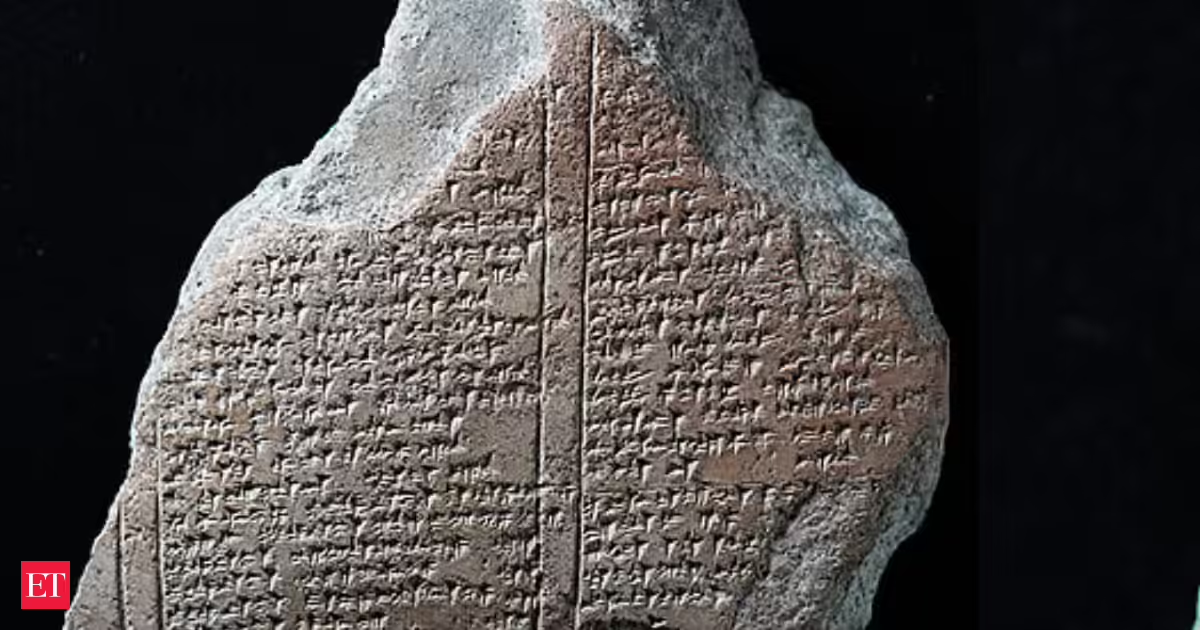
A new AI-powered tool is helping researchers crack one of history’s oldest writing systems — and it could completely transform the study of ancient civilizations.Called “Palaeographicum,” the tool can identify tiny differences in cuneiform handwriting on clay tablets dating back over 3,500 years. Developed by researchers from the University of Würzburg and the Academy of Sciences and Literature Mainz, the AI system is being described as a major breakthrough in the field of Ancient Near Eastern Studies.Cuneiform is one of the world’s earliest known writing systems. Ancient scribes pressed wedge-shaped symbols into wet clay tablets using a stylus. Over thousands of years, many of these tablets broke apart, leaving researchers with the difficult task of reconstructing them like giant historical puzzles.The new AI tool dramatically speeds up that process.Researchers say Palaeographicum can scan millions of cuneiform symbols and compare handwriting styles in minutes — a task that previously took experts several days. The system currently works with more than 70,000 photographs containing over five million cuneiform characters.What makes the technology especially powerful is its ability to spot unique writing habits of ancient scribes. Even though the symbols were pressed into clay, each writer had subtle personal styles, similar to modern handwriting. Some made deep flourishes, while others spaced symbols differently.According to Professor Daniel Schwemer, head of Ancient Near Eastern Studies at the University of Würzburg, the AI is “radically changing” research work and saving thousands of hours for scholars.The tool could also help historians determine the age of undated clay fragments by analyzing how handwriting styles evolved over centuries. Researchers hope future versions of the AI will become advanced enough to automatically identify individual scribes and trace their careers across different documents.Experts believe this could eventually help build a detailed social history of writing culture in the ancient Hittite civilization, which flourished in present-day Turkey around 3,500 years ago.
AI cracks 3,500-year-old ancient code, reveals secrets of forgotten empire
A new AI tool, Palaeographicum, is revolutionizing the study of ancient civilizations by identifying subtle differences in cuneiform handwriting on clay tablets. Developed by researchers, this technology rapidly scans millions of symbols, speeding up the reconstruction of fragmented historical documents and potentially identifying individual scribes to build detailed social histories.
309 words~1 min read