Life in Finland offers many advantages to people who move to the 'world's happiest country' from abroad.There is the enviable work-life balance that focuses on family and personal time, an education system with a glowing global reputation, and of course the fact that you're never too far from a sauna — with an estimated 3 million dotted around the forested landscape.But there are many challenges too.The Finnish language has a fearsome reputation as being "impossible to learn", not to mention the fact that getting a job in Finland is notoriously difficult — especially for those who move to the country from abroad — and the reserved, small-talk-light communication style of many Finns can lead to some people feeling marginalised from society.In fact, a research study by the University of Turku in 2021 found that Finland's immigrants were two-and-a-half times more likely to develop mental health disorders compared to the general population.Navigating and knowing where to navigateAlthough a self-confessed Finnophile who regularly shares the good sides of life in Finland with her social media audiences, Australian national Hannah Lewis recognises too that the various challenges can "amount to quite a big mental load".Speaking on Yle News' All Points North video podcast, Lewis cited as an example her experiences navigating the Finnish healthcare system."I had a pretty awful experience giving birth to my son here, and I continue to find it difficult to navigate," she said, adding that the system is not properly explained to foreigners because how it works comes as second nature to the native population."I do think there's amazing services available, but just knowing that they're available and knowing how to get access to them is kind of half the battle," she said.Lewis also mentioned the constant uncertainty and stress that comes with living in Finland on a temporary residence permit."When my whole family was on a visa based on my employment, and I was pregnant at the time, it's not just a visa, it's where you live and your whole family's stability and routine," she said. "I think that's super stressful".Hannah Lewis on the APN podcast.Getting helpEnglish content creator Dave Cad also discussed the issue of mental health on the same episode of All Points North.Cad's comedic takes on everyday life in Finland has seen him garner huge followings on social media, but he revealed that — although he has a strong network of family and friends — the content creator lifestyle can be a "very lonely existence"."Having moved here as self-employed and in a very lonely industry, filming yourself, because there's no cameraman, no help, so every day for 7 years just working by myself," he said. "Of course, my family was there and that was wonderful, but I definitely missed that connection in this line of work."Similar to Hannah Lewis' experiences with the Finnish healthcare system, Cad recounted how he has only recently started to access the help he needs, as he didn't previously know where to start looking for it — an experience that reflects that of many immigrants in Finland."I'm not surprised, to be honest, that so many people would be struggling," he said. "I've been here almost seven years and how did I not know that this existed. It's good stuff, but do people know about it and can they access it is a different question."Dave Cad (left) and Hannah Lewis (centre) were guests on the All Points North video podcast. Image: Ronan Browne / Yle"Huge learning curve"Clinical psychology therapists Annabel Battersby and Hatty Francis-Ehnholm run a private practice in Helsinki called Compass Psychology, offering therapy in a dozen different languages.They therefore often hear from clients about the mental toll of adapting to life in Finland, a process Battersby calls a "huge learning curve"."It's just so multifaceted and you have to use all of yourself, all of the time," she told Yle News. "You don't have your network around you, you have to make new friends, and I think socially, Finns are slow burners."This means that making friends, building relationships and networks, and becoming part of Finnish society can take years, Battersby noted."I think a lot of people get quite downhearted about that," she added.Dr Hatty Francis-Ehnholm (left) and Annabel Battersby. Image: Annabelle AntasFrancis-Ehnholm meanwhile pointed to the Finnish government's tougher policies on immigration and integration, which have been criticised as creating an unwelcoming atmosphere for people who move to Finland from abroad."I think this present government have made it a lot worse," she said. "The emphasis is on telling people that if they want to come here, they just have to get on with it. The government is not going to give you support and their attitude is: why should you even get support?"You can watch the full All Points North episode from the video below or on our YouTube channel.Embracing Finland's cultural norms, quirks and shocks
Loneliness, uncertainty and bureaucracy — The psychological toll of adapting to life in Finland
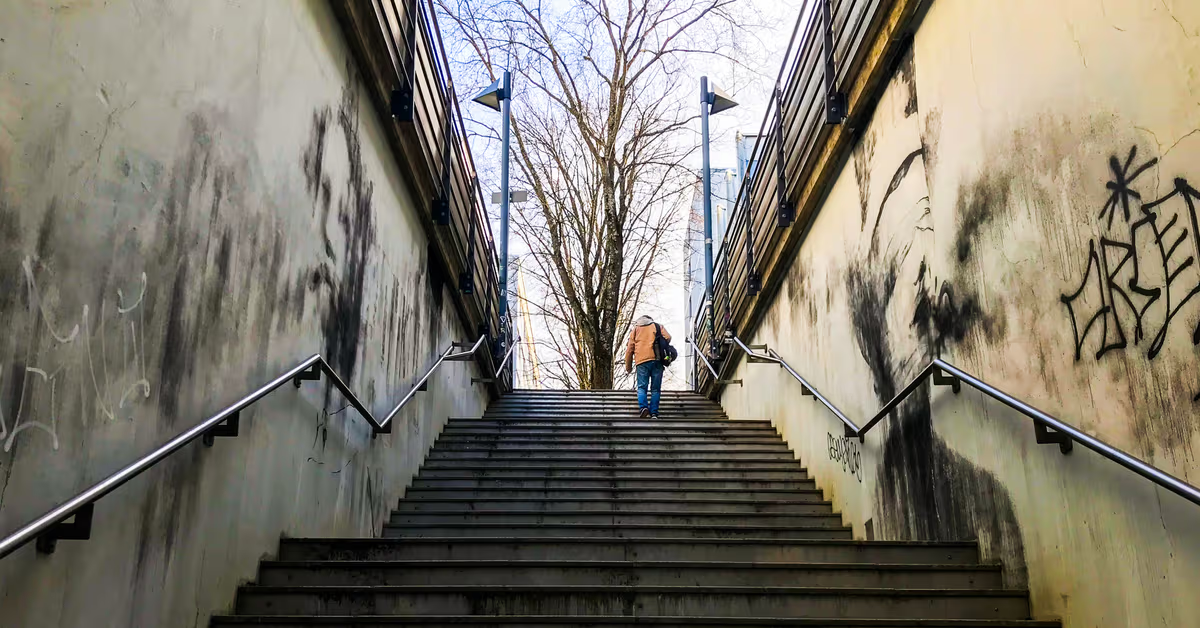
A study by the University of Turku found that Finland's immigrants were two-and-a-half times more likely to develop mental health disorders compared to the general population.
805 words~4 min read