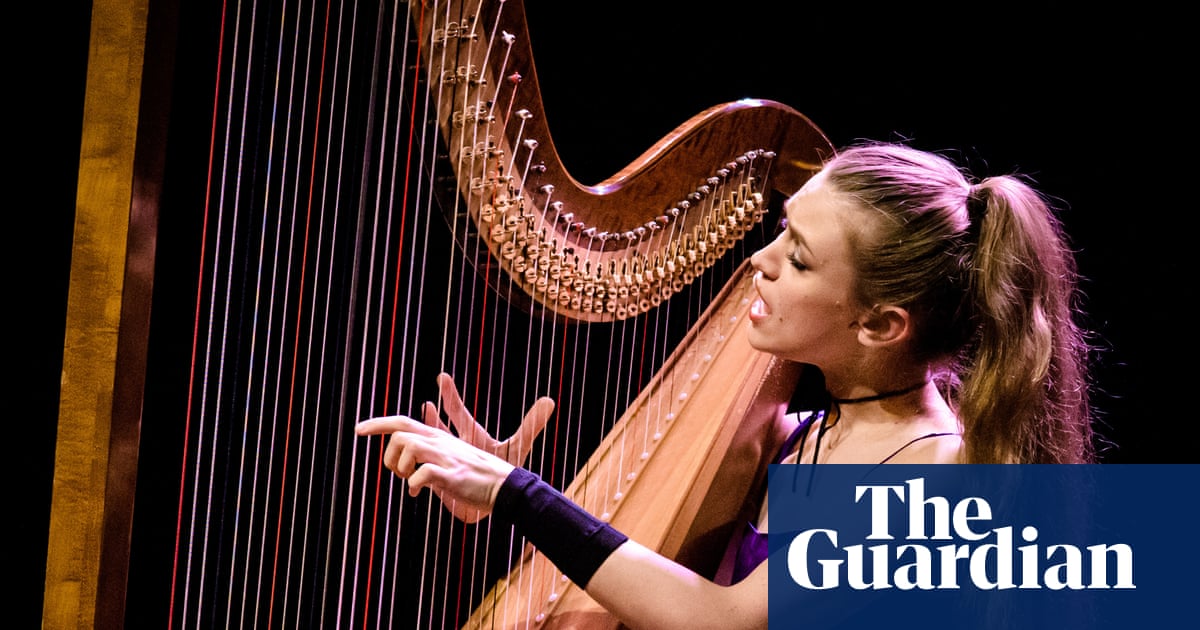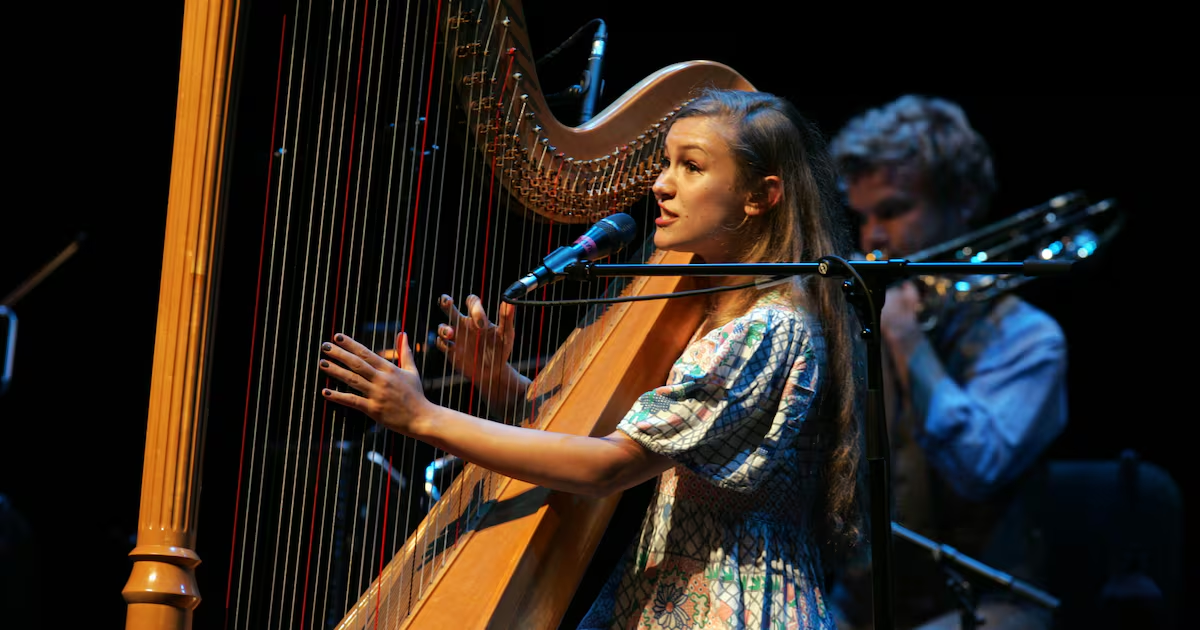
On Saturday morning I wake up to discover that my brother, who works for a tech firm, has sent me a message. “Someone I know told me they loved listening to Suno music and I laughed it off. But this evening I thought, what would I like?” Attached is a song created by the generative AI platform, along with a prompt: “Joanna Newsom singing ukulele music, backed by a brass section.”“Did you listen to the track?” he asks later. Not yet. If it’s bad, that would be vaguely reassuring, like learning the polar ice caps haven’t reached some critical point. And if it’s good? I press play while walking the dog. The song, whimsically titled Clockwork Honey fills my ears, cheery and propulsive. An internal rhyme pairs “folded” with “eroded” in lyrics that feel Newsom-coded, while a slightly, well - clockwork - vocal, sings about love. It’s not bad. But it’s Newsom by numbers, as if everything that makes art human has been stripped back to the skeletal maths beneath. I remember a radio conversation I had with the writer Colm Tóibín where he said, with the same kind of desolate cheer now ringing in my ears, that generative AI would soon make literary prose. A recent New York Times piece offered readers the chance to judge two writing samples and choose which they preferred, one AI-authored, one not. I recognised Bishop’s The Fish as the poetry sample. Her fish hangs a “great grunting weight” beside her boat, his scales are “like ancient wallpaper”. The AGI’s painstaking description of a dead owl, by comparison, one wing extended as though in flight, with feathers the colour of wet bark, etc read like a student exercise: formalist poems about roadkill. Why does this song make me feel so wretched? It’s not just the sense that the robots are at the gates, it’s that listening to it makes me feel less human and feel less for human art, as though the music I love can be distilled to formulae too, to expectations that are set up and cleverly subverted. In college I took a course on music and emotion. We read papers that explained why the music of Arvo Pärt felt spiritually transcendent. We learned that Samuel Barber’s Adagio for Strings shares measurable characteristics with other “moving” pieces of music – the melody climbs slowly and swells, like physical grief. It was fascinating. But it was also unnerving, like you could break open a symphony and find, inside, the beating heart of an algorithm. This is how streaming platforms already “hear” music, breaking songs into measurable features, grouping them by mood, energy, what they’re “for”. Critics such as Liz Pelly argue this moves music toward the functional: ambient beats, instead of what moves us. AI feels like the next step. If music can be broken into neat patterns, it can be built from them too. “This is a chord. This is another. This is a third. Now form a band.”I know I’m circling big aesthetic questions here. Is good art a golden mean or Fibonacci sequence, where beauty is the same as statistical success? Or is it good because it connects us to what makes us human? The synthesised voice on Clockwork Honey has come a long way from the eerie rendition of Daisy Bell in 2001: A Space Odyssey, but still sounds strangely inanimate, like this singer doesn’t need to breathe in the rests. Maybe what’s beautiful isn’t the good or surprising patterns, then, but the sense that somebody was there, the sound of pianist Glenn Gould mumbling along in The Goldberg Variations or Amy Winehouse messing about in studio: “I’m sorry Charlie Murphy, I was having too much fun.” These little frictions are what make it human; they’re what make us pause; they might also be what make something matter. This may be why Clockwork Honey sounds just like a real song, but it still doesn’t sound like good music. Later, on Saturday, I walk to our local park while my son cycles ahead. I sit on one of the logs near the playground and I’m soon joined by another parent, Ciara. She loves Agatha Christie novels. If generative AI churned out some more, she admits, she wouldn’t mind. But maybe there are art forms – the detective novel being one – that lend themselves to formula. She loves reading books, she says, but she is not sure she always understands the intention behind them. “Does that matter though, if it changes and affects me?” By this logic, AI should be squared away, but somehow this only complicates the unease. That night I go to YouTube. I watch a performance in San Francisco, where Newsom, a little awkward, makes conversation with the audience on the other side of the camera. I spot another clip that’s 19 years old. It’s a hipster artefact from a bygone era, a recording of Peach Plum Pear set to found super-eight footage. I’d meant to write about the music, but I’m drawn to the comments beaneath. Someone has described her voice as “a mixture of cats and witches. But it’s great”. “Like a teenage girl with her hand caught in a gate,” my colleague Francis once said, less kindly. “I am blue and unwell,” Newsom sings. Someone else has written, with the hyperbole of the YouTube thread, that this song “literally saved [their] life.” They realised that other people “felt true sorrow” and “that I am truly not alone.” Maybe we listen not only because something sounds good, but to be reminded that we’re not alone, that someone else has felt what we feel, and felt it strongly enough that it had to be expressed. Listening to a generated song felt alienating. It sounded like music, but not like anything that needed to be made.
Rachel O'Dwyer: Why does this cheery, propulsive love song make me feel so wretched?
It sounds like music, but not like anything that needed to be made
969 words~4 min read