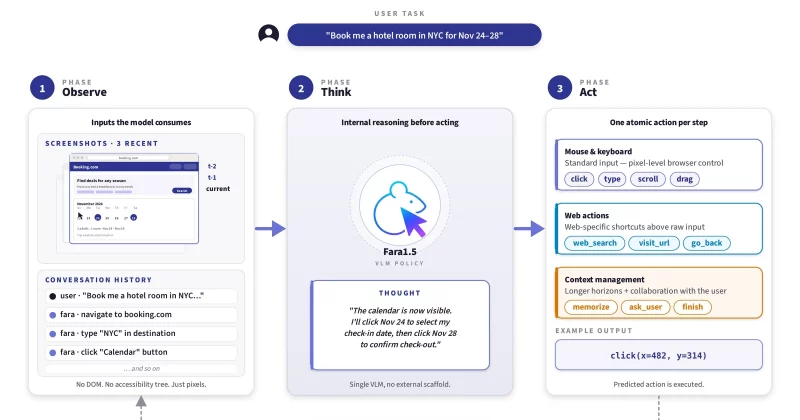
Microsoft Research just dropped a set of AI models that can browse the web better than anything OpenAI or Google has built. And in a twist that should make the closed-source crowd uncomfortable, the models are open-weight.
The Fara1.5 family, released on May 22, comprises three models with 4B, 9B, and 27B parameters. The flagship 27B variant scored 72% on the Online-Mind2Web benchmark, a grueling test that throws 300 tasks across 136 live websites at browser-using AI agents. OpenAI’s Operator managed 58.3%. Google’s Gemini 2.5 Computer Use hit 57.3%. In English: Microsoft’s model completed nearly three-quarters of real-world web tasks successfully, while its Big Tech rivals couldn’t crack six in ten.
The benchmark gap is real
The 9B model scored 63.4%, which puts it ahead of both OpenAI’s and Google’s proprietary systems despite being a fraction of their size. It came within striking distance of Yutori Navigator n1, a competitive agent that posted 64.7%.
For context on how fast this space is moving: Microsoft’s previous model, Fara-7B, launched in November 2025 and scored just 34.1% on the same benchmark. That means the team roughly doubled performance in about six months.