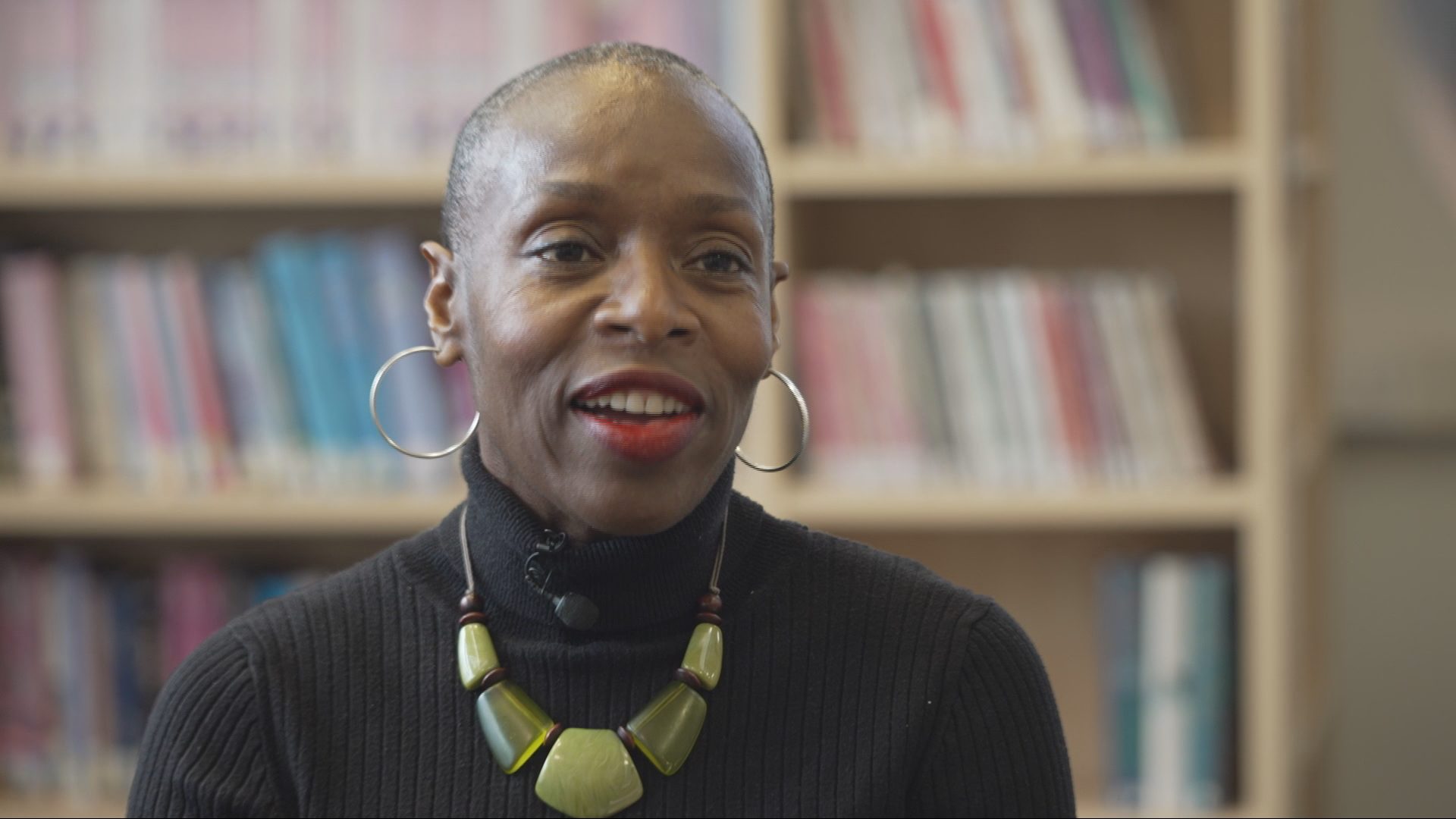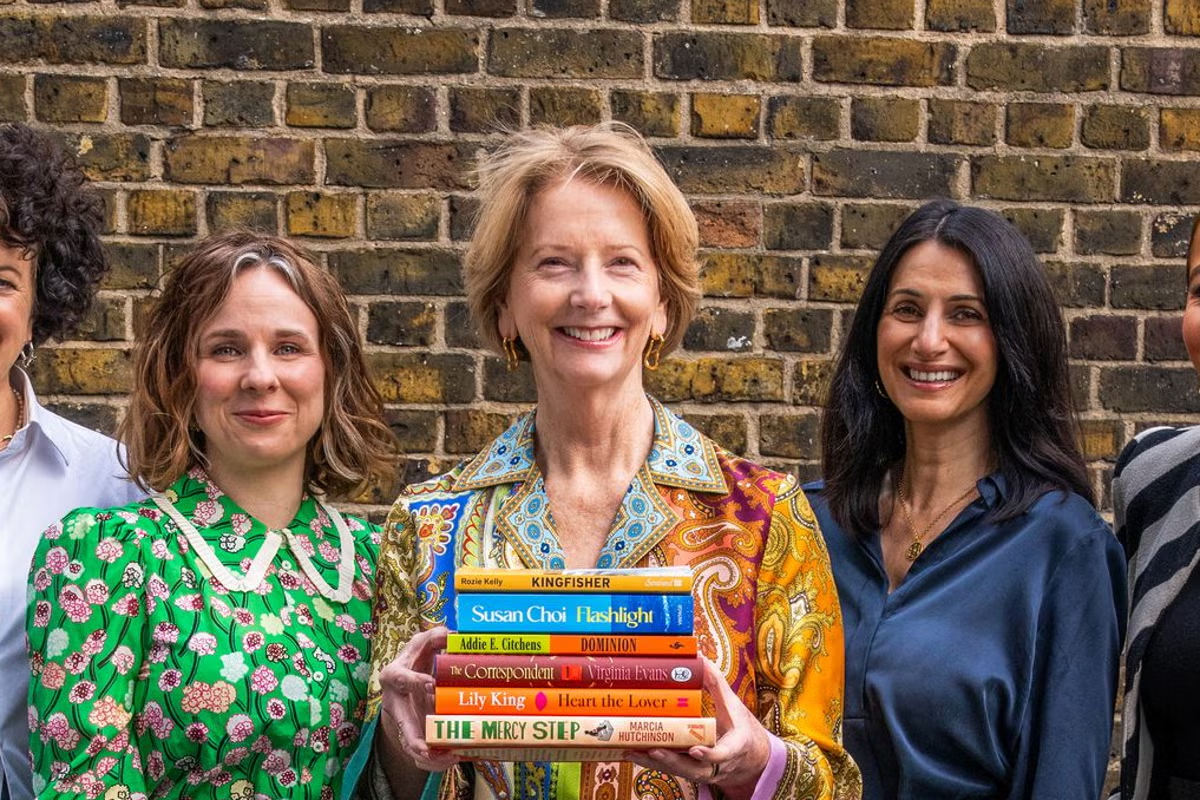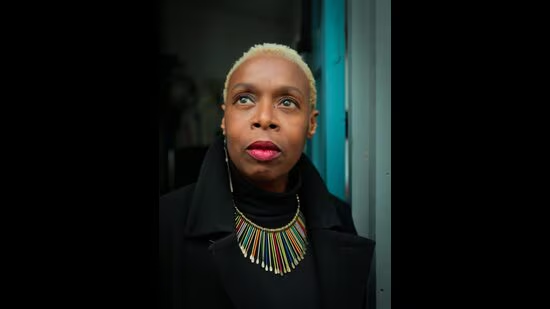
In an interview you noted that as a 62-year-old, you thought your moment had passed. But here you are, shortlisted for the Women’s Prize for Fiction for your debut novel. Please share the significance of this journey for writers who have given up on themselves? Author Marcia Hutchinson (Rik Jundi)I didn’t exactly realise it at the time, but I had given up on my creative writing career when I was in my early thirties. I’d been writing on and off with friends in my twenties and when I got married and had children, I decided that it was time to “put away childish things” and focus on my family.I pivoted, but not completely away from writing. I set up an educational publishing company and commissioned teachers to write culturally diverse educational resources. I thought that would be fine but the urge to write never really left me. It really wasn’t until my children had grown up and left that I decided that it was now or never. So, in my mid-fifties, I doubled down on my writing and within five years I had completed a novel and got a book deal.How did the voice of Mercy come to you and how challenging was it for you to sustain the curiosity, idiosyncrasy of this child throughout the book?The voice of Mercy has always been with me. I would like to be able to tell you how it came, but I genuinely do not know.My early life mirrors that of Mercy’s and I always knew there was a story there. The difficulty I had was not knowing how to write it. I remember talking to a friend, who said that I always seemed old as if I had been born an adult and that was the light-bulb moment. Although Mercy is still ‘technically’ a child in her mother’s womb, in her head, she is an adult, operating a body that just doesn’t function properly yet.In a way, writing The Mercy Step was an exercise in going back and interviewing my younger self. Although Mercy is very different from me — she has the confidence that I never had because I could tell her that she survived that childhood and I could go back there with her and hold her hand, so she felt safe to recount her story. She is who I would have been as a child if I had more confidence.The Mercy Step is also an ode to storytelling and books. Encountering the Carlisle Road Library is a defining moment for Mercy. Growing up in 1960s Bradford, did you have access to books and a library, and how crucial was it for Mercy to be introduced to books?Carlisle Road Library is a real library and the place I spent a lot of time on my way home from school. One of the lovely things about The Mercy Step and the process of writing and publishing it is that the Carlisle Road Library (now called Manningham library) is still there and the book was launched in the very room where Mercy sat and read stories.For a child who does not feel safe in her own home, a third space, such as a library, is absolutely crucial. One of the saddest points of Mercy’s day is when the library closes and she is asked to leave. I cannot stress how important it is for children to have books and libraries. I didn’t have books growing up and that’s why the library was my sanctuary.You use several Caribbean expressions like “kissing the teeth” in the book, and then there’s the precise diction of family members. What was it like to weave in those details?It wasn’t a challenge to weave those details into the book because I grew up in a household that spoke in Jamaican dialect. The difficulty was deciding how much Jamaican dialect to use.I decided to take Toni Morrison’s advice and wrote my first draft in a ‘closed room’. By which I mean I couldn’t think about the reader whilst I was writing because I would have ended up censoring myself. I simply had to write the way I knew Mercy’s family spoke and hope that it resonated with the reader. Another way that the dialect came easier to me is that I do not type my first drafts, I dictate them straight into Google docs, and then edit later on the laptop. It would have been more difficult to write The Mercy Step without Jamaican dialect than with it.Growing up in an environment where her mother’s voice goes unheard, Mercy tends to navigate this tension, deciding whether to speak or stay quiet in Big People’s affairs. But there are two standout moments — one, when she ‘cold stares’ her father and the other when she chimes in during the housing interest rate discussion. Please tell us the significance of these moments.The time when she ‘cold stares’ her father is an existential moment for Mercy. She genuinely thinks her father is about to kill her and her mother, so she decides that she would rather die on her feet than live on her knees. Even though she is a young child, she knows that she has more intelligence than her father and that all he has is brute force.In many ways, Mercy is more intelligent than her mother and she delights in being able to help translate the administrative world into a language her mother can understand. But despite her intelligence, she is still a child and does not have the life experience to understand that even though her mother is being charged an extortion at rate of interest for her mortgage, owning her own house is so important to her that she is willing to be fleeced -- because she is a woman and in the 1970s, women couldn’t open bank accounts in their own names [in the UK]. These two incidents are very much coming-of-age turning points in the novel.There are several occasions when Mercy’s mother wants to return to her husband. Please talk about the messiness of love and how it’s almost difficult to separate the man who abuses you from the one you love. It’s never explicitly said in the novel, but Mercy’s mother had a traumatic upbringing herself and has never really experienced unconditional love. Therefore, what she gets from her husband, she thinks is all there is. Instinctively, Mercy knows that there should be more to love than this. Mercy’s mother has nine children with this man and untangling that relationship is more than she can actually bear, so she stayed.I didn’t want to go into detail but the societal pressures which means that in those days a woman found it hard to leave an abusive relationship also bear heavily on her parents’ marriage.Parts of The Mercy Step also push back against some kinds of Black representation. There’s a moment when Mercy is reminded of the Black lady in Tom and Jerry, “the one without a face”.I very much decided to address Black representation obliquely and from the viewpoint of a child who sees that something is wrong but doesn’t know why it is wrong. I certainly remember as a child watching Tom and Jerry cartoons and seeing that Tom’s owner was a Black woman and yet her face was never seen; she was nothing more than a caricature. However, I was very aware that an indirect approach might be more successful than a direct one [to approach representation].The Bradford you portray is seemingly diverse. There’s the Windrush Generation facing racism, and a discussion about The Troubles in the book. There’s also an Indian shopkeeper. In a character-driven novel like this where everything could’ve been only about Mercy, how important was it for you to make the community feel alive, and not a trope serving the character/plot?I did not consciously think about making the community feel alive; it just happened as I was writing the novel. I wanted to address it with a relatively light touch though.Is the title — The Mercy Step — a way to signal the space that Mercy wants to own, take up?The original title for the book was simply ‘Mercy’, but my editor said that because there are so many other books called Mercy, could we change it to The Mercy Step? So, the title is effectively a happy accident.You say you abandoned a book before The Mercy Step came out. Have you started working on it again? What can readers expect from you in the coming years?I didn’t actually abandon the book I wrote before The Mercy Step; it was the book that my agent signed me on. However, once she saw the first few chapters of The Mercy Step, she pivoted and suggested I make that one my debut novel instead. The other novel is done and dusted and hopefully will find a publisher in time.Saurabh Sharma is a Delhi-based writer and freelance journalist. They can be found on Instagram/X: @writerly_life.
Marcia Hutchinson: “The urge to write never really left me”
The author of The Mercy Step on being a debut novelist at 62, having her work shortlisted for The Women’s Prize for Fiction, and using Jamaican dialect in her writing
1,493 words~7 min read