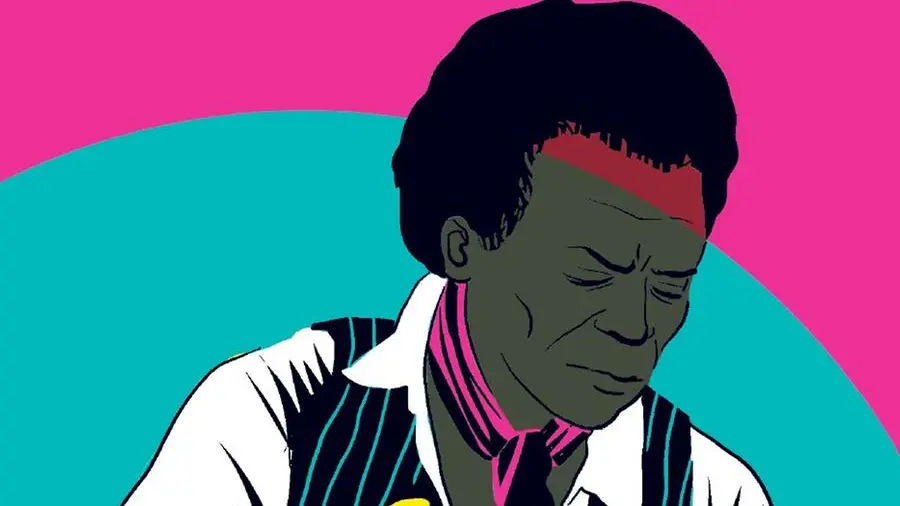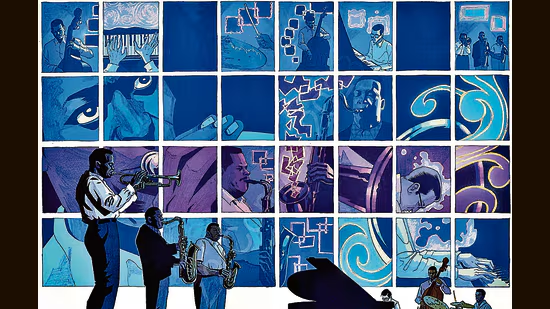
Trace the jazz legend’s explosive relationship with music through a children’s book, a graphic novel, an artist’s account and more. * For kids (and grown-ups looking for a quick catch-up)Art from Miles and the Search for the Sound (2023).Birth of the Cool: How Jazz Great Miles Davis Found His Sound (2019)Think of Kathleen Cornell Berman’s children’s book as the gentlest introduction to jazz, and to the childhood and early life of Miles Davis. It follows the musician as a young boy — shy, standing out in band, but obsessed with beats, gospel choir, the radio and rhythm everywhere — as he learns to develop his own sound.Berman’s story flows in a kind of free verse, but keeps the more sordid details of Harlem nightlife out of the tale, ending with Davis, still in his 20s, at the 1955 Newport Jazz Festival (in a line-up that included the legends Louis Armstrong, Duke Ellington and Count Basie). The book’s illustrator, Keith Henry Brown, is a jazz fan too. He presents Davis’s early creativity and drive as exactly the kind of inspirational tale children tend to love.Art from the children’s book Birth of the Cool (2019)..* For those who want to see the soundMiles Davis and the Search for the Sound (2023)Writer-artist Dave Chisholm has a doctorate in jazz trumpet. His graphic novel uses narration that draws from Davis’s own words, to track the artist’s explosive relationship with his music. It’s a short read (about 150 pages), but covers the pivotal 40 years, from Davis’s beginnings as an artist in 1951 to his death (from pneumonia and a stroke) in 1991. The hook: The legend’s lifelong quest to track down and recreate a sound he heard, as a child, on a moonlit country road..* For artists who want to break it downThe Music of Miles Davis: A Study & Analysis of Compositions & Solo Transcriptions from the Great Jazz Composer and Improvisor (2005)Lex Giel’s instructional book is for those who already understand jazz, but want to examine Davis’s key compositions more deeply. It’s free of jargon and dull theory, and helpfully includes trumpet transcriptions of the solos. It’s probably the simplest technical analysis of his most-acclaimed works.The cover of The Music of Miles Davis (2005)..* For those who’ve read the biographyIt’s About that Time: Miles Davis On and Off Record (2007)Richard Cook’s book is exhaustive. He covers the 14 major albums Davis recorded and connects each of them to his life and the mood of the time. He highlights how each shaped the musician, his music, and music at large.Think of the book as part-biography, part-discography. Readers see Davis minus the myth, and follow how he developed as an instrumentalist, group leader and composer. It’s what to read when you’re listening to Bitches Brew or Birth of the Cool for hundredth time, because this is where you’ll find all the details you hadn’t known existed.The cover of Miles on Miles: Interviews and Encounters with Miles Davis (2008).-* For a wider viewMiles on Miles: Interviews and Encounters with Miles Davis (2008)Editors Paul Maher Jr and Michael K Dorr bring together 30 interviews (conducted between 1957 and 1989), for a sense of how the man viewed his legacy, life and obsession with overhauling his signature sound.Davis wasn’t always straightforward about his process, and tended to exasperate interviewers, so this collection offers glimpses of the legend at his most honest and his most guarded. His voice here sometimes seems more real than in the 1998 biography by Ian Carr. Davis’s sense of humour shows up in unexpected places too; as in his compositions, only he knows when a bomb is about to drop.Rachel Lopez is a a writer and editor with the Hindustan Times. She has worked with the Times Group, Time Out and Vogue and has a special interest in city history, culture, etymology and internet and society.Read More
Something to riff through: A reading guide to Miles Davis, by Rachel Lopez
Trace the jazz legend’s explosive relationship with music through a children’s book, a graphic novel, an artist’s account and more.
644 words~3 min read