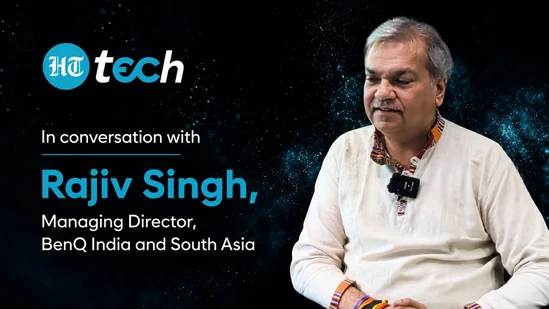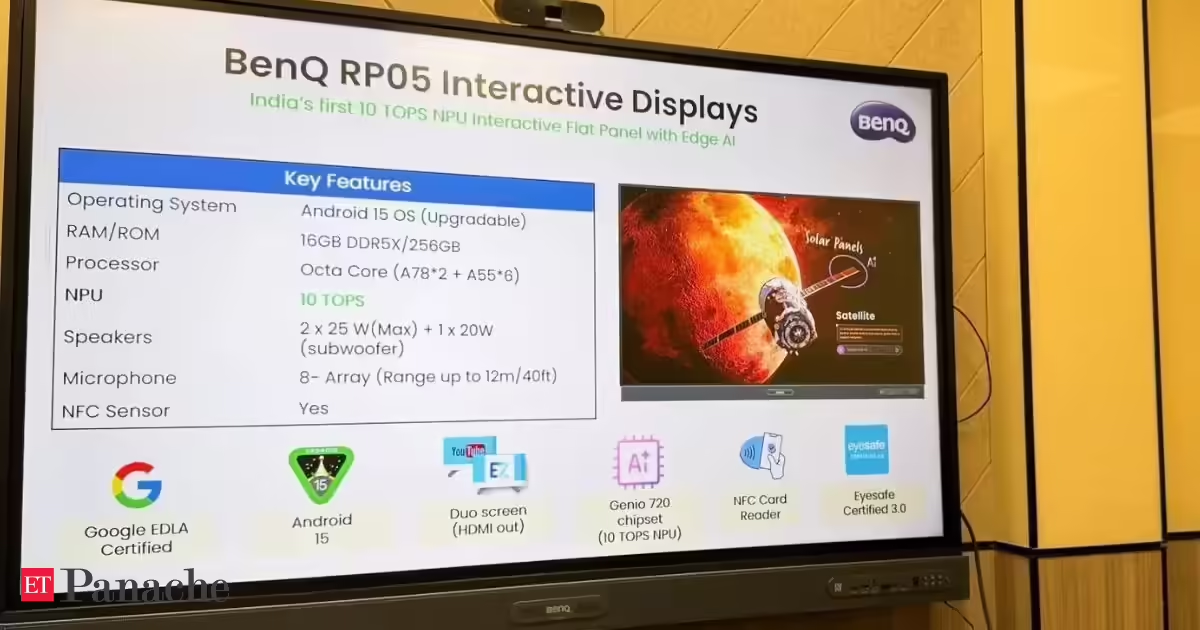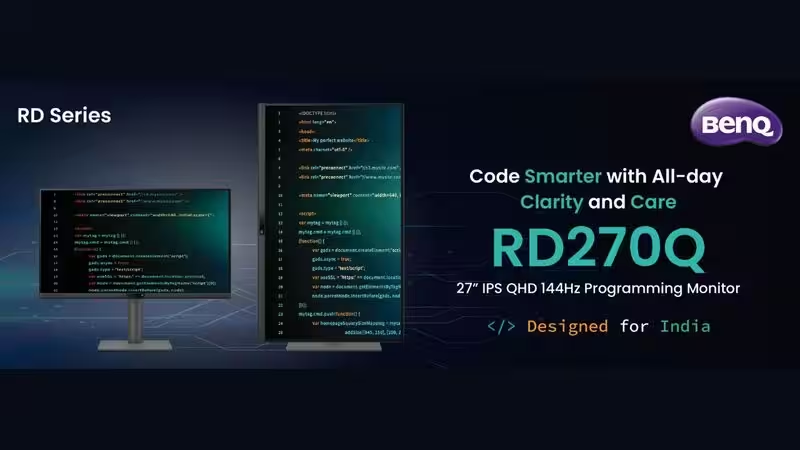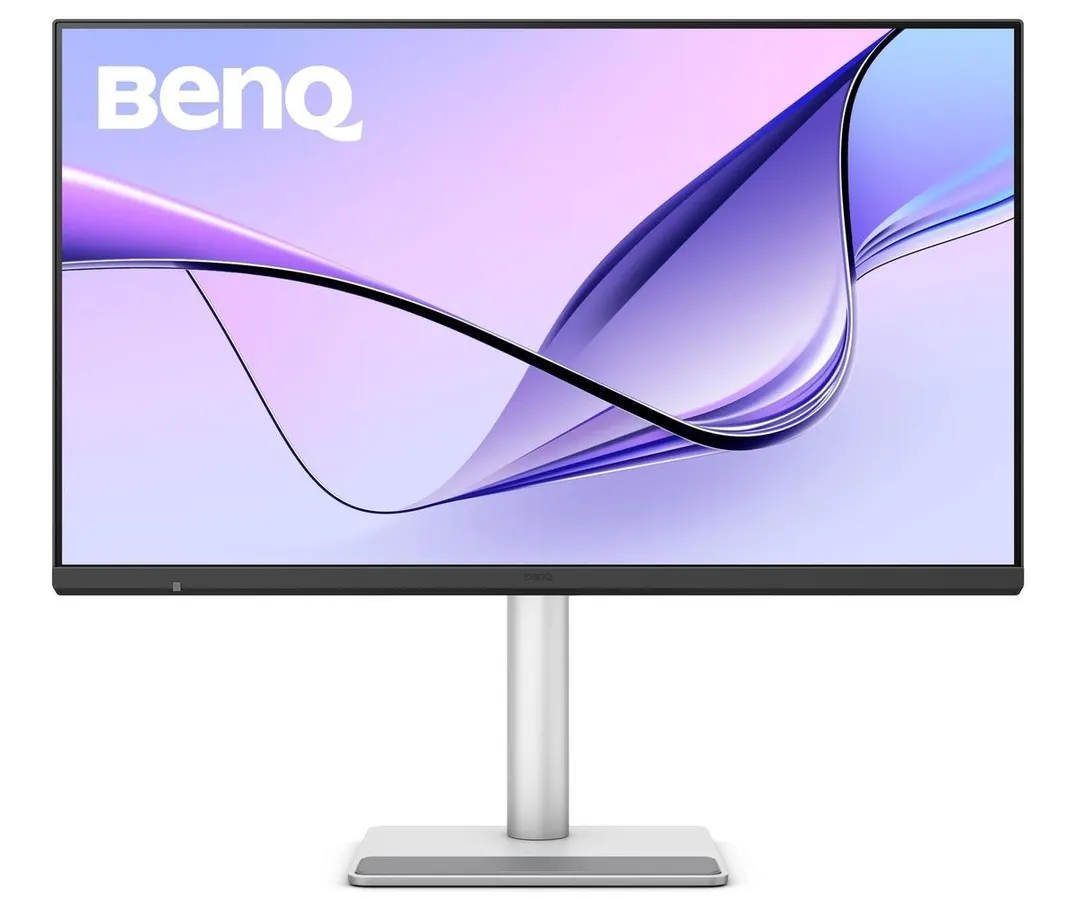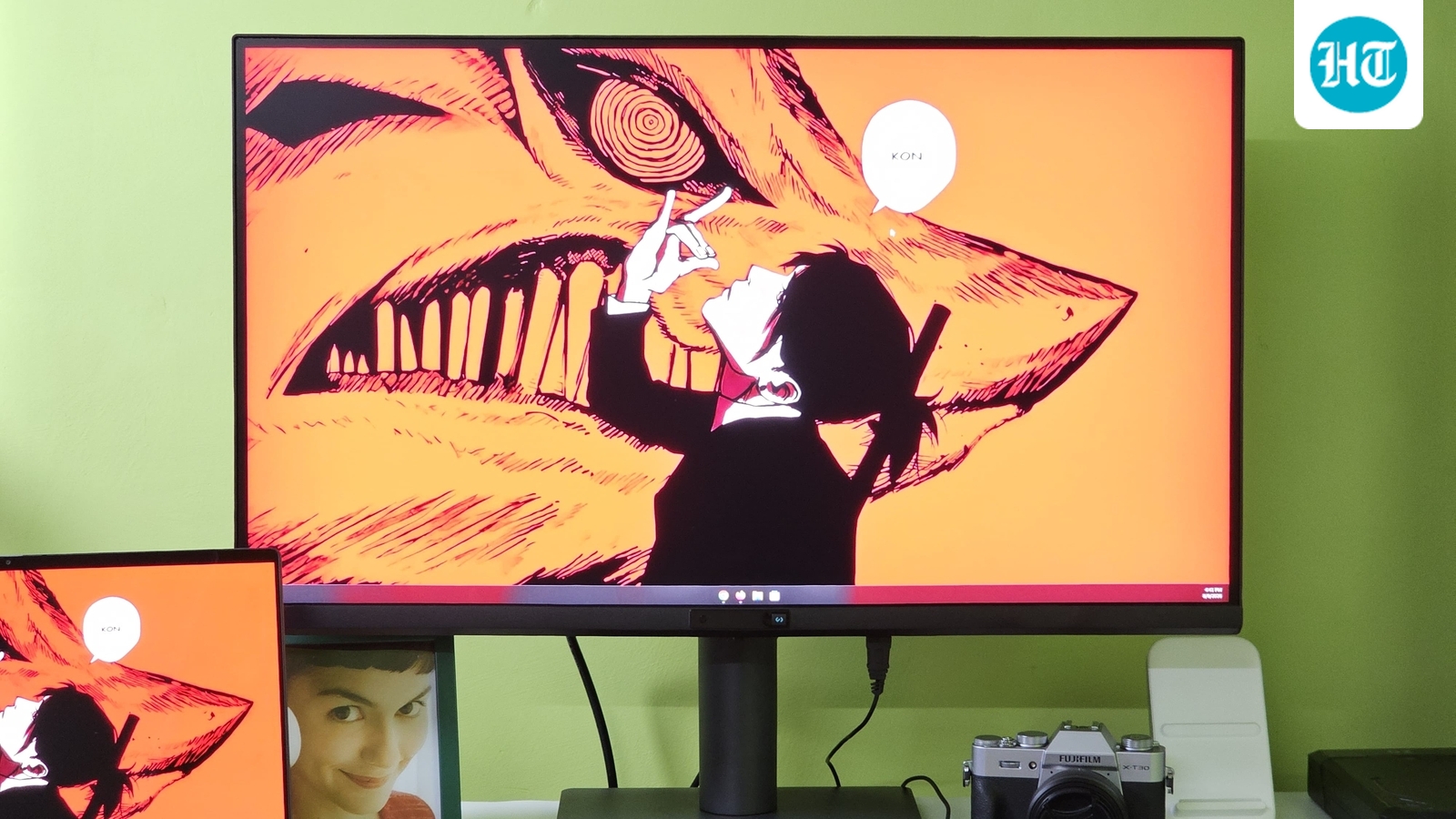
BenQ India is on course for Rs 1,000 crore turnover this December — its 25th anniversary year — with monitors up 30 per cent, projectors 50 per cent and interactive panels 60 per cent. India head Rajiv Singh thinks the MacBook switch is the next big wave, and he has been preparing for it for years.The coffee shop at Sheraton Saket holds the ambient cool only a Delhi five-star manages on a 44-degree May afternoon — marble floors keeping the chill, the AC dropping the temperature two metres past the entrance. Outside, the road shimmers. Inside, Rajiv Singh has already settled into the banquette, wearing the unhurried smile of a man who knows his brand is about to his the Rs 1,000 crore revenue mark by the end of the year.He is mid-fifties with a comfortable build, salt-and-pepper hair combed back, a moustache gone the same way. A cream mandarin-collar shirt, sleeves buttoned at the cuff, a pen clipped into the chest pocket — the working executive's tell. Wedding band on the left ring finger. Right wrist wrapped in mauli threads in red and orange, the kind tied at family pujas. Charcoal trousers, black oxfords. Hands clasp low in front, the old-school stance of a man who has done a thousand of these meetings and yielded to the convention.The dogs come up before the displays do. Rajiv is a self-professed dog lover, and Delhi's lunch culture being what it is, the conversation finds the pariahs at home before either of us has touched the menu. This is my second meeting with him, and my first since joining Gadgets Now. Half the year is gone, and BenQ India is running a qualifying lap inside its own industry: Rs 1,000 crore beckoning by December, twenty-five years in India this year, three product lines firing at once.The Lap"This year, specially, is a very good year for us," Rajiv said. "We are growing at more than 50 per cent over last year. This year, we should be crossing almost a Rs 1,000 crore turnover in India."The headline number is the marketing line. The interesting signal sits one layer down. Monitors are growing 30 per cent. Home projectors 50 per cent. Interactive Flat Panels, the B2B classroom and conference-room product, 60 per cent. All three in parallel.The monitor line carries the volume, and the segmentation inside it shapes everything that follows. BenQ is the only mainstream monitor brand that splits its catalogue not by size or refresh rate but by user. Coders. Mac users. Designers. Each gets a different monitor, tuned the way a guitarist tunes a Strat differently for a blues gig and a metal session — same instrument family, different pickups, different signal chain, different room."We are the only monitor brand which does very heavy segmentation by the type of usage," Rajiv said. "Our Mac monitors, the MA Series, we are the only brand which has got a complete series for the Mac ecosystem. Whether you are using a MacBook Air, MacBook Pro, an iMac, or a Mac mini, you have a specific BenQ monitor for you."The Mac install base in India is shifting. Until two years ago, Macs lived in two pockets — creative professionals and senior executives. The MacBook Air is now priced inside the gap that used to keep mid-tier Indian buyers in Windows territory. Rajiv has been watching the curve from inside the monitor data."We are feeling that in our sales," he said. "When you are getting a MacBook in comparison to an entry-level i5, a lot of people — unless they are totally averse to the Mac ecosystem — would prefer this."The SwitchThe MA Series sits on a problem the industry has worked around for a decade. Plug a MacBook into any third-party display and the first thing a Mac user notices is the colour. macOS does not push its ColorSync profile through HDMI or DisplayPort the way Windows handles ICC profiles. The laptop's panel and the external monitor run different profiles. They look like two devices because, calibration-wise, they are."We did a lot of study on what the pain points of a Mac user are," Rajiv said. "The moment you connect your MacBook to any external monitor, colors look very different. You feel like these are two different devices."The colour-profile mismatch is the single most common Mac-with-external-monitor complaint among Indian creative professionals, and every third-party brand has worked around it because solving it requires building software on Apple's terms."We developed a software by which our Mac monitors, the moment you connect any MacBook, can read which MacBook you have, which version, which M-series processor is inside, and what the color profile of your MacBook is," Rajiv said. "It automatically adjusts the monitor color profile exactly to your display color profile. By default, 100 per cent the same."The series now includes a 5K monitor that Rajiv positions against Apple's own Studio Display."We have recently launched our 5K monitor over there also, which is comparable to the Studio Display of Apple in terms of its performance, but in terms of connectivity and all, it is better," he said. "I find that as the most exciting thing in the monitor portfolio."Apple's Studio Display has been the default Mac monitor recommendation for three years. BenQ is the first mainstream brand to take a credible swing at it on price-to-feature without leaving the colour-accuracy game.The CodersThe second segmentation story is in some ways the larger one. India is the world's second-largest country for software programmers, after China and the United States. The country generates the developers. The tools the developers use have been imported. BenQ noticed this and built the world's first coding monitor by going to Indian programmers' homes during Covid."We are the only monitor brand to have monitors specifically for coders and programmers, which nobody else has," Rajiv said. "India is the second-largest country for programmers and coders, after China and the US. We first launched it for the Indian market, it became a huge hit, then we launched it in other markets."Most consumer electronics brands run R&D out of headquarters and treat India as a deployment market. BenQ inverted that."We even visited their homes," Rajiv said. "Because this happened when COVID was still on. Our product development team from Taiwan came and visited a lot of customers, primarily in Bangalore and Hyderabad, and took feedback about what you would like to have in your monitor which is not there right now."The product is built around a 3:2 aspect ratio. Every other monitor is 16:9, optimised for video. Code runs vertically. A 3:2 panel gives a programmer thirty per cent more vertical real estate — thirty per cent more lines visible without scrolling — which, on a long debugging session, is the difference between a clear head and a stiff neck."For a programmer, they need more vertical space," Rajiv said. "Microsoft Surface — the entire Surface lineup is 3:2. Apple's iPad Pro is also close to 3:2. To date, nobody has come out with any coding monitor, while we are already into our third year of coding monitors and second year of Mac monitors. They don't mind paying a premium for something which is really solving their pain points."The PivotTen years ago, BenQ India did something most consumer electronics brands would consider corporate harakiri. It walked out of the entry-level monitor segment. Killed the catalogue. Stopped competing in the 70 per cent of the Indian monitor market where the volume sat. Decided to play only in the mid-and-high segment, which was then the bottom 30 per cent of the market.For three years, the decision looked terrible."We decided to go for premium," Rajiv said. "We felt our buyer will soon be a second-time or third-time buyer. The first two to three years were very difficult, but today we are reaping the benefit. We are now ruling in the mid-and-high segment compared to our competition, which is still saddled with a lot of low-end things while the low-end market is continuously going down."The Average Selling Price proves the case. BenQ India's monitor ASP is now upwards of Rs 15,000 — the highest among the top five mainstream monitor brands in the country. The QHD and 4K monitors, sitting in the Rs 20,000 to Rs 50,000-plus range, do the volume lifting. ASP is climbing 15 per cent year-on-year."Among the mainstream brands, our ASP is the highest among all our competitors," Rajiv said. "Year-on-year, we are able to increase our ASP by close to 15 per cent every year. Monitor has also become a personal entertainment device. TV is going out of favor; small TVs are done. That's all 43-inch and upwards now."The throwaway line at the end deserves a paragraph of its own. The small TV is dead. The monitor has absorbed its job. BenQ's ASP climb is happening because the monitor has become something else — a hybrid productivity-entertainment device, the same way smartphones absorbed the point-and-shoot camera fifteen years ago.The SpineThe premium story sits on a manufacturing spine that, four years ago, BenQ India would have called optimistic. Three locations now — Kutch, Tirupati, Noida. Two-thirds of the IFP business is Made in India. The 98-inch interactive panel, technically beyond the local manufacturer when the initiative began, now rolls off Indian lines."That is progressing very well, better than our expectations," Rajiv said. "We thought maybe three to four years down the line we would be at a 20 per cent local production balance, but the ramp-up has been quite aggressive. Within a period of almost one to one-and-a-half years, they developed the capability for the 98-inch as well."The Indian-made stock now flows to Bangladesh, Sri Lanka and Nepal as exports. Tariff geopolitics stays out of the story — BenQ's category lacks the kind of India-to-US arbitrage that has driven Apple's iPhone production shift.The IFP business is where the big state government contracts sit. Seven thousand seven hundred classrooms fitted in Delhi last quarter. Four thousand five hundred in Punjab. Fifteen hundred in Assam. UP and Himachal Pradesh this quarter. The Delhi project is the largest — the previous government had left smart classrooms unbuilt, leaving an estate-sized order book on the table.The CameraThe third leg is projectors, where BenQ has done something that should change the home-theatre conversation in India. The W2720i and W4100i — its first AI projectors — carry an onboard camera that monitors the projected image and auto-calibrates the colour mapping in real time, regardless of lighting in the room.Calibration used to be a specialist's job. You paid Rs 30,000 or Rs 40,000 to a home-theatre consultant who came home with a colorimeter, sat in your dark room, and dialled in a profile that held until you opened the curtains. The room changed; the calibration did not.BenQ has automated the loop the way a good front-of-house sound engineer adjusts EQ between songs — checking the room, dialling, never letting the mix drift."There is a camera along with the lens and lamp," Rajiv said. "It is continuously monitoring your screen on a real-time basis and it is doing auto-calibration frame-by-frame. It has become a very big hit."The category itself is shifting. Millennials are buying projectors instead of large TVs. Part economic — 120-inch picture for the price of a 65-inch TV. Part ergonomic."When you sit in front of a big TV screen, you have so much of light coming to your eyes," Rajiv said. "If you watch an IPL match, by the end of those three to four hours, your eyes will be very tired. But the same thing on a projector, screen size more than double, there is no eye fatigue because it's reflected light."A TV blasts photons into your retina. A projector throws them at a wall and lets the wall do the bouncing. Your eye reads a reflection, not a source. Stare at a torch versus look at a painting. The difference is the same.The FloorFor all the manufacturing investment and product engineering, there is one thing BenQ India has had to work around. Indian organised retail treats monitors as a corner-of-the-shop category. The Cromas and Reliance Digitals have built their floor space around television. Monitors get a corner near the printers, one or two units on display, the full range always elsewhere."Distribution is not a problem," Rajiv said. "Retail is a problem. We sell through more than 5,000 retailers, but giving that live demonstration experience is very difficult right now."Then the line that should embarrass every Indian organised retail chain that has spent the last decade calling itself a tech destination."Even Sri Lanka has very nice retail infrastructure for IT products in comparison to India," Rajiv said. "In Bangladesh, there are good chain outlets only for IT retail with world-class showrooms in almost the top 15 cities. We don't have any such chain in India at all. The Cromas and Reliances of the world, they have never taken the monitor category seriously."Bangladesh has better IT retail than India. That sentence has waited a decade for someone in Indian organised retail to disprove it.The GraveyardThere is an older story Rajiv has been carrying for seventeen years. He joined BenQ in 2009, when the company looked nothing like it does today. BenQ then was a value brand with a sprawling catalogue — laptops, LCD televisions, optical media drives, mobile phones, monitors, projectors. The mobile phone line is the detail that matters most for the rest of this story.The pivot — catalogue-trimming, premium repositioning, the bet on second-time and third-time buyers — happened around 2015-2016. It looked like retrenchment then. It now looks like a marque doing what Ferrari did when it walked out of certain race classes to concentrate on the ones that mattered. Smaller portfolio, sharper focus, higher margin.The mobile phone exit is the part that should be required reading at every consumer electronics business school in Asia."BenQ is the only surviving company from that mobile phone era which went out of mobile phones but is still there and doing very well," Rajiv said. "All the other companies which were there at that point of time no longer exist. Even if the name is there, it is a brand licensing kind of a thing, like Motorola. I myself worked for Motorola before joining BenQ, but today's Motorola is not Motorola — it has been sold off to Google and then after that to Lenovo. Nokia is also brand-licensed; Sony Ericsson, any of the companies of that time are all gone."The line — today's Motorola is not Motorola — is the kind of verdict only a former insider can deliver. The graveyard of early-2000s mobile phone brands is one of the most sobering exhibits in modern consumer electronics. Nokia. Sony Ericsson. Motorola. Siemens. Alcatel. Sagem. Sendo. NEC. Some are licensed shells. Some are footnotes. Among the era's tier-two challengers, BenQ walked away in time and built something else with the cash.The chai arrives. The conversation slows. Rajiv talks about the 25th anniversary plans for December. The marketing teams are still working out the partner-celebration formats. The number is locked."The biggest gift that we want to give to ourselves is that Rs 1,000 crore turnover mark," he said.Outside the glass, the Delhi afternoon still shimmers. Somewhere in a Bandra editing suite, a colourist plugs a MacBook Pro into a BenQ MA Series 5K and watches her display flicker once, then settle. The two screens match. The decade of work pays out as a single calibrated image.end of article
BenQ India Eyes Rs 1000 Crore Turnover: Growth Drivers, Mac Monitor Strategy & Coding Displays
BenQ India is on track for a Rs 1,000 crore turnover this year, celebrating 25 years in the country. The company sees significant growth in monitors, projectors, and interactive panels. A key strategy involves catering to the rising MacBook user base with specialized monitors. BenQ also leads with innovative coding monitors, developed with direct user feedback.
2,570 words~12 min read