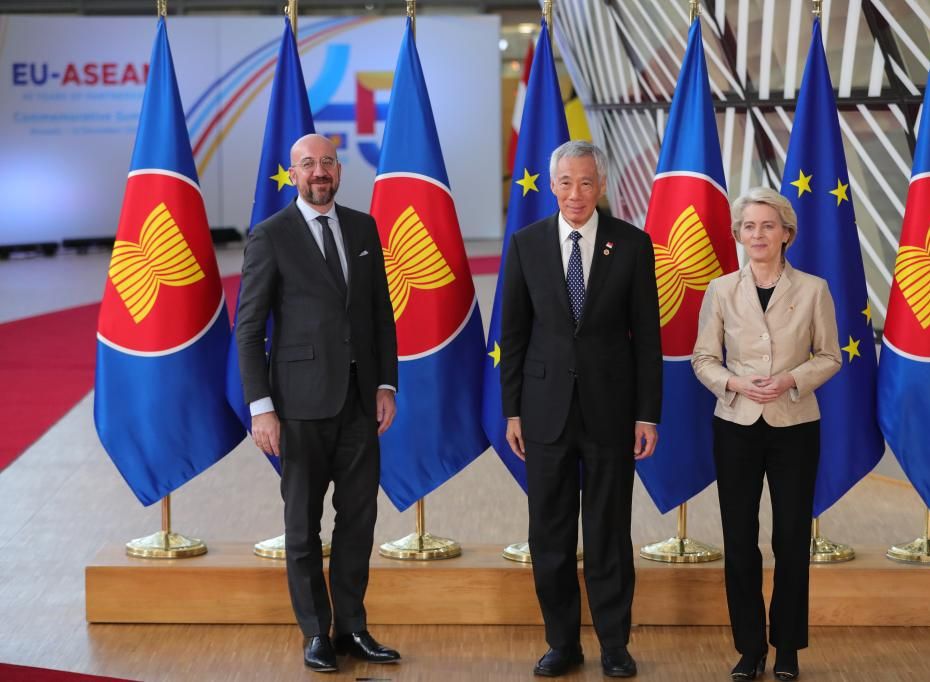
European Council President Charles Michel (L), Singaporean Prime Minister Lee Hsien Loong (C), and European Commission President Ursula von der Leyen pose for a photo at the welcome ceremony of the EU-ASEAN commemorative summit at the EU headquarters in Brussels, Belgium
It is an untold truth, that those who control global banking systems and major investors are globally informed and advantaged regarding critical junctures on a scale between global catastrophe and global triumph. Often decision-making influence is said to reside in this portion of global society. We look at regions in the world and its investment trends, a snapshot of Donald Trump starting his second term in 2025 to 2026 (specifically the period of Israel-US-Iran at war). It is believed that looking at these investment changes beyond trends provide a global map for power concentration and global order changes.
The following index is an interpretive geopolitical investment model using 2025 as a base year (100), designed to illustrate directional capital movement trends during the conflict period:
Africa and the Asia-Pacific recorded the sharpest investment contractions during the US-Israel-Iran conflict, declining by approximately 13% and 28% respectively. Unlike North America, Europe, and the Middle East; which benefited from safe-haven capital flows, defence spending, and energy market gains; both regions were more exposed to global uncertainty, disrupted trade routes, and investor caution.