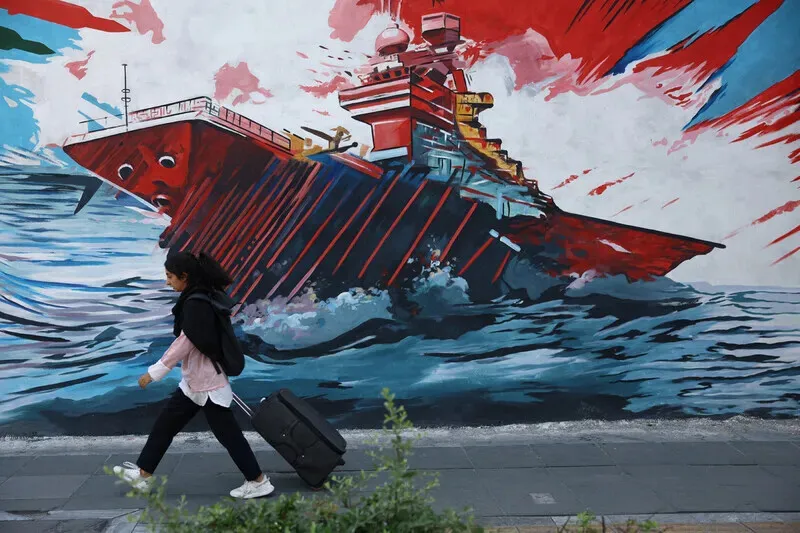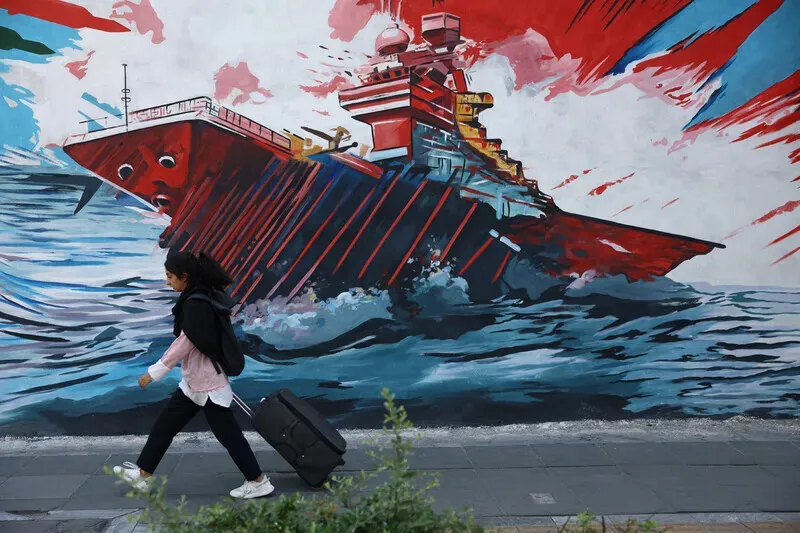
A woman walks past a mural of an American warship being hit by an Iranian missile on a street in Tehran, Iran, on May 11, 2026. (Reuters/Yonhap)
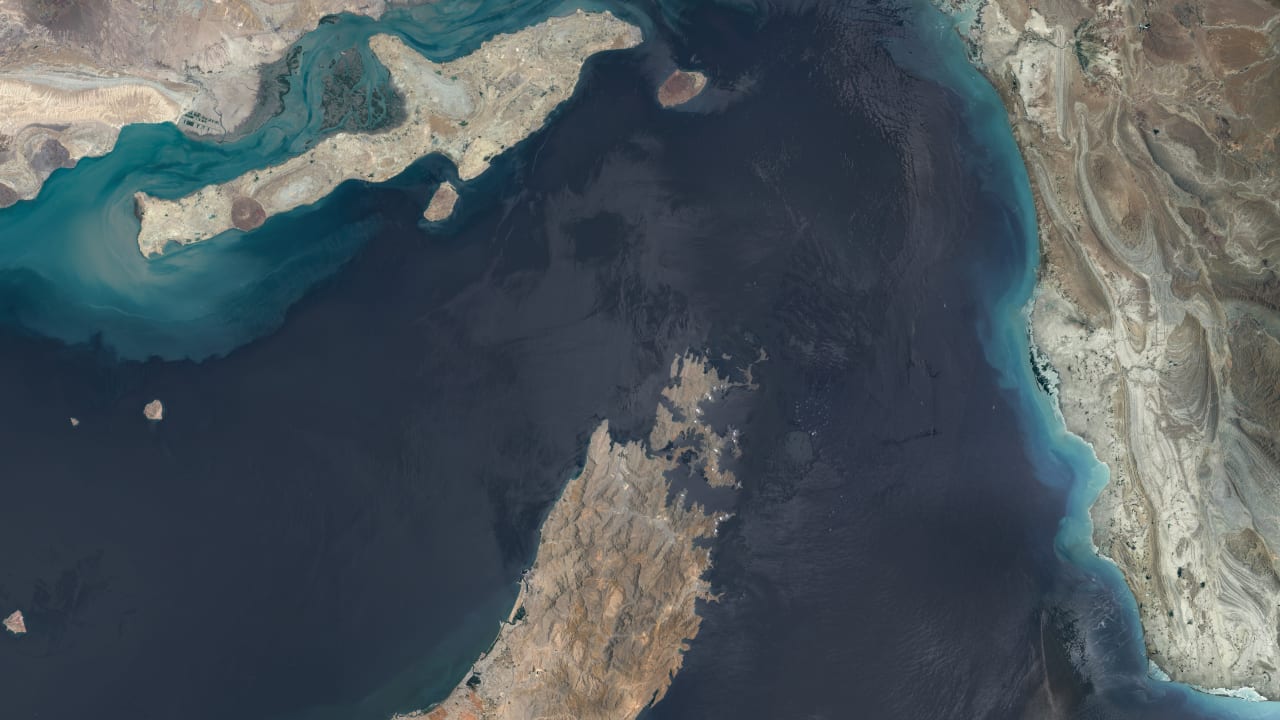
By Kim Jong-dae, former Justice Party lawmakerThe Strait of Hormuz has effectively come under the control of Iran’s Islamic Revolutionary Guard Corps.The US has deployed overwhelming force, including two carrier strike groups and 16 warships, but those vessels remain at a distance in the Gulf of Oman, unable to cross Iran’s declared line of control.When the US sought to reopen the strait by force in early May through Project Freedom, its effort barely lasted two days.After being deployed to block Chinese merchant ships and oil tankers, the Tripoli Amphibious Ready Group, under the 31st Marine Expeditionary Unit, had to withdraw to waters near Pakistan, in the Arabian Sea. Even more troubling is the bankruptcy of the modern warfare paradigm the US military had been so ambitious to develop.Adm. Brad Cooper — current leader of US Central Command, which is prosecuting the war against Iran — is the person who launched Task Force 59 with such fanfare while he was commander of the US 5th Fleet in Bahrain. Integrating AI and automation, Force 59 was grounded in the novel scientific concept of achieving an overwhelming degree of maritime domain awareness at a low cost through an intricate network of digital sensors and manned/unmanned assets.But when actual warfare broke out with Iran, that flashy theory of digital security totally failed to seize the maritime advantage against Iran’s thickets of naval guns, cruise missiles and cheap drones. The US’ bulky carriers and destroyers had to remain in distant waters, unable to approach the shore, leading to a clumsy arrangement in which the mission of maritime interdiction had to be handled by F-35 fighters and attack helicopters rather than the exhausted carrier strike groups.That represents the technological paradox of mistaking means and ends. At the outset of the war, US aircraft carriers and military bases in the Gulf region unleashed a massive barrage on Iran. But before long, they became juicy targets for precision strikes by the IRGC.What happened to the US military’s vaunted digital systems and battlefield awareness capabilities? The US can parade its hulking carriers and sleek destroyers in the open ocean, but it lacks the mine clearance capabilities needed for coastal combat. There are few signs of the kind of littoral combat ships or underwater drones that could swat down Iran’s “mosquito fleet” of small but agile boats.It’s doubtful whether huge warships that cost billions of dollars are even capable of fully defending themselves from Iran’s bargain-basement drones.Following this war, there’s sure to be a fierce debate about whether the US’ carrier strike groups are capable of penetrating China’s anti-access/area denial (A2/AD) operations.The war against Iran suggests that the sun is setting on the age of the aircraft carrier, which has dominated naval warfare since World War II. The ramifications of that shift go beyond this war, casting doubt on the US’ ability to maintain naval supremacy.In his recently published book “The Troubled American Way of War: From Hiroshima to the Age of Algorithms,” John Arquilla, professor emeritus at the US Naval Postgraduate School, blames those failures on the US military’s strategic culture and attitude toward war.Some of the problems identified in Arquilla’s book are the US’ overinvestment in air power since World War II due to a blind faith in strategic bombing, its fixation on nuclear war and achieving victory through nuclear deterrence, and war planning based on simplistic comparisons of military hardware.Arquilla roasts the US military for forfeiting the innovation and flexibility that are key elements of modern warfare through its preoccupation with costly, tech-heavy weapon systems. Even the embedded forces and special units that saw success in Afghanistan and Iraq have been pushed to the periphery, accounting for less than 5% of the US’ defense spending.Instead, the US has gone all in on large-scale bombing by an air force that cannot prosecute a war to completion. That’s a chronic ailment that has only worsened of late. The dilemma faced by the US military in the Strait of Hormuz is due to these structural challenges.The US’ war against Iran poses grave security challenges for Korea.Koreans need to stop deluding themselves into assuming they will inevitably have the advantage in joint operations with the US military.The US is no longer capable of prosecuting the ground campaigns or special operations we witnessed during the Korean War in the Battle of the Naktong Bulge or the Incheon Landing. Today, the US military is solely governed by the mindset of a military-industrial complex fixated on elaborate weapons platforms and indiscriminate bombardment.Arquilla also offered a shocking assessment of Ukraine’s struggle in its war against Russia. Early in the war, Ukraine gained the upper hand with guerrilla warfare waged with drones and Javelin antitank missiles. But it lost ground when it pivoted to conventional warfare that relied on heavy weapons from the US military.That’s what happens when you fall for the allure of big military toys and depend too heavily on allied support. If Korea neglects such warnings, it too may find itself on the list of countries that have compromised their national security.Please direct questions or comments to [english@hani.co.kr]