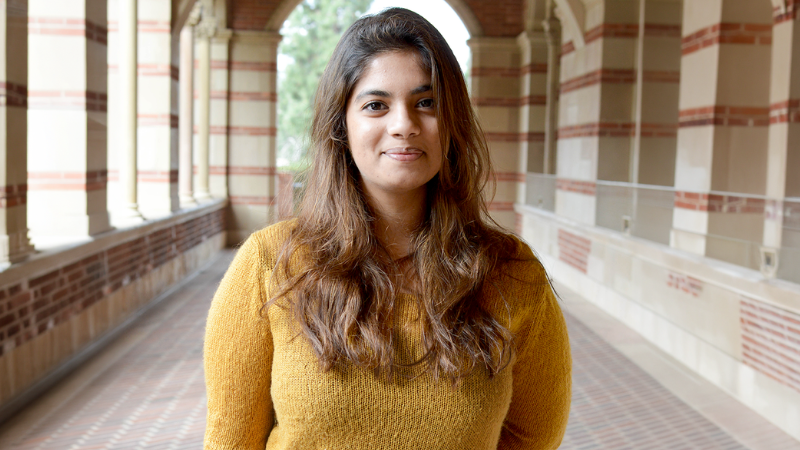
Kshitija Shah ’19, M.S. ‘21, Ph.D. ‘25 was nine years old when she started an environmental protection club at her elementary school in Mumbai, India. Like other developing cities, Mumbai was urbanizing rapidly, and with it came disparities between the haves and have-nots.
“Access to potable water was reserved for those who could afford it,” she said. “Whereas that should be a right to all.” In high school, she interned at water and wastewater treatment facilities and ran her first full experiment by age 16.
Shah’s increasing awareness of such environmental challenges, especially around water pollution and waste, shaped her curiosity. She was also heavily influenced by her grandfather, who had a Ph.D. in chemical engineering and was an expert in the water field.
“I was drawn to understanding how we could build systems that are both economically viable and environmentally sustainable,” Shah said. “I knew I needed to have a strong technical educational background.”
When it came time to choose a university, UCLA stood out from other schools with its emphasis on interdisciplinary science and its culture of innovation. But what caught Shah’s attention was the lab of Shaily Mahendra, a professor of civil and environmental engineering at the UCLA Samueli School of Engineering whose work on bioremediation, the use of living organisms to break down pollutants, mirrored the kind of science Shah planned to study one day.