Immersing oneself in the virtual and augmented reality world is not only awesome for entertainment, it helps industries like manufacturing and medicine operate more efficiently. Nevertheless, as fast as the technology brings you into the world, the weight and stiffness of its hardware can just as easily remind you that you aren’t really golfing on the PGA tour or preparing for a surgery.
Inspired by Softbotics, researchers in the Soft Machines Lab at Carnegie Mellon University are developing wearable electronics to augment our senses with natural-feeling hardware. A paper published in Nature Electronics illustrates how a flexible, skin-mounted haptic interface can seamlessly bridge virtual and real-world experiences without unnecessary distractions.
“We are building imperceptible technology,” said Carmel Majidi, professor of mechanical engineering at Carnegie Mellon University and head of the Soft Machines Lab. “This is technology to assist us that won’t cause distractions, doesn’t require a big cognitive load, and won’t take away from other areas of our lives that require our full attention.”
\
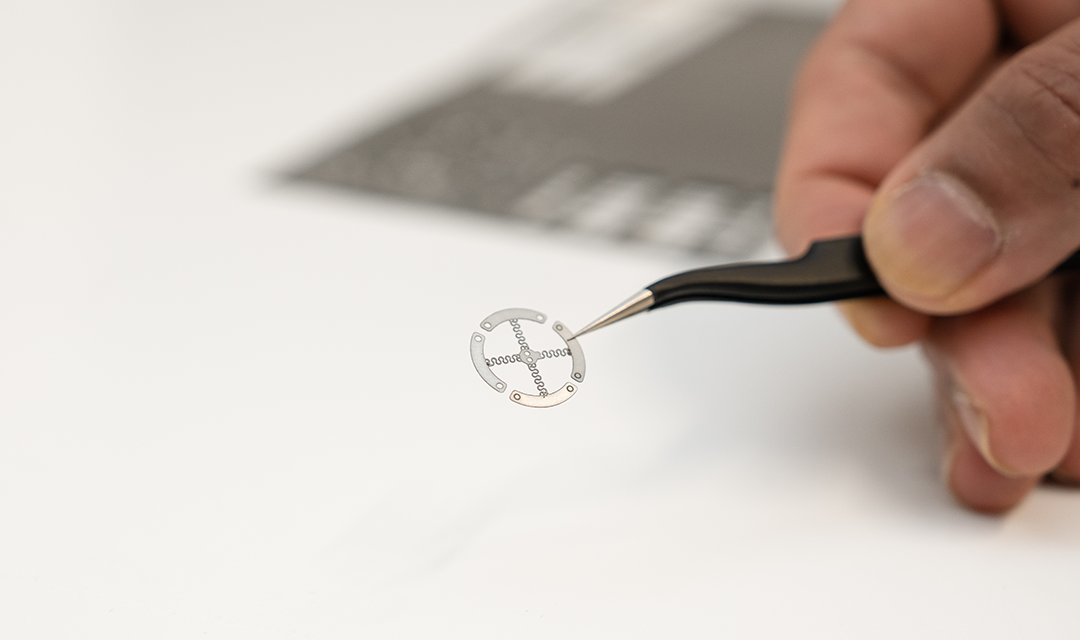
Roughly the size of a thimble, the wireless, flexible, lightweight, and skin-mountable haptic interface is able to communicate with the wearer through 11 distinct, multi-directional movements. The device is powered by a soft, serpentine-structured shape memory alloy (SMA) actuator. An epoxy probe serves as a barrier between the actuator and user to protect the skin from any heat generated by the SMA.