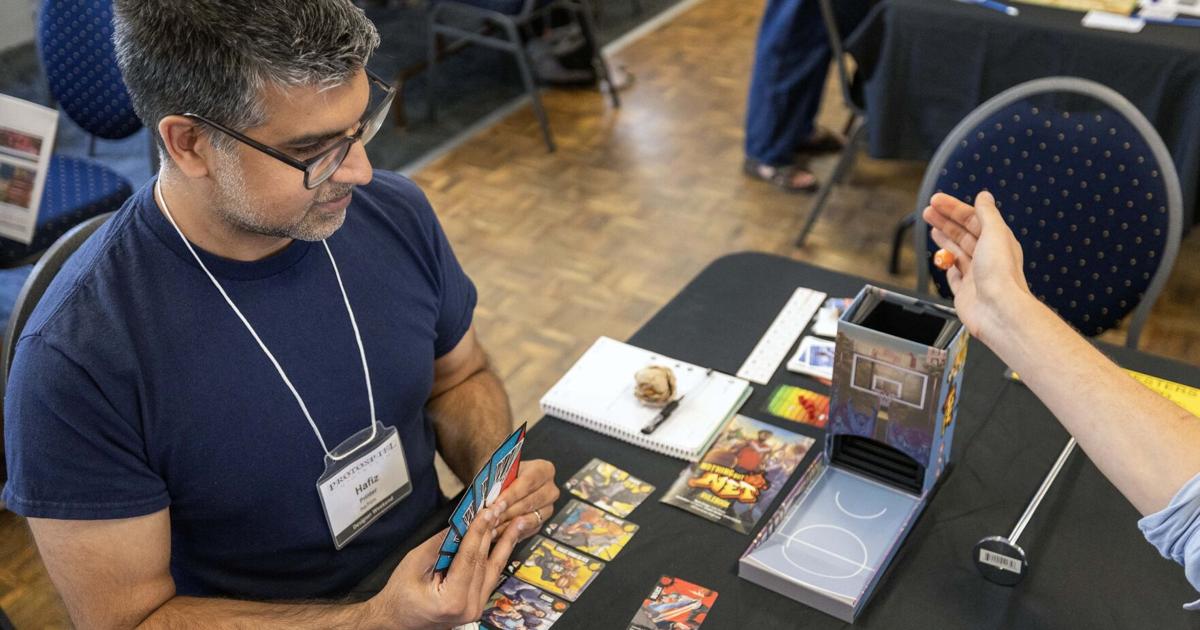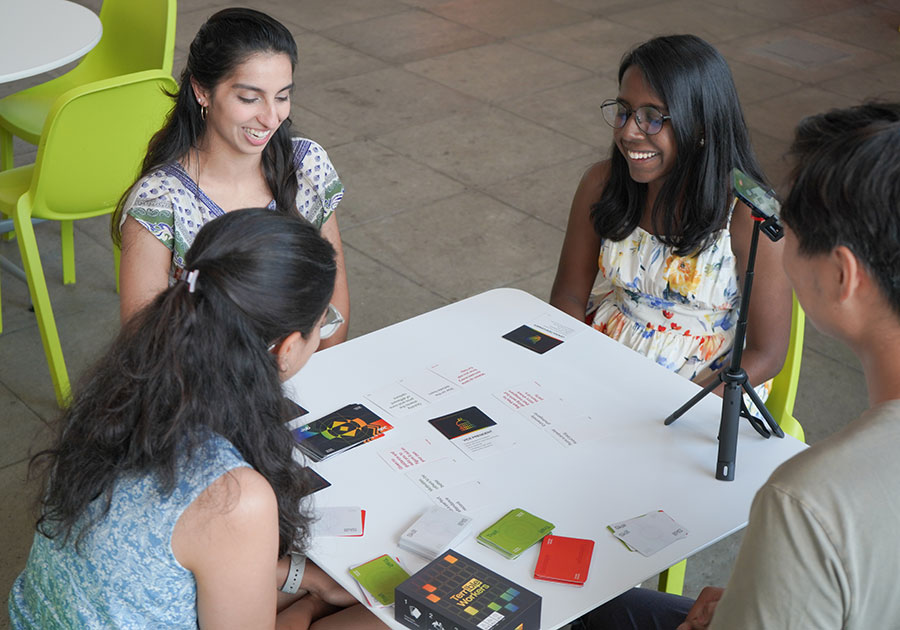
A team of recent graduates from Carnegie Mellon University turned career prep into a card game.Terrible Workers helps middle and high school students practice interpersonal skills like active listening, adaptability and conflict resolution. Players pitch themselves for a mix of both realistic and unconventional jobs in a low-stakes, high-engagement setting.During gameplay, one player takes on the role of the boss, while others compete as candidates for a range of roles, from cat cafe manager to supervillain sidekick. Players build their pitches using prompt cards that highlight personality traits, strengths and unexpected quirks. These range from always motivating others to do their best or quickly making well-informed decisions to being extremely photogenic or even knowing Morse code.Terrible Workers, a card game designed by a team of recent SCS alums, helps middle and high school students practice interpersonal skills like active listening, adaptability and conflict resolution.Players then present their case to the boss, who ultimately decides who gets the job. Along the way, players can complicate how candidates are perceived by assigning each other terrible personality traits, such as always being late or making up excuses anytime someone asks for help. The result is part improv, part storytelling and — most importantly — a way for students to explore how they communicate, collaborate and present themselves without the overwhelming pressure of a real interview.By reframing traditionally high-stakes scenarios like job interviews into something playful, Terrible Workers creates space for more authentic self-expression. Instead of asking students directly what they want to be, which often leads to anxiety, the game invites them to experiment with who they could be. Through humor and creativity, players can discover real skills and preferences that might otherwise go unnoticed."If students weren't engaging with serious questions in a serious format, why not meet them where they are and make it fun?" said Archana Ramakrishnan, part of the team that created the game. "We immediately saw more critical engagement from students after working to understand them instead of forcing them into a box."The project originated as a Master of Human-Computer Interaction (MHCI) Capstone by 2023 program graduates Ramakrishnan, Simran Chawla, Lawrence Zheng, Manvi Gupta and Jenny Liu in partnership with the South Fayette School District. Early research revealed that students often shut down when asked to talk about their futures, answering with jokes instead of serious thoughts.The team observed students in the classroom, interviewed them and conducted hands-on playtest sessions as they developed the game. Many early prototypes were digital, from chatbots to mobile apps. But through repeated testing and direct comparisons of how students engaged across formats, they discovered that the most effective experiences were analog, emphasizing face-to-face conversation and collaboration.The final result was a card game designed to foster interaction, reflection and meaningful social connections."The MHCI program is often associated with technology like apps, interfaces and robotics, but what it really teaches is a human-first mindset to solving problems," Zheng said. "Technology is just one way to bring those ideas to life. For this project, 'human-first' meant focusing on interpersonal skills that aren't always explicitly taught, but are essential for navigating school, work and life."The team's approach comes through in how the game unfolds. Students work through fast-moving rounds of roleplay where they build and defend their pitches as the boss evaluates candidates and personality traits change how each one is perceived. The boss listens to each pitch, asks follow-up questions and weighs not just the listed traits but how convincingly each player responds under pressure and adapts to new information.At the end of the round, the boss makes a hiring decision, selecting a candidate for the role based on a combination of creativity, communication and how well they navigated the social dynamics of the game. Rather than rewarding a single correct answer, the outcome reflects how effectively players advocate for themselves and respond in real time. The final choice then opens a discussion about perception, persuasion and interpersonal skills rather than a simple win or loss.After the team presented their final prototype at the end of their project, momentum continued to build. Terrible Workers earned first place at the 2024 International Educational Game Awards in Denmark and third place at the 2024 International Serious Play Awards in Canada.The recognition helped validate not just the game itself, but the broader framework behind it, something the team now shares as they expand the project's reach. In addition to the physical game, they offer "Play for People Skills," a set of heuristics — mental shortcuts that can help facilitate problem-solving — designed to help educators create engaging curricula focused on social and emotional learning. These components reflect the team's larger vision of a scalable approach that blends structured guidance with playful interaction.Although the team members have since moved into full-time roles, they continue to meet regularly and explore opportunities to further develop and distribute the project.To learn more about Terrible Workers, visit the game website.
Job Interviews, But Make It a Game Night
A team of recent graduates from Carnegie Mellon University turned career prep into a card game.Terrible Workers helps middle and high school students practice interpersonal skills like active listening, adaptability and conflict resolution. Players pitch themselves for a mix of both realistic and unconventional jobs in a low-stakes, high-engagement setting.During gameplay, one player takes on the role of the boss, while others compete as candidates for a range of roles, from cat cafe manager to supervillain sidekick. Players build their pitches using prompt cards that highlight personality traits, strengths and unexpected quirks. These range from always motivating others to do their best or quickly making well-informed decisions to being extremely photogenic or even knowing Morse code.Terrible Workers, a card game designed by a team of recent SCS alums, helps middle and high school students practice interpersonal skills like active listening, adaptability and conflict resolution.Players then present their case to the boss, who ultimately decides who gets the job. Along the way, players can complicate how candidates are perceived by assigning each other terrible personality traits, such as always being late or making up excuses anytime someone asks for help. The result is part improv, part storytelling and — most importantly — a way for students to explore how they communicate, collaborate and present themselves without the overwhelming pressure of a real interview.By reframing traditionally high-stakes scenarios like job interviews into something playful, Terrible Workers creates space for more authentic self-expression. Instead of asking students directly what they want to be, which often leads to anxiety, the game invites them to experiment with who they could be. Through humor and creativity, players can discover real skills and preferences that might otherwise go unnoticed."If students weren't engaging with serious questions in a serious format, why not meet them where they are and make it fun?" said Archana Ramakrishnan, part of the team that created the game. "We immediately saw more critical engagement from students after working to understand them instead of forcing them into a box."The project originated as a Master of Human-Computer Interaction (MHCI) Capstone by 2023 program graduates Ramakrishnan, Simran Chawla, Lawrence Zheng, Manvi Gupta and Jenny Liu in partnership with the South Fayette School District. Early research revealed that students often shut down when asked to talk about their futures, answering with jokes instead of serious thoughts.The team observed students in the classroom, interviewed them and conducted hands-on playtest sessions as they developed the game. Many early prototypes were digital, from chatbots to mobile apps. But through repeated testing and direct comparisons of how students engaged across formats, they discovered that the most effective experiences were analog, emphasizing face-to-face conversation and collaboration.The final result was a card game designed to foster interaction, reflection and meaningful social connections."The MHCI program is often associated with technology like apps, interfaces and robotics, but what it really teaches is a human-first mindset to solving problems," Zheng said. "Technology is just one way to bring those ideas to life. For this project, 'human-first' meant focusing on interpersonal skills that aren't always explicitly taught, but are essential for navigating school, work and life."The team's approach comes through in how the game unfolds. Students work through fast-moving rounds of roleplay where they build and defend their pitches as the boss evaluates candidates and personality traits change how each one is perceived. The boss listens to each pitch, asks follow-up questions and weighs not just the listed traits but how convincingly each player responds under pressure and adapts to new information.At the end of the round, the boss makes a hiring decision, selecting a candidate for the role based on a combination of creativity, communication and how well they navigated the social dynamics of the game. Rather than rewarding a single correct answer, the outcome reflects how effectively players advocate for themselves and respond in real time. The final choice then opens a discussion about perception, persuasion and interpersonal skills rather than a simple win or loss.After the team presented their final prototype at the end of their project, momentum continued to build. Terrible Workers earned first place at the 2024 International Educational Game Awards in Denmark and third place at the 2024 International Serious Play Awards in Canada.The recognition helped validate not just the game itself, but the broader framework behind it, something the team now shares as they expand the project's reach. In addition to the physical game, they offer "Play for People Skills," a set of heuristics — mental shortcuts that can help facilitate problem-solving — designed to help educators create engaging curricula focused on social and emotional learning. These components reflect the team's larger vision of a scalable approach that blends structured guidance with playful interaction.Although the team members have since moved into full-time roles, they continue to meet regularly and explore opportunities to further develop and distribute the project.To learn more about Terrible Workers, visit the game website.