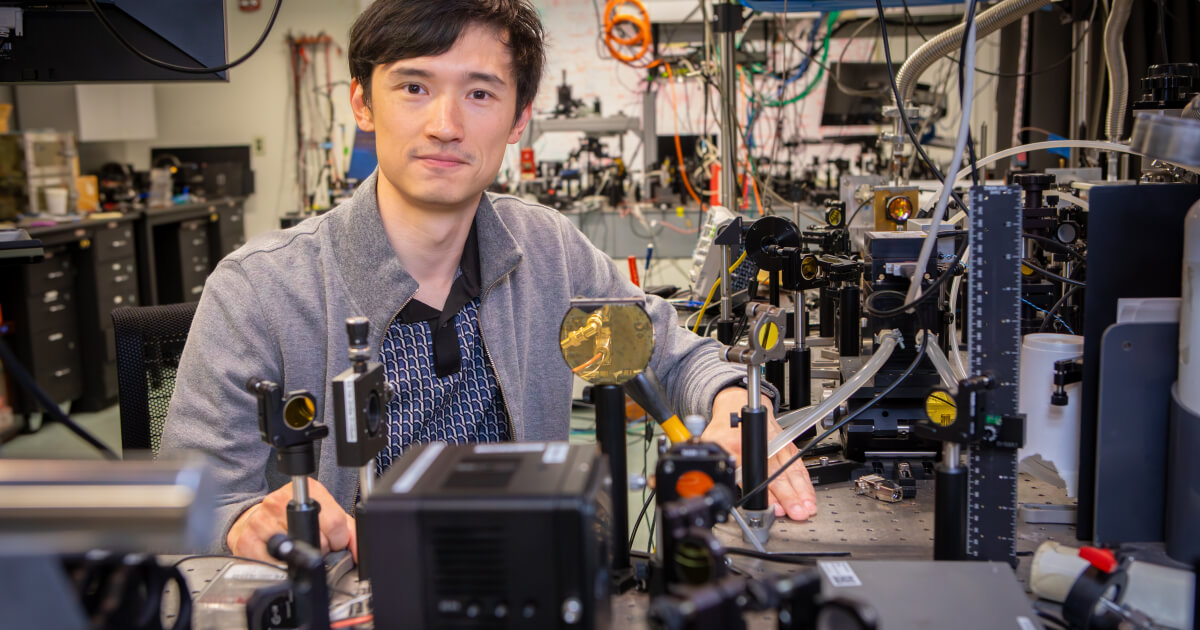
Arman Amirzhan, Ph.D. in applied physics (Eliza Grinnell/SEAS)
Arman Amirzhan chose to study materials science as an undergraduate at Imperial College in the United Kingdom thinking he’d learn about cutting edge technology like nanomaterials. Instead, he got ceramics and metallurgy – classical areas of the field, but not his area of interest. He was worried he’d picked the wrong field of study, and because of the U.K. educational system, changing majors would be much harder than in the U.S.Fortunately, he met Mark Oxborrow, a professor in his department researching optoelectronics, the study and application of electronics that interact with light. Oxborrow offered Amirzhan a spot on a summer project developing a maser, a microwave-emitting device similar to a laser that works at room temperature.“He really guided me very well,” Amirzhan said. “He gave all of the materials I needed to get into this field very fast, and that ultimately ignited my interest in scientific research.”That summer project directed Amirzhan onto a path that eventually brought him to the Harvard John A. Paulson School of Engineering and Applied Sciences (SEAS), where he became a researcher in the lab of Federico Capasso, Robert L. Wallace Professor of Applied Physics and Vinton Hayes Senior Research Fellow in Electrical Engineering. Amirzhan’s research as an applied physics Ph.D. student in the Capasso Group has focused on the ongoing development of the next generation of lasers, which could eventually revolutionize communications, industrial imaging technology and astrophotography. Amirzhan defended his dissertation last summer and will be hooded at Commencement.“What really appeals to me about physics is that it kind of explains almost everything,” Amirzhan said. “It explains how we see stuff, how we interact with things, how things work. And from a very early age, I always liked to tinker with stuff, build things and understand how they work. This is a continuation of that curiosity about the world.”