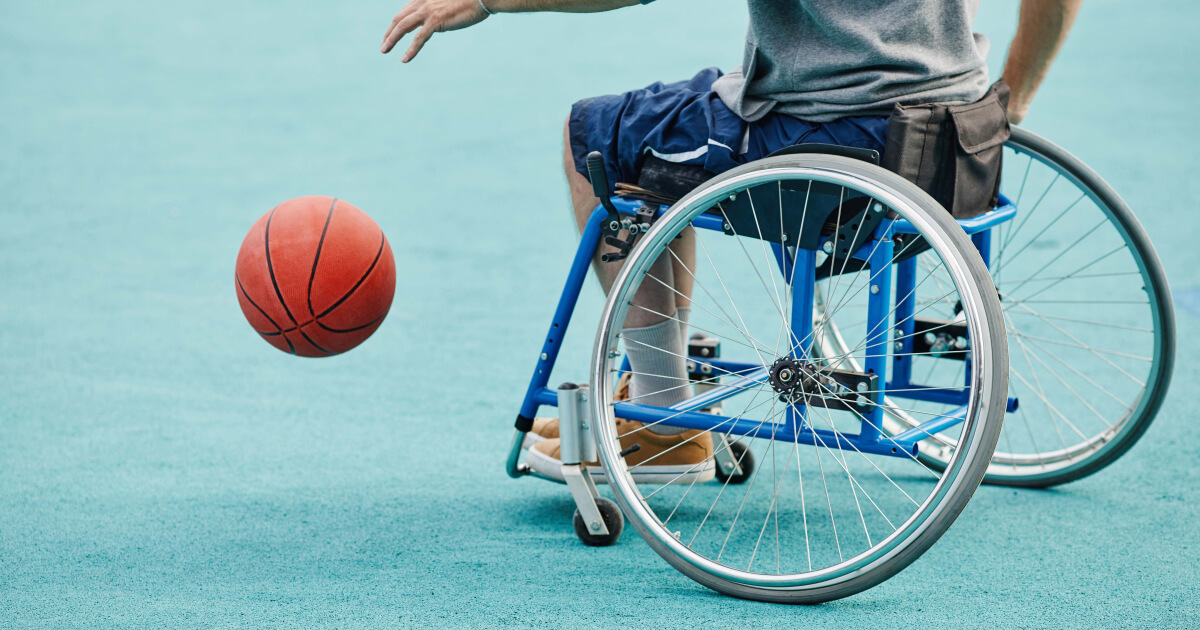
A Harvard-led computer science study that addresses barriers in sports training for athletes with disabilities was recently honored with a Best Paper Award at the ACM Conference on Human Factors in Computing Systems (CHI), the premier venue for human-computer interaction research.A research team that includes senior author Hanspeter Pfister, the An Wang Professor of Computer Science in the John A. Paulson School of Engineering and Applied Sciences (SEAS), developed BRIDGE, a simulation technology that reinterprets traditional non-disabled basketball footage into realistic wheelchair basketball video representations. The system is designed to give para-athletes and coaches access to video analysis resources that are commonplace in non-disabled sports but are rare in parasports.
The Harvard team at CHI 2026.
The paper’s co-lead authors were Chunggi Lee, a Ph.D. student in Harvard’s Visual Computing Group, and Hayato Saiki, a former visiting scholar from University of Tsukuba. Since the Visual Computing Group has long worked on sport-viewing and tracking tools, explained Lee, they have noticed how such systems quietly assume a non-disabled body as the default user. “We were motivated to expand our research to inclusive sports analytics and accessible tools,” Lee said. With a connection to the Japanese national basketball team facilitated by Saiki, the researchers set out to ground their research into day-to-day practice. “Through our collaboration with the team, we realized that the main bottleneck was not tactical understanding itself, but the constant effort needed to translate stand‑up footage into wheelchair play,” Lee said. “What made it compelling was hearing national wheelchair basketball team players describe how much cognitive effort they spend mentally translating non-disabled footage.” BRIDGE is designed with this gap in mind. It employs a reconstruction pipeline that detects and tracks players and the ball from broadcast video to generate 3D play sequences. It then applies an “embodiment-aware” visualization framework that decomposes and remaps head, trunk, and wheelchair base orientations. This layered mapping conveys where a player is looking, what they intend to do, and how they move, all within the constraints of wheelchair basketball.