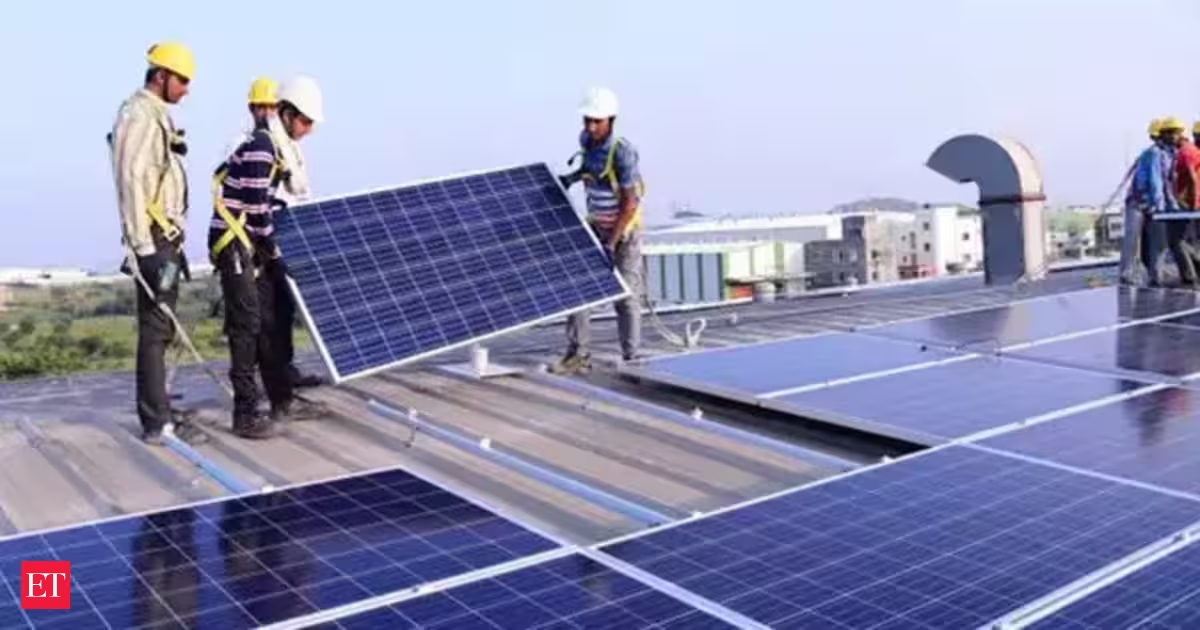
India’s rooftop solar market is beginning to move beyond the “1-in-4 wall” it hit in FY25, with PM Surya Ghar installations crossing 31 lakh households in FY26 and conversion rates improving from roughly one in four applicants to nearly one in two.But the country’s electricity infrastructure is now emerging as the next major bottleneck in India’s clean-energy transition and the next phase of rooftop solar growth, with rising summer power demand and the latest West Asia crisis sharpening concerns around energy security even as transformer saturation, DISCOM delays, reverse power-flow constraints and shortages of domestically compliant solar components slow installations across several states.Data from the Ministry of New and Renewable Energy (MNRE) show rooftop solar capacity surged 51% year-on-year to 25.7 GW in March 2026 from 17 GW a year earlier, with the sector adding a record 8.7 GW during FY26 as adoption spread beyond traditional leaders Gujarat and Maharashtra into emerging markets such as Odisha, Assam and Uttar Pradesh.The rapid expansion comes at a critical moment for India’s energy-security strategy as the latest West Asia crisis once again exposes the country’s dependence on imported fossil fuels even as summer electricity demand touches record highs.However, industry executives warned that ageing distribution infrastructure, delays at the DISCOM level and shortages of domestically compliant solar components are slowing rooftop installations just as India attempts to accelerate decentralised clean-energy adoption.Industry executives said India’s electricity network was originally designed for one-way power flows from substations to consumers, not for millions of households simultaneously generating electricity and feeding surplus solar power back into the grid.Grid stress grows with solar surgeIndustry executives say Parts of Maharashtra and Tamil Nadu are already seeing feasibility rejections in some pockets due to reverse power-flow constraints and transformer saturation.The stress is emerging even as India’s rooftop solar capacity surged 51% year-on-year to 25.7 GW in March 2026 from 17 GW a year earlier, with the sector adding a record 8.7 GW during FY26 as adoption spread beyond traditional leaders Gujarat and Maharashtra into emerging markets such as Odisha, Assam and Uttar Pradesh, according to MNRE data.“India has cracked solar adoption, cumulative renewable capacity has nearly tripled since FY21, but a sun-only grid hits a ceiling at sundown. Battery energy storage is the missing half of the sentence, and the next decade of distributed energy belongs to the players who can finance solar and storage as a single asset,” said Gautam Kaushik, founder and director at of Waree Energy backed Solfin Sustainable Finance.Industry experts said India is increasingly facing a mismatch between surplus daytime solar generation and rising evening electricity demand, creating growing stress on ageing grids and local transformers that were originally designed for one-way electricity flows. Parts of Maharashtra and Tamil Nadu are already seeing feasibility rejections due to reverse power-flow constraints and transformer saturation.Industry executives said DISCOMs are also facing a structural financial conflict as affluent residential consumers adopting rooftop solar gradually move out of the high-tariff consumer base that subsidises broader power distribution networks. Utilities remain tied to long-term power purchase agreements even as their most profitable consumers reduce dependence on grid power.At the same time, domestic-content requirement-linked supply constraints are slowing installations. While India’s solar module assembly capacity has crossed 170 GW, domestic solar cell manufacturing capacity remains far lower at roughly 25 GW, creating supply bottlenecks for subsidy-compliant rooftop systems.Solar After SunsetBattery storage systems are emerging as a critical part of India’s rooftop solar ecosystem because solar generation falls sharply after sunset even as evening household electricity demand peaks. These systems store excess daytime solar power for later use during outages or peak-demand hours, reducing dependence on weak grids and expensive diesel backup.Industry executives said financing could become one of the biggest levers for breaking the sector’s “1-in-4 wall,” especially as rooftop solar shifts from commercial users to middle-income households, housing societies and MSMEs that require lower upfront costs and bundled solar-storage financing solutions.“There is a huge opportunity in the last mile: rooftop homes and condominiums, agri feeders, MSME shop-floors, telecom towers and cold chains. We see purpose-built solar-plus-storage lending as the single biggest unlock between India’s installed gigawatts and dependable, dispatchable power,” Kaushik said.“Government is not giving very attractive tariffs for feeding excess solar power back into the grid. In many cases consumers are getting ₹2 per unit for exporting power while paying ₹8–10 per unit when drawing electricity later. Consumers increasingly want to store that power instead of giving it away cheaply,” said Amitanshu Satpathy, founder of Best Power Equipments (BPE).Satpathy said battery storage systems are increasingly being deployed across housing societies, MSMEs and commercial establishments as alternatives to diesel generators as economics improve and urban emission norms tighten.Rooftop Goes MainstreamThe sharp rise in rooftop solar marks a major shift for a segment that historically lagged utility-scale solar in India’s clean-energy transition. The residential segment accounted for nearly 76% of rooftop additions during FY26, reflecting a sharp shift from commercial and industrial demand toward household-led adoption.Industry executives said the latest adoption cycle is increasingly being driven by heatwave-linked electricity demand, rising residential tariffs and concerns around grid reliability. Much of the new demand is emerging from Tier-2 and Tier-3 cities where unreliable local grids are accelerating household adoption.The Rise of India’s New Solar States
Assam, Odisha, UP and Bihar lead solar wave as rooftop boom outpaces India’s grid readiness
Assam, Odisha, UP, and Bihar drive India's rooftop solar boom, yet grid challenges threaten future growth amid rising energy demands.
1,359 words~6 min read