Show Caption
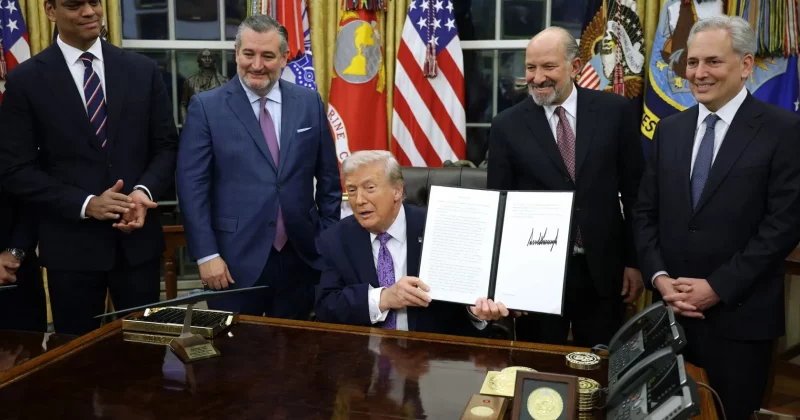
WASHINGTON — President Donald Trump abruptly halted plans to issue a long-awaiting executive order on artificial intelligence hours before prominent tech executives were set to attend an Oval Office ceremony to watch the president sign the order.Trump told reporters on May 21 he didn't like "certain aspects" of a draft order that White House officials prepared for the president to sign as he raised concerns about overregulating the industry."I think it gets in the way," Trump said, touting U.S. innovation in artificial intelligence. "We're leading China. We're leading everybody, and I don't want to do anything that's going to get in the way of that lead."The signing ceremony, originally scheduled for the afternoon, was canceled.Just a few hours before Trump confirmed the postponement, White House officials held a morning phone call with reporters to preview an order ‒ typed out, but lacking Trump's signature ‒ that would make a federal government review of artificial intelligence models voluntary for tech companies before releasing the systems to the public.Although not mandating that AI models first be reviewed by the government, the order would represent more aggressive engagement with AI than Trump has pursued to date for the rapidly growing industry. Trump has taken a more lax approach with government intervention in the AI industry than his predecessor, former President Joe Biden.The voluntary framework, as outlined in the draft order, would create a process for AI developers who choose to engage with the federal government before releasing certain AI models. Participating developers would be asked to provide their models to the government 90 days before public release, and also give pre-public access to critical infrastructure providers such as banks, Reuters reported."Nothing in this section shall be construed to authorize the creation of a mandatory governmental licensing preclearance or permitting requirement for the development, release or distribution of new AI models," the draft order states.Yet despite the assurance, Trump raised concerns that even a voluntary framework could impede on AI innovation. "I really thought that could have been a blocker," Trump said, without specifying which components in the order have him worried.Some AI companies, including OpenAI and Anthropic, already voluntarily submit their models to the U.S. Center for AI Standards and Innovation for safety evaluations and testing before releasing to the public.A voluntary framework seemed to be a middle ground between tech executives who oppose mandatory AI requirements and MAGA activists, including the president's former chief strategist Steve Bannon, who have pushed for requiring AI developers to submit their AI models for government security tests.The draft order would also direct the expansion of advanced AI in national security systems, national critical infrastructure and states and municipalities.Contributing: ReutersReach Joey Garrison on X @joeygarrison.