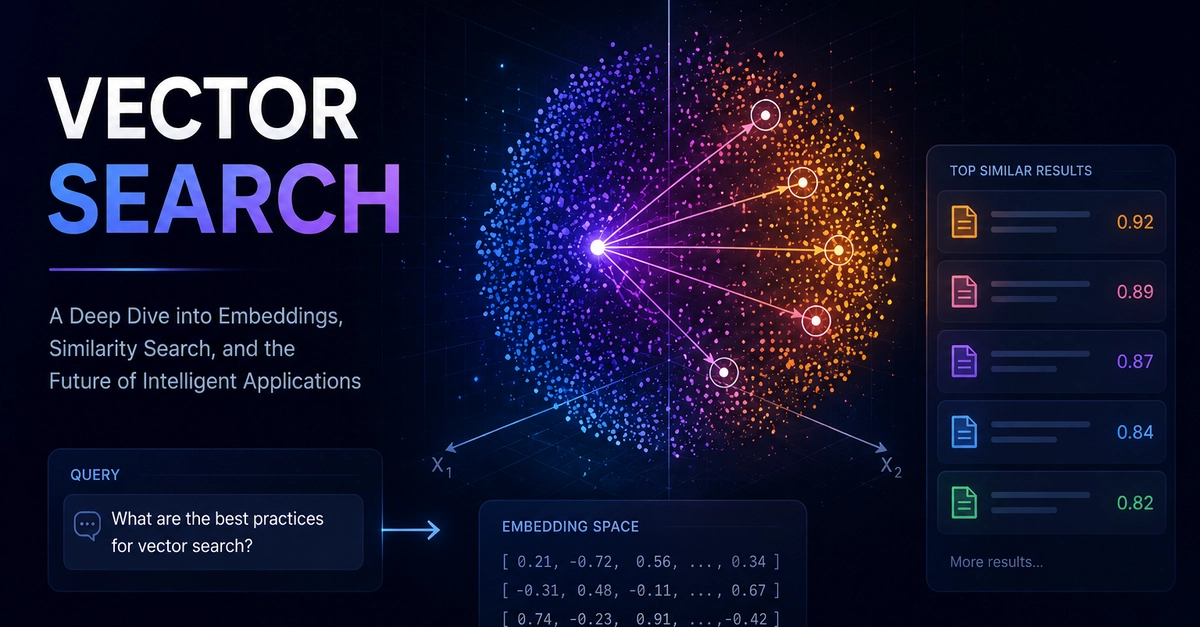
Every developer working with Large Language Models quickly learns about vector embeddings—arrays of floating-point numbers mapping words, sentences, or images into multi-thousand-dimensional semantic spaces. But while we write APIs calling text-embedding-3-small daily, humans lack the biological architecture to conceptualize 1536-dimensional coordinates.
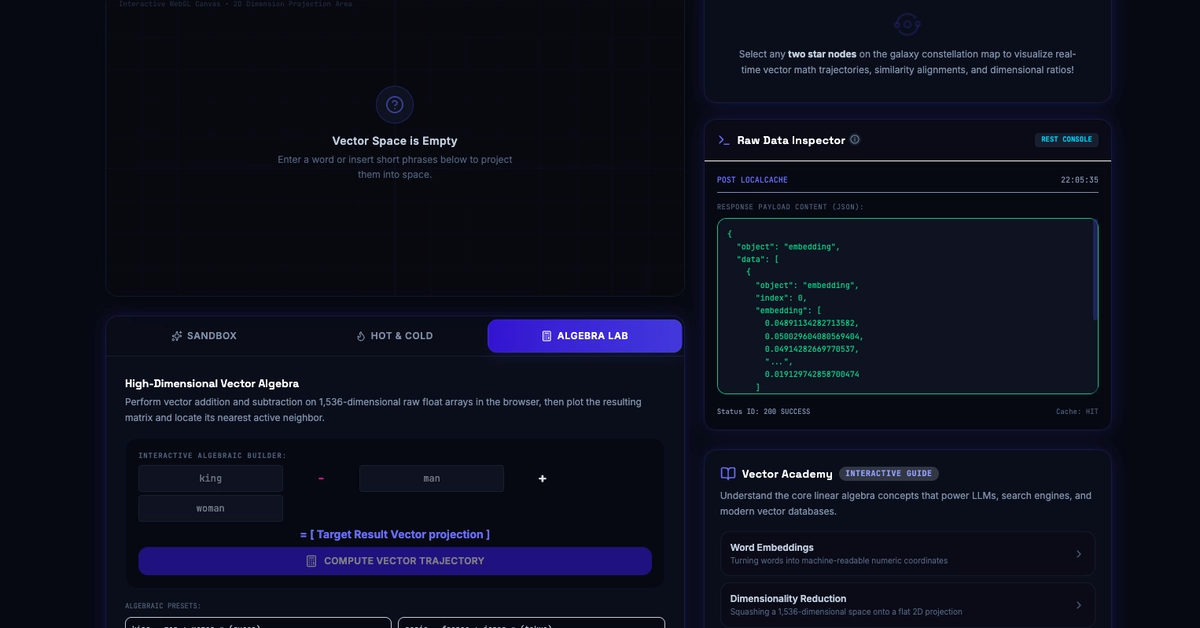
To bridge this intuitive void, we built Vector Space Explorer: an interactive web visualizer allowing developers to input custom vocabularies, perform real vector arithmetic (like puppy - dog + cat = kitten), play semantic clustering games, and examine the raw JSON outputs returned from deep learning hubs.
Here is the technical architectural breakdown of how we built this application using React 18, Tailwind CSS, and pure client-side linear algebra math.
1. Multi-Provider Endpoint Ingestion
Depending on budget or privacy restrictions, developers use different pipelines. To serve all needs, we wrapped our request adapters to handle multiple standard API specifications through a unified, client-secured interface: