Evolutionary biologists are uncovering genomic mechanisms that allow populations to adapt quickly to different, hyperlocal habitats without splitting into new species.
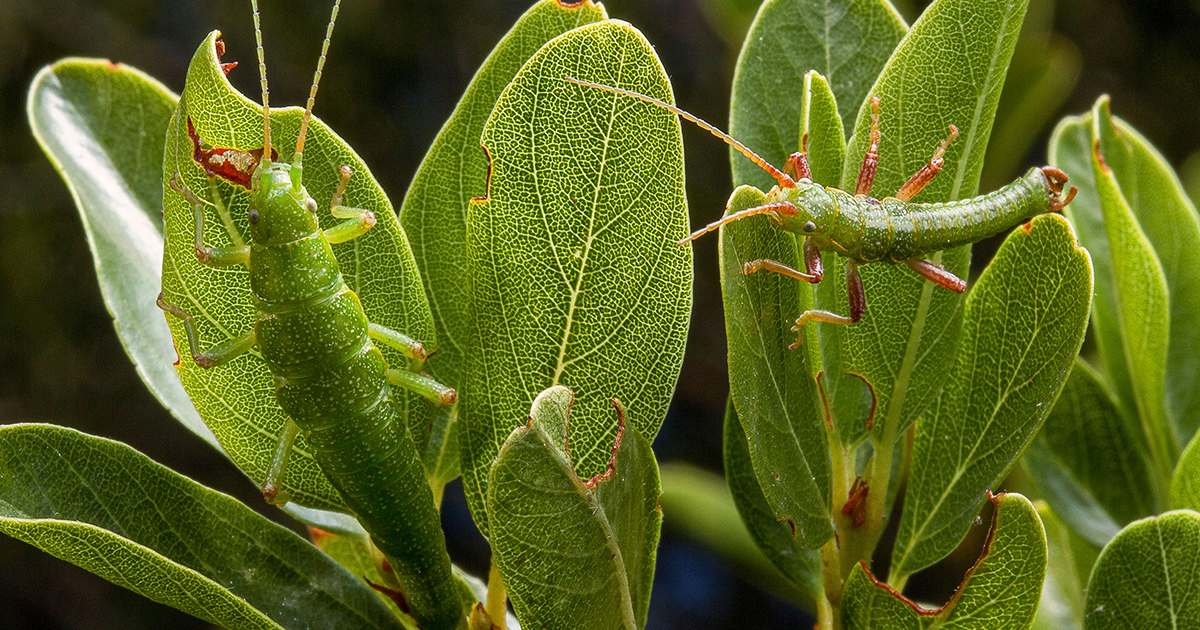
The green ecotype of Cristina’s timema, a species of stick insect, blends in with broad leaves. Other ecotypes of the same species are colored to blend in with narrower leaves. With genomics, scientists are answering century-old questions about how a single species can manifest such distinct traits.
Aaron Comeault
Introduction
When she was a graduate student in the 1970s, the evolutionary biologist Kerstin Johannesson regularly walked the shores of a Swedish archipelago, scanning the ground for pebbles that moved: marine snails. Her adviser, a taxonomist, had tasked her with describing the species present there by documenting their traits. She noticed that snails with thicker shells stayed on the shore, while those with thinner shells seemed to prefer wave-battered rocks, and in between the two habitats were snails with intermediate shell thickness. While they seemed like distinct species, Johannesson couldn’t help but wonder whether these snails might instead be different types of the same one.