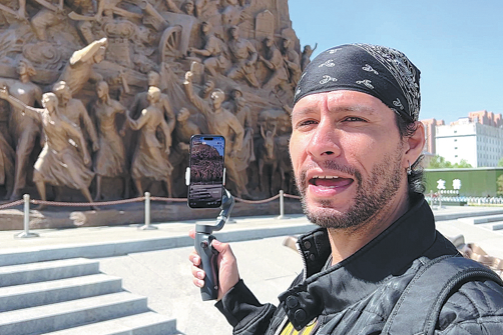
The afternoon sun slants through the tinted glass walls of a livestreaming base in Chengmai county, Hainan province, casting a golden light on the busy venue.At 2 pm, the place comes alive. Behind one soundproof door, a young woman from Morocco adjusts a ring light; behind another, a Ghanaian man flashes a wide smile at his camera. In less than a minute, they will begin speaking to thousands of shoppers thousands of miles away — in places like New York, Casablanca, Lagos and Jakarta.This is not a scene from well-known Chinese e-commerce cities such as Shenzhen, Guangdong province, or Hangzhou, Zhejiang province. This is Hainan, the southern island province known for coconut trees, beach resorts and rocket launches.But after the island-wide special customs operations came into effect in December at Hainan Free Trade Port, a different kind of tide is rolling in — not of tourists, but of foreign faces speaking into phones, selling “Made in China” to the world.“What makes me come to Hainan? It’s growing. It’s a good opportunity. I feel like I’m going to grow together with this island,” said Imane, a 25-year-old from Morocco, taking a quick break from her setup.A male foreign host livestreams Chinese products in Chengmai in September (PROVIDED TO CHINA DAILY)Imane is one of a growing number of foreign livestreamers who have made Hainan their home base. Since arriving in October, she has gone from a newcomer to a seasoned host. Now she speaks not just as a seller, but as a cultural bridge.She held up a box of coconut tea, a Hainan specialty. “I drink Chinese tea every day — green tea, very refreshing. But when I moved to Hainan, I really like this: coconut tea. In Morocco, we also have tea, it’s famous. So I tell my audience: ‘This is like your tea, but with a tropical touch’. The biggest challenge is not the language,” she reflected, “It’s the trust.” The trust-building is exactly why Hainan’s cross-border e-commerce players are doubling down on foreign hosts. Xu Jie, co-founder of Hainan Chuangchen Overseas Enterprise Services, runs a livestreaming base in Chengmai that now employs hosts from nine countries — Pakistan, Egypt, Morocco, Ghana, Congo and beyond.Behind the smiling faces on camera is a carefully engineered policy environment. Xu said: “Without Hainan’s special policies, we couldn’t have built this international team.”Hainan Free Trade Port has rolled out a suite of measures that directly benefit cross-border e-commerce. For foreign talent, the process has been streamlined. Hainan now offers a joint work permit and residence permit application that takes just three working days — a reduction of more than 70 per cent compared to traditional procedures. Work permits, once issued for three or six months, are now routinely valid for a year.Why has Chengmai become the epicentre of this activity? The county, located in northwestern Hainan, sits inside the half-hour economic circle of the provincial capital Haikou. It is close enough to benefit from Haikou’s infrastructure, but affordable enough to host large-scale operations.Huang Wanshu, deputy director of the Bureau of Commerce in Chengmai, said the strategy comes with right timing, right location and right people.The location includes Macun Port — a national first-class open port connecting to Southeast Asia and the countries and regions involved in the Belt and Road Initiative. As for people, Chengmai has adopted a “talent first” philosophy, streamlining bureaucratic hurdles and providing value-added services.Across Hainan, a bigger picture is emerging. In Haikou’s industrial parks, livestreaming rooms facing Southeast Asia are running at full capacity. In Sanya, cross-border e-commerce charter flights are also busy travelling around the world.Hainan, once a tropical vacation getaway, is now a frontier of a different kind — an island where a young woman from Casablanca and a young man from Accra are helping the world see a new China, one livestreaming session at a time.
Foreigners booming in Hainan livestream market
THE ARTICLES ON THESE PAGES ARE PRODUCED BY CHINA DAILY, WHICH TAKES SOLE RESPONSIBILITY FOR THE CONTENTS
639 words~3 min read