(Image credit: Google Deepmind)
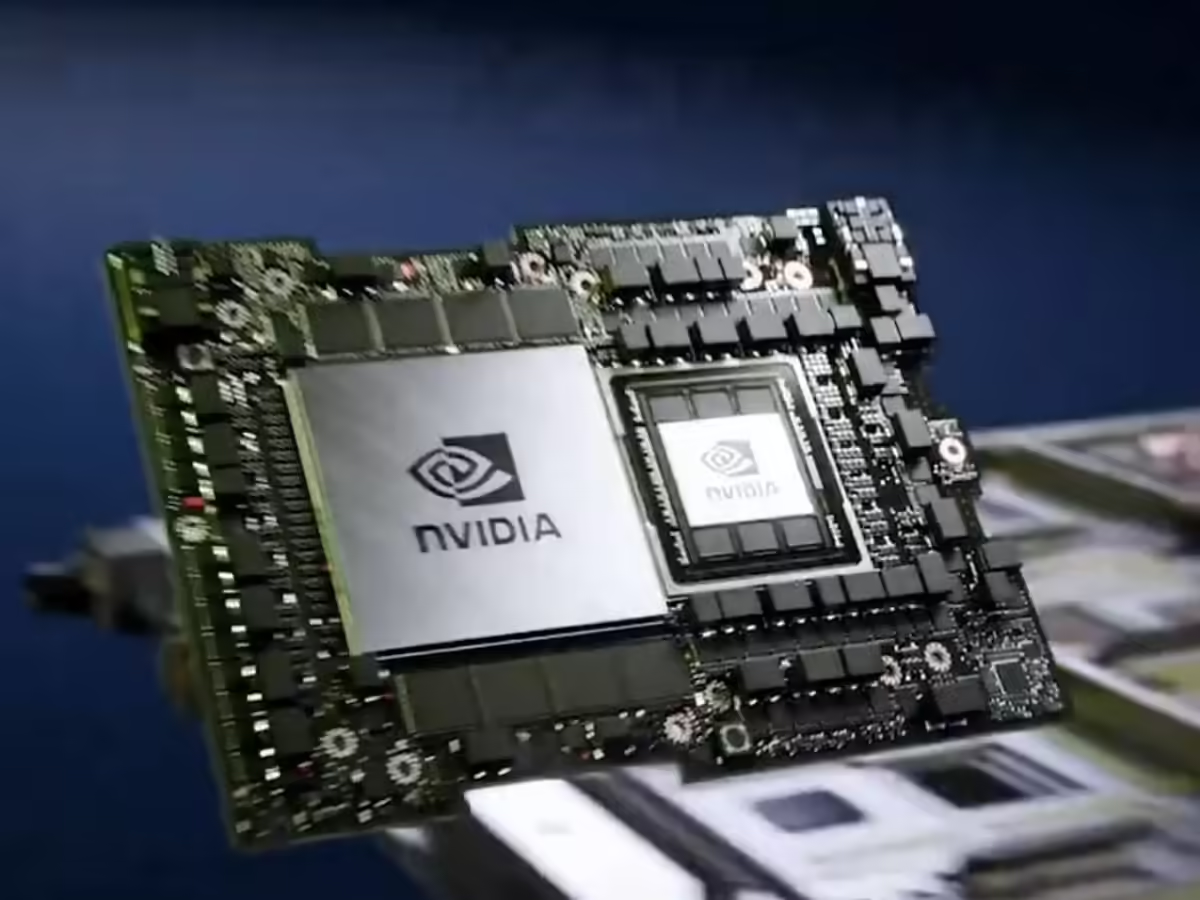
Nvidia still holds approximately 70% of the AI chip market share, but that share is projected to erode as Google, Amazon, Meta, Microsoft, and OpenAI invest billions in purpose-built chips designed for their specific workloads. ASIC-based AI server shipments are projected to reach 27.8% of the market in 2026, the highest share since 2023, which also forecasts that custom ASIC shipments will grow 44.6% year-over-year in 2026, nearly triple the 16.1% growth rate projected for merchant GPUs.This is being enabled almost entirely by TSMC, which fabricates chips for all five hyperscalers and for Broadcom, the dominant custom AI chip architect. Broadcom alone carries a $73 billion AI backlog and is targeting $100 billion in annual AI chip revenue by 2027.
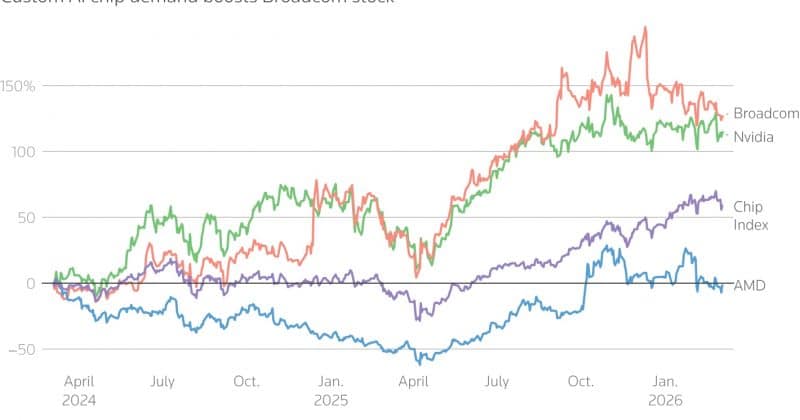
(Image credit: Getty Images / Justin Sullivan)Broadcom, which has arguably emerged as the core enabler of the AI ASIC ecosystem, reported $8.4 billion in AI semiconductor revenue for Q1 FY2026 (ending February 2026), a 106% year-over-year increase, and guided to $10.7 billion in Q2. CEO Hock Tan told investors the company has "line of sight to achieve AI revenue from chips in excess of $100 billion in 2027," backed by a disclosed $73 billion AI backlog.Broadcom has confirmed six major XPU customers, including Google, which remains the longest-standing partner, with seven generations of co-designed TPU's since 2014. OpenAI signed a multi-year collaboration in October 2025 for 10 gigawatts of custom accelerators, with first deployment targeting the second half of 2026 using both 3nm and 2nm designs. That deal came after OpenAI was widely reported to be behind a separate $10 billion order. However, Broadcom semiconductor president Charlie Kawwas joked on CNBC that OpenAI "has not given me that PO yet," leaving the identity of the mystery customer officially unconfirmed.Meta, ByteDance, and Fujitsu round out the confirmed customer list, and analysts have identified Apple and Arm/SoftBank as potential future engagements. Arm is separately developing a custom CPU for OpenAI's Broadcom-built accelerator, a contract that could be worth billions to SoftBank.The tech behind this growth is Broadcom's 3.5D XDSiP platform, which uses face-to-face 3D stacking via TSMC's SoIC process combined with 2.5D CoWoS integration. The platform enables packages exceeding 6,000 mm squared of silicon with up to 12 HBM stacks, far beyond the roughly 2,500 mm squared limit of conventional 2.5D designs. In February, Broadcom announced it had begun shipping the industry's first 2nm compute SoC built on this platform, integrating four N2 compute dies, one I/O die, and six HBM modules.In terms of networking, Broadcom’s Tomahawk 6 switch chip entered volume production in March as the industry's first 102.4 Tbps Ethernet part. The companion Jericho 4 fabric chip (51.2 Tbps) began shipping last August and is designed to interconnect over one million XPUs across data centers. Nvidia's competing Spectrum-X1600, meanwhile, isn’t expected in volume until the second half of 2026.Google TPU