(Image credit: Getty Images / Justin Sullivan)
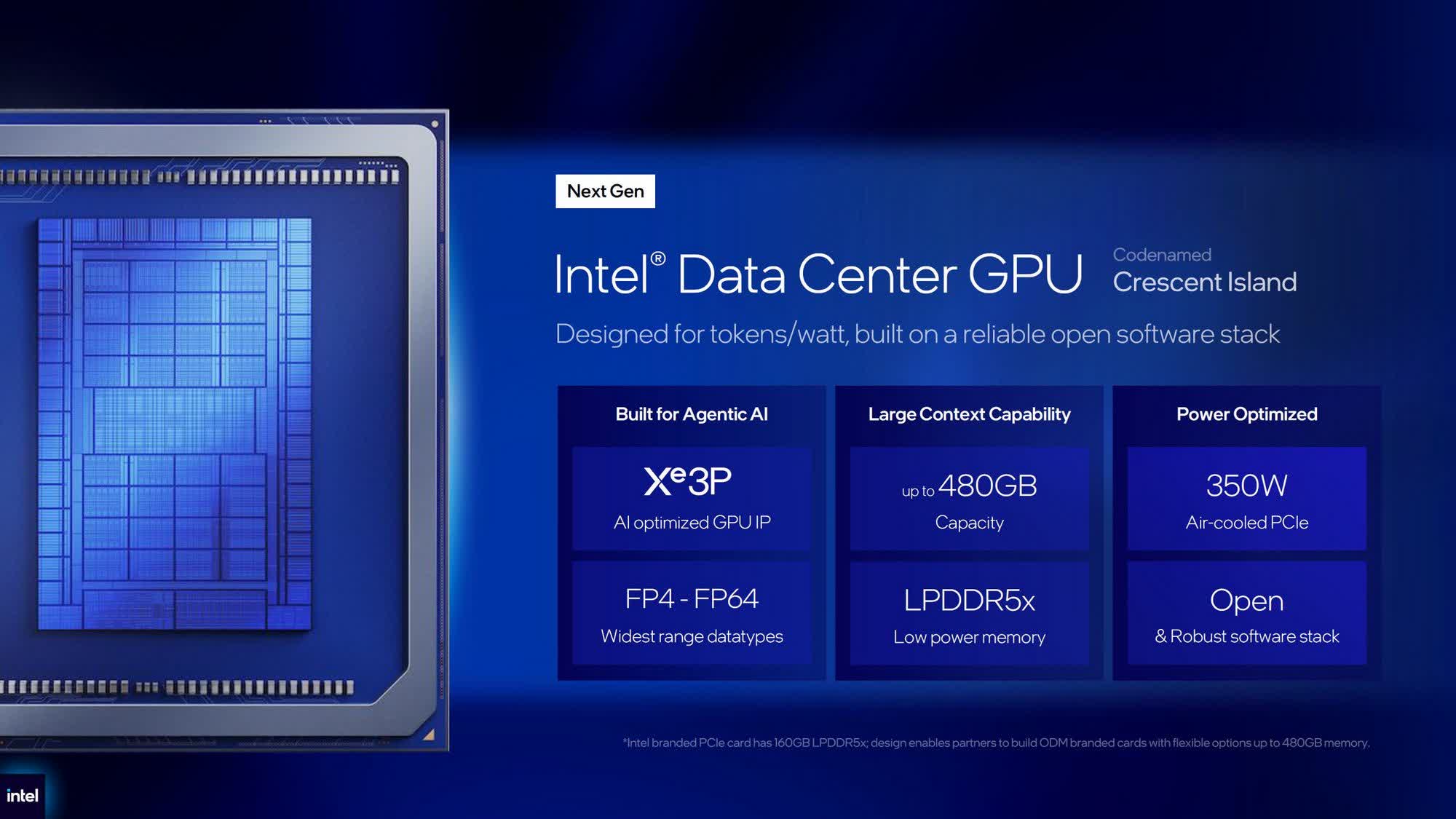
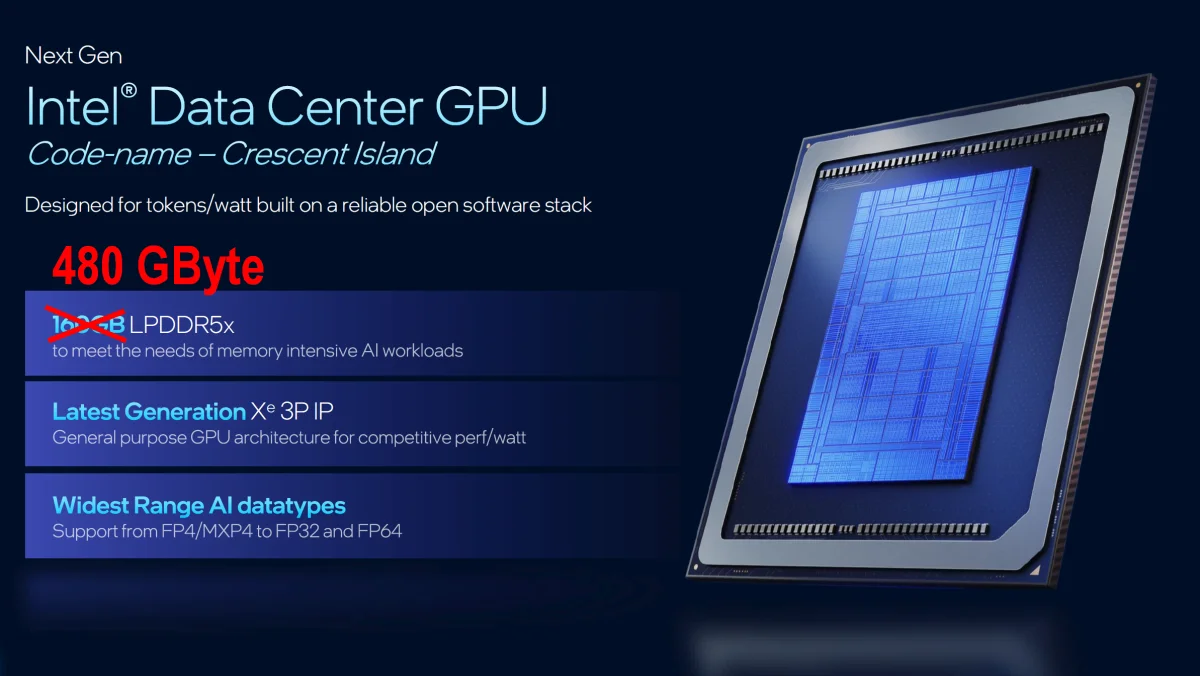
Pictures of the PCB of Intel’s upcoming Crescent Island data center GPU, announced last year, have surfaced. The images, which come by way of @yuuki_ans on X, show the front and back of the Crescent Island PCB and reveal the layout of the board's components, including the GPU, VRAM, and power delivery system.Go deeper with TH Premium: ChipmakingThe PCB shots confirm that Intel has opted to go with a single-GPU setup for Crescent Island, rather than a dual-GPU setup. A vast majority of the PCB’s real estate is consumed by a massive GPU socket in the middle, taking up the width of almost the entire PCIe x16 slot below.There are pads for twelve LPDDR5X modules to the top, left, and right of the GPU socket and an additional eight on the back of the PCB, totaling 20. This confirms the GPU will use 32GB (8 GB) modules, the highest capacity modules out there for LPDDR5X currently on the market. The power delivery system consists of a single 16-pin 12V-2x6 power connector on the right and 19 power phases.No12+8 https://t.co/zutF2SJ7qK pic.twitter.com/LAtiFXfzV4May 19, 2026Crescent Island is the codename for Intel’s next-generation data center GPU powered by its Xe3P GPU architecture. Its most noticeable trait is the inclusion of LPDDR5X memory over HBM, which should make Crescent Island the world’s first AI GPU to use LPDDR5X. This will give Crescent Island significantly inferior memory bandwidth, but undoubtedly, Intel is opting to use slower memory to save on production costs, thanks to the memory shortage. (HBM memory sits at the center of the outgoing memory shortage crisis, as it's the hardest to secure for GPU manufacturers .) Assuming the GPU comes with a 640-bit memory interface and uses 10.7Gbps memory, maximum memory bandwidth will be well under 1TB/s — a far cry from Nvidia’s older H200 GPUs, which have nearly 5TB/s of memory bandwidth. Memory bandwidth is one of the most important aspects of an AI GPU's performance and how quickly it can execute machine learning workloads, so it will be interesting to see how much LPDDR5X impacts Crescent Island’s performance compared to HBM-equipped cards.Intel’s new AI-GPU will be targeted at air-cooled servers and will be a competitor to existing Nvidia and AMD cards in the same target demographic, such as the recently released AMD MI350P with 144GB of HBM3E and the Nvidia H200 NVL with 141GB of HBM3. Intel plans to start sampling Crescent Island to its customers in the second half of 2026.