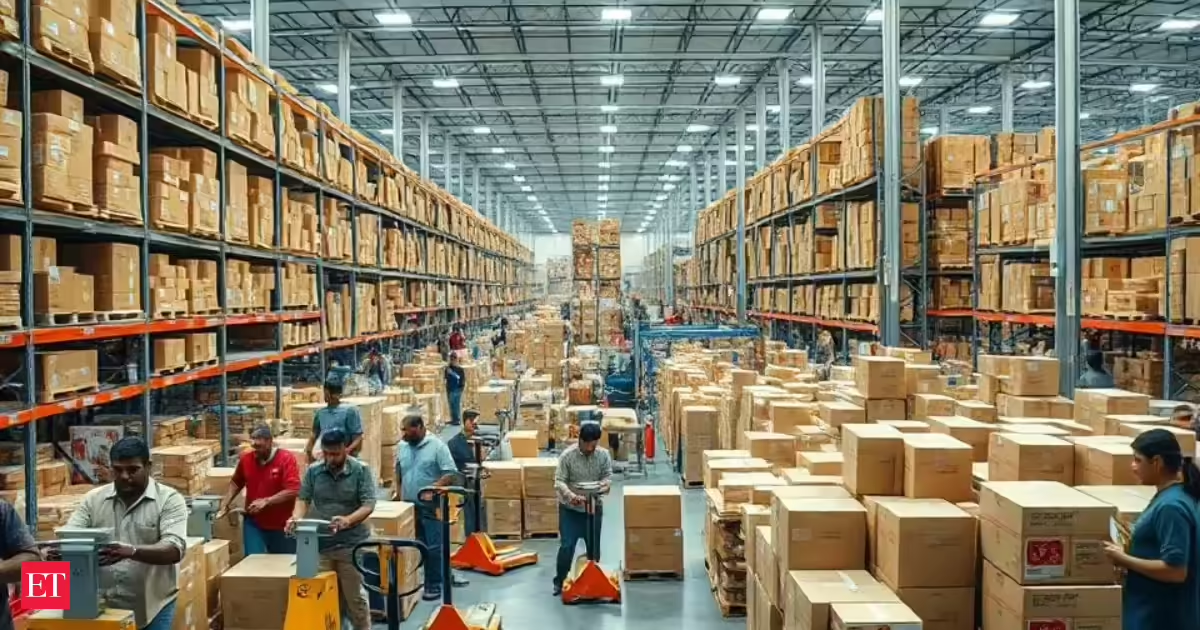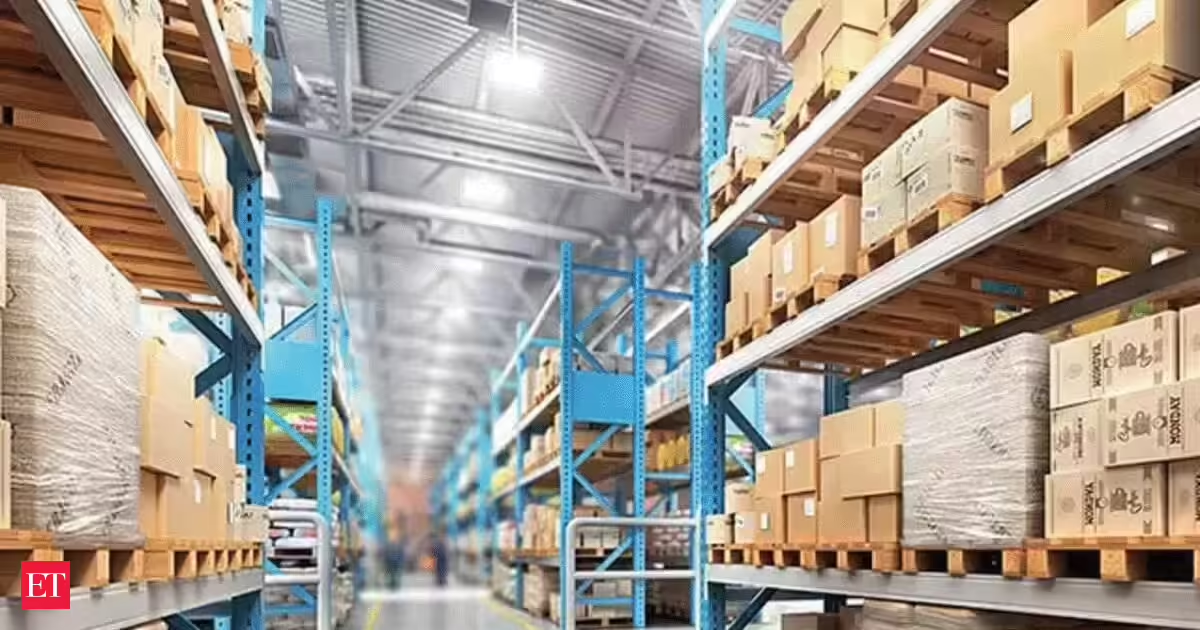
As India increases its investments in logistics infrastructure, multimodal connectivity, and digital supply chains, global logistics major Kuehne+Nagel says the country is emerging as one of the world’s most important supply chain hubs. In an interaction with The Economic Times Digital, Eduardo Razuck, Executive Vice President-Contract Logistics and Member of the Management Board at Kuehne+Nagel, spoke about India’s growing strategic importance, the company’s technology investments, warehousing expansion plans, geopolitical disruptions, and more. Edited excerpts:ET: What brings you to India on this visit?Eduardo Razuck (ER): This visit to India is important because the country is becoming increasingly strategic for us. It is an opportunity to meet teams on the ground, understand the pace of transformation taking place here, and prepare for the future growth we expect from the market.ET: How do you view India’s emergence as a global supply chain and logistics hub?ER: India is rapidly becoming one of the most important supply chain hubs in the world. The country has been making substantial investments in infrastructure and logistics connectivity, and we believe its role in global supply chains will become even larger over the coming years.A strong logistics ecosystem requires both private and public investment. Companies like us continue investing in warehousing, technology, and customer solutions, while governments need to create enabling infrastructure and policy frameworks. India is moving in that direction quite decisively.We are also seeing major global manufacturers, especially from the US and Europe, increasingly looking at India as a manufacturing and export base. The investments being announced across sectors clearly indicate that India is gaining relevance in global supply chain diversification strategies.ET: Which government reforms, in your view, have significantly influenced logistics and supply chains in India?ER: The National Logistics Policy has been one of the most significant reforms in recent years; along with initiatives such as PM Gati Shakti and Sagarmala, it is improving connectivity, reducing inefficiencies, and strengthening multimodal infrastructure.GST has also been transformative from a supply chain perspective. Earlier, companies often had warehouses in multiple states mainly due to tax considerations. GST has enabled businesses to redesign supply chains more efficiently, consolidate inventories, reduce costs, and optimise their distribution networks. When these reforms are combined with infrastructure investments, India becomes increasingly attractive as a manufacturing and logistics destination.ET: How is Kuehne+Nagel leveraging India as a logistics and manufacturing hub?ER: We are seeing India evolve not only as a domestic consumption market but also as a regional manufacturing and distribution hub. Many global companies are establishing manufacturing lines in India under broader “China-plus-one” diversification strategies. As a logistics partner, we support these customers in moving goods across India and to overseas markets. India’s improving infrastructure and policy ecosystem are creating conditions where companies can manufacture competitively and distribute efficiently to nearby regions and global markets.ET: Kuehne+Nagel has invested significantly in technology and control towers in India. Could you explain their role?ER: Our India control tower is currently the most advanced technology and operations centre we have globally. It plays a critical role in providing customers with supply chain visibility, inventory management, order management, and operational control.The facility is scaling rapidly. We currently have around 250 people there and expect the workforce to grow to nearly 400 by this year. We also operate a dedicated software development centre, with around 150 professionals supporting global customer operations and technology onboarding.The control tower essentially orchestrates the entire supply chain—from the manufacturing facility to ports, warehouses, and final delivery points. It provides customers with real-time visibility into where products and components are across the network.More importantly, it enables predictive decision-making. It is not just about tracking shipments; it is about understanding supply chain performance, identifying disruptions early, and benchmarking operational efficiency against industry peers.ET: How is technology changing logistics operations globally?ER: Logistics is becoming far more data-driven, predictive, and intelligent. Advanced technologies combined with AI are enabling companies to move beyond transactional logistics towards integrated supply chain management.This shift is also reflected in industry benchmarks, such as Gartner’s Magic Quadrant, a globally recognised assessment that evaluates companies based on their ability to execute and the completeness of their vision. Kuehne+Nagel was positioned as a ‘Leader’ in Gartner’s Magic Quadrant for Third-Party Logistics and integrated logistics capabilities, reflecting its strength in combining technology, operational scale, and supply chain visibility solutions. Customers increasingly want resilience, predictability, and benchmarking capabilities. They want to know how their supply chains compare against market standards and where they can improve efficiency.ET: How are geopolitical tensions impacting logistics strategies globally for your operations?ER: Geopolitical disruptions have become more frequent in recent years. Since the pandemic, companies across industries have learned the importance of resilience and adaptability.At Kuehne+Nagel, our focus is on helping customers navigate uncertainty. Through our control towers and integrated logistics solutions, we provide alternative routing options, multimodal transportation strategies, and real-time updates during disruptions.In periods of geopolitical stress, customers prioritise reliability and continuity of essential products. Our role is to ensure supply chains remain operational and adaptable under changing conditions.We continuously update customers about available routes and logistics alternatives through our digital platforms and communication channels. ET: What is your outlook on India’s warehousing sector?ER: India’s warehousing market has evolved significantly and still has enormous growth potential. Currently, Kuehne+Nagel operates around 500,000 square metres of warehousing space in India. Our roadmap is to nearly double this to about 1 million square metres by 2030. The country’s size and regional diversity require a distributed warehousing network. Companies need multiple nodes across the north, south, east, and west parts of the country to serve customers efficiently. We are already planning major expansions, including a new logistics hub in Bengaluru and another large facility in Mumbai over the next 12 months.ET: Which sectors are driving growth for Kuehne+Nagel in India?ER: We have a strong focus on healthcare, consumer goods, and technology. These sectors are expected to see sustained growth due to India’s demographic trends, rising consumption, and digital transformation.We are also seeing increasing opportunities linked to cloud infrastructure and data centre supply chains. Currently, we support the movement of equipment and cargo for these facilities globally, and we expect warehousing and distribution opportunities around data centres to expand further in India.ET: Which regions within India do you see as future growth engines?ER: Growth is no longer restricted to metro cities. Tier II and Tier III markets are becoming increasingly important due to rising consumption and industrial activity.Cities such as Lucknow, Rajpura, Nagpur, and Guwahati are emerging as important logistics nodes. We are expanding into these regions because customer demand is increasingly coming from beyond the traditional metropolitan centres. However, these facilities primarily focus on serving domestic demand rather than acting as export hubs for neighbouring countries.ET: What lessons can India draw from global logistics leaders, such as Singapore, China, and Mexico?ER: India does not need to replicate any one country’s model, but it can certainly learn from successful examples globally. Singapore succeeded by building world-class connectivity, policy consistency, and ease of trade. China invested heavily in infrastructure and manufacturing ecosystems over many years. Mexico became a major export hub due to its integrated trade and manufacturing framework with the US.The key lesson is consistency in execution. Infrastructure and logistics reforms need long-term continuity to create real impact. Governments play a crucial role in facilitating investment, simplifying trade, and enabling industrial growth.India is already moving in the right direction, and if policy execution remains consistent, the country has the potential to become one of the world’s most influential logistics and manufacturing hubs.ET: Finally, what is Kuehne+Nagel’s long-term commitment to India?ER: We are fully committed to India and will continue investing aggressively in the market. We believe India will become one of the largest and most important logistics markets globally over the next decade, driven by trade agreements, infrastructure upgrades, manufacturing growth, and rising domestic consumption. As these trends accelerate, demand for warehousing, transportation, integrated logistics, and technology-driven supply chain solutions will continue to grow, and we intend to be a major part of that journey.
Why Kuehne+Nagel is betting big on India’s supply chain ambitions
The global logistics major says it will double its warehousing capacity in India by 2030, as it sees the country emerging as one of the worlds key supply chain hubs.
1,327 words~6 min read