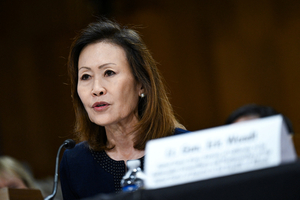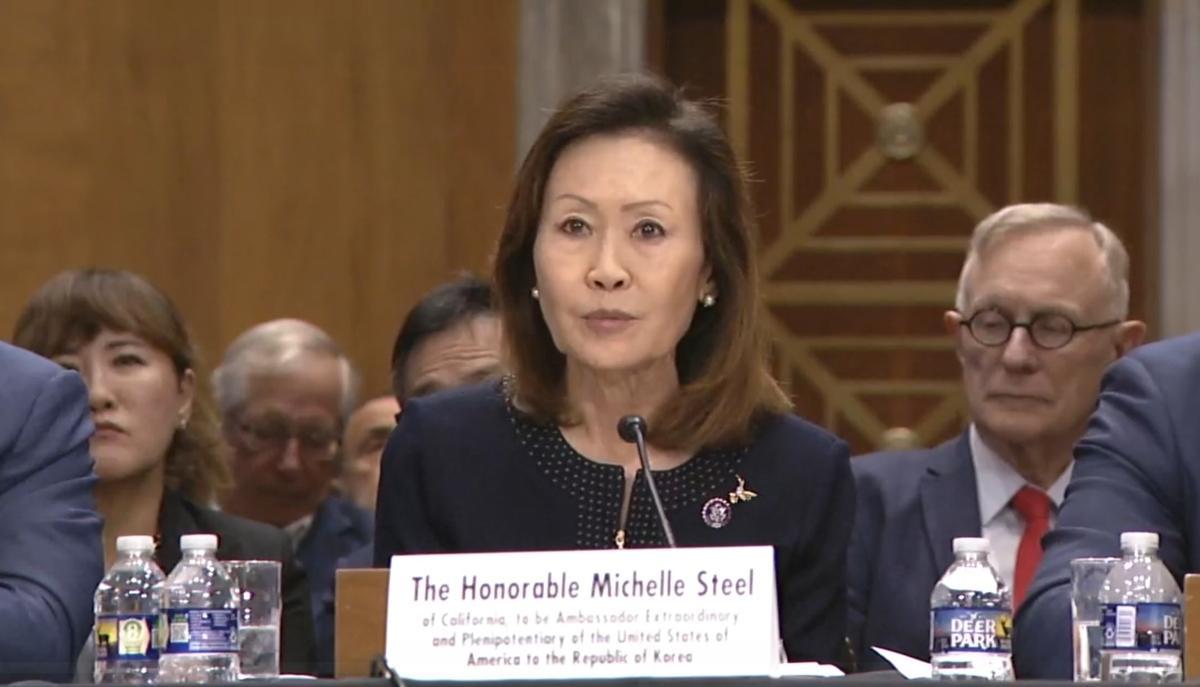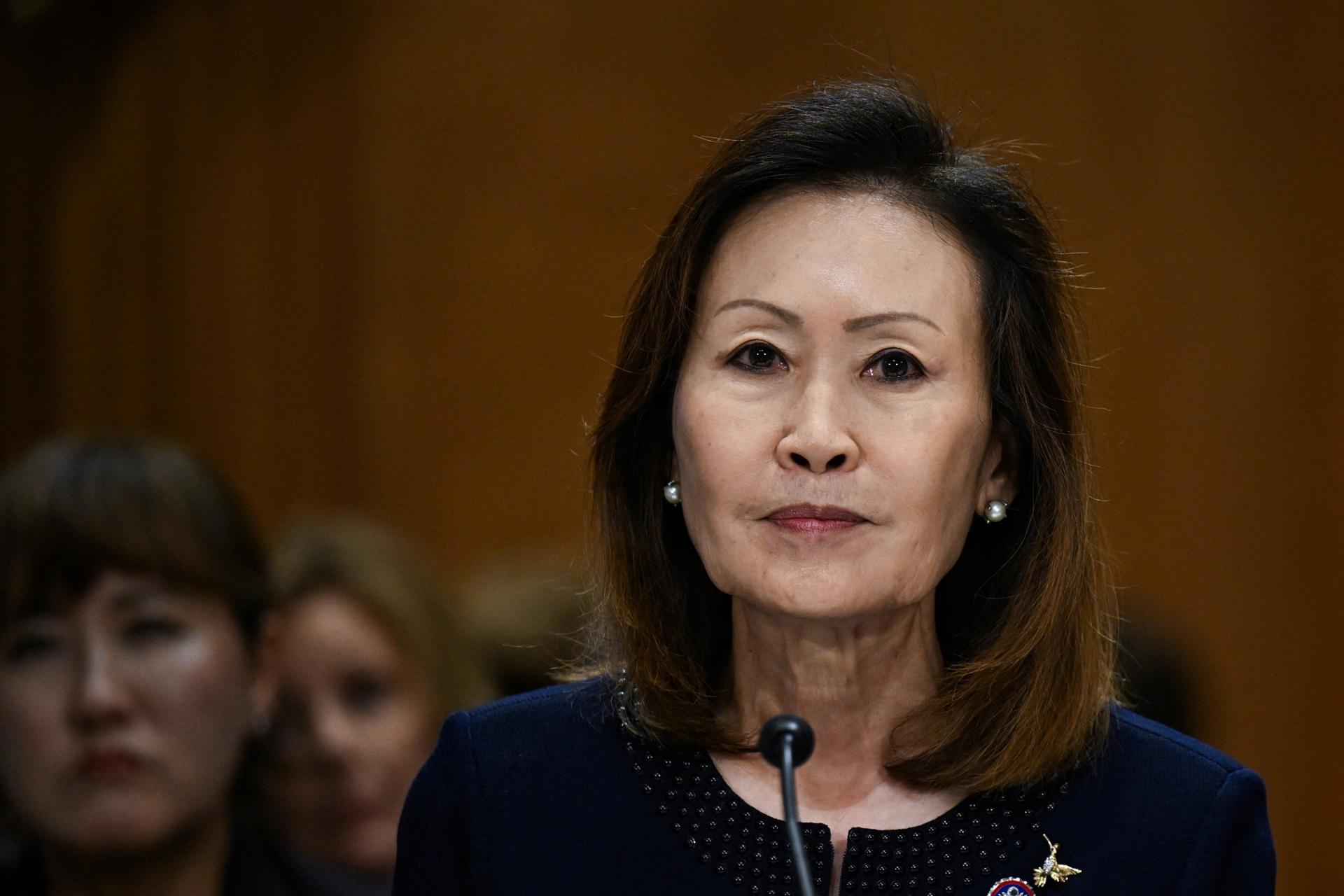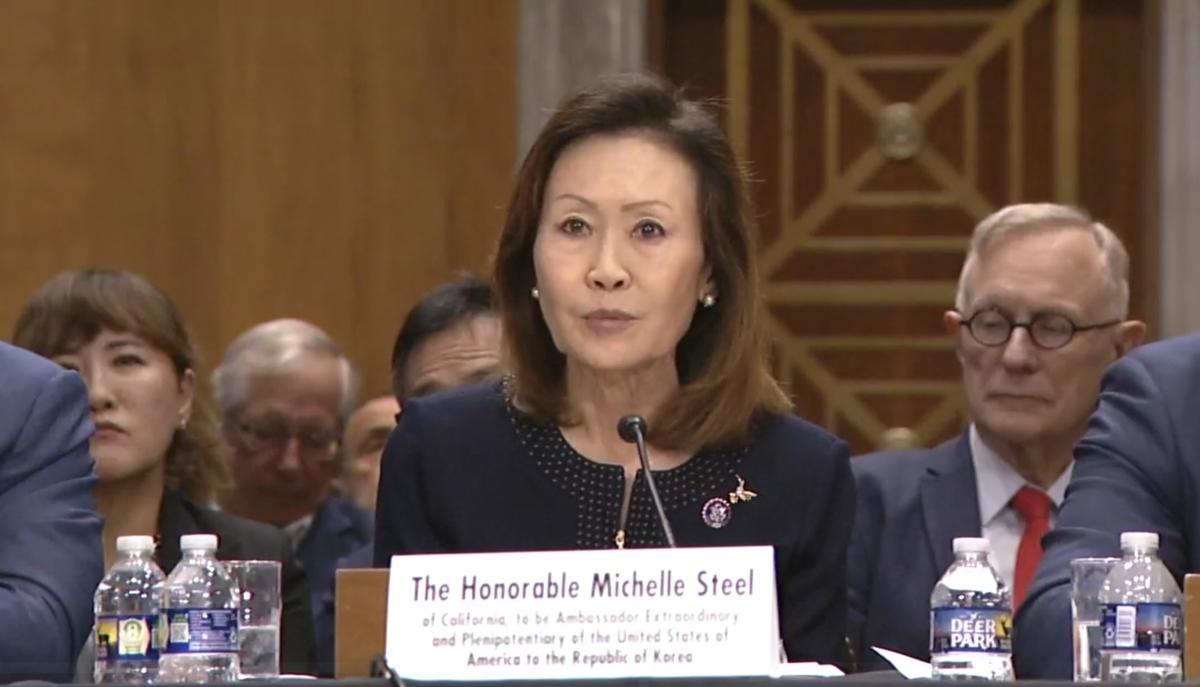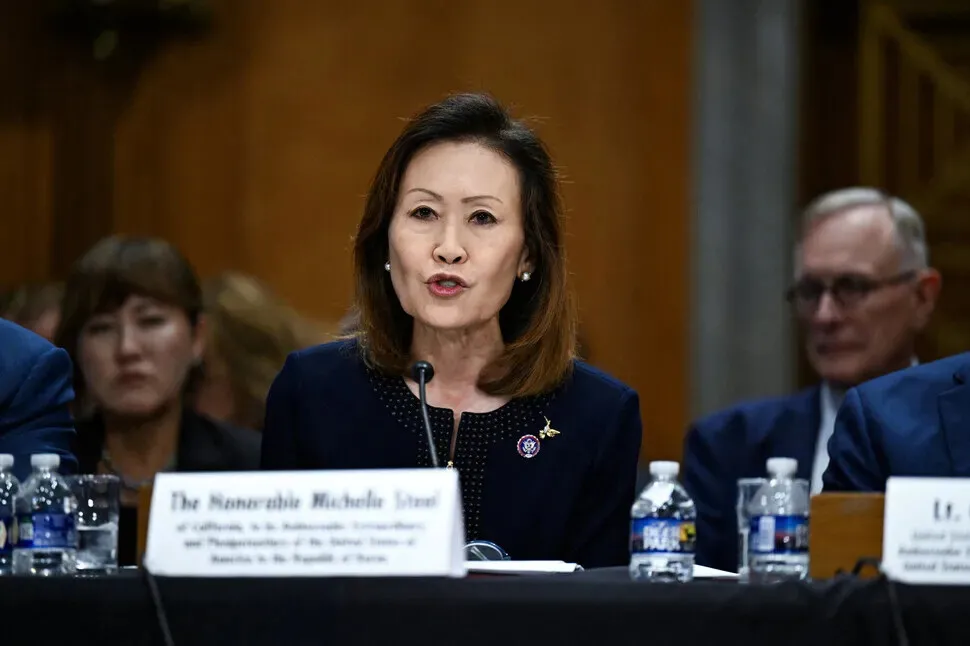
Michelle Steel, the nominee to serve as US ambassador to South Korea, testifies at her confirmation hearing before the Senate Foreign Affairs Committee on Capitol Hill in Washington, DC, on May 20, 2026. (Reuters/Yonhap)
Michelle Steel, the nominee to serve as US ambassador to South Korea, said Wednesday that US firms operating in South Korea should not be subjected to discrimination, promising to follow up on such issues with the Korean government if confirmed. Key topics addressed during her confirmation hearing included concerns over discrimination of US firms operating in South Korea, such as Coupang, non-tariff barriers on US agricultural products, and the measures for the implementation of South Korea’s US$350 billion investment in the US. “American companies operating in Korea deserve the same market access that Korean companies enjoy in the United States,” Steel said during her confirmation hearing before the US Senate Foreign Relations Committee that day. Referencing the joint fact sheet signed by the leaders of South Korea and the US last year, Steel said that the two countries “made it very clear that US companies cannot be discriminated [against], nor are they going to have unnecessary barriers.” “All the Korean companies here in the US, they get equal treatment, and I think US companies in South Korea have to get equal treatment too,” she continued. The comment was made in response to Sen. Bill Hagerty (R-TN), who voiced concerns about the treatment of certain US technology companies, including Coupang, in South Korea. “Some of our technology companies [. . .] seem to be discriminated against in South Korea,” Hagerty stated, telling Steel that he would “very much appreciate [her] attention to those matters [. . .] to make certain that all US companies, technology companies and alike, are not treated in any way differently. Not just from South Korean companies, but, for example, Chinese companies.” Steel replied by saying, “If I get confirmed, yes, I am going to follow up with that very clearly.” Problems related to the market access of US agriculture were also raised. Sen. Pete Ricketts (R-NE) cited non-tariff barriers South Korea has on US agriculture and the reduced trade rate quota for US soybeans, asking that Steel ensure that South Korea upholds the agreement it made with the US to ease non-tariff barriers. In response, Steel said that, if confirmed, she was “going to sit down with the Korean government and whoever is in control of these trade issues” regarding soybeans and other agricultural products. Steel also made clear her intention to confirm more specific implementation measures for South Korea’s promised investment in the US. While mentioning the US$350 billion that South Korea has pledged to invest, she stated that she wanted to “see exactly where that’s coming from.” She also brought up how South Korea’s US trade surplus is over US$50 billion, stating that if she is confirmed, she will come up with measures to ensure that the US can export more to South Korea. Sen. Jeanne Shaheen (D-NH), the ranking member of the US Senate Committee on Foreign Relations, criticized the lack of transparency on Korea’s US$350 billion pledged to the US. When Shaheen requested that Steel commit to sharing relevant information with the Foreign Relations Committee, Steel replied that she would. The hearing also stressed the importance of the South Korea-US alliance when it comes to military and security cooperation. Sen. James Risch (R-ID) said in his opening remarks that “in many ways, South Korea has been a model ally for the US,” while noting that cooperation in shipbuilding, semiconductors, artificial intelligence, and nuclear energy should be expanded.Shaheen also mentioned how the US should demonstrate concrete proof to bolster its pledge to its allies in the Indo-Pacific, stating, “Allies like South Korea are watching closely to see whether American commitments remain firm.” During her opening testimony, Steel stated, “For more than seven decades, the alliance between the US and the Republic of Korea has served as the linchpin of peace, security, and prosperity in Northeast Asia.” “Our combined defense posture, anchored by the 28,500 members of the US Forces Korea and reinforced by America’s extended nuclear deterrent, remains ironclad,” she continued. “Our governments cooperate closely to respond to the DPRK’s unlawful weapons programs, its expanding cybercrime operations, and its deepening military cooperation with Russia.” “We are strengthening a vital trilateral partnership alongside Japan to defend a free and open Indo-Pacific,” she also noted. When asked by Risch to state her opinion on the political, social, and economic disparity between the two Koreas, Steel mentioned how her parents fled North Korea during the Korean War. “We all know how many people [suffer] in North Korea. That’s why we need a very strong alliance between the US, Japan, and South Korea. It’s not just [about] protecting South Korea, but protecting all [of] the Indo-Pacific region,” she replied.Sen. Tim Kaine (D-VA) referenced the Korean American Divided Families National Registry Act, which he co-sponsored with Steel when she was in the House of Representatives, and said he hoped she would prioritize the issue of divided families despite strained relations between the two Koreas. Steel did not provide a separate response to Kaine’s comments, but she was deeply invested in this issue as she introduced the bill during her time as a congressperson. US President Donald Trump nominated Steel as US ambassador to South Korea on April 13. Steel, 70, whose Korean name is Park Eun-joo, was born in Seoul in 1955 and migrated to the US in 1975. Since then, she served as a member of the California State Board of Equalization and the Orange County Board of Supervisors before serving as a Republican congressperson from 2021 to 2025. Steel must be confirmed by the Senate Foreign Relations Committee and the full Senate before she can serve as US ambassador to South Korea. The US ambassador to South Korea position has been vacant for over a year since the retirement of the previous ambassador, Philip S. Goldberg, in January 2025.By Kim Won-chul, Washington correspondentPlease direct questions or comments to [english@hani.co.kr]