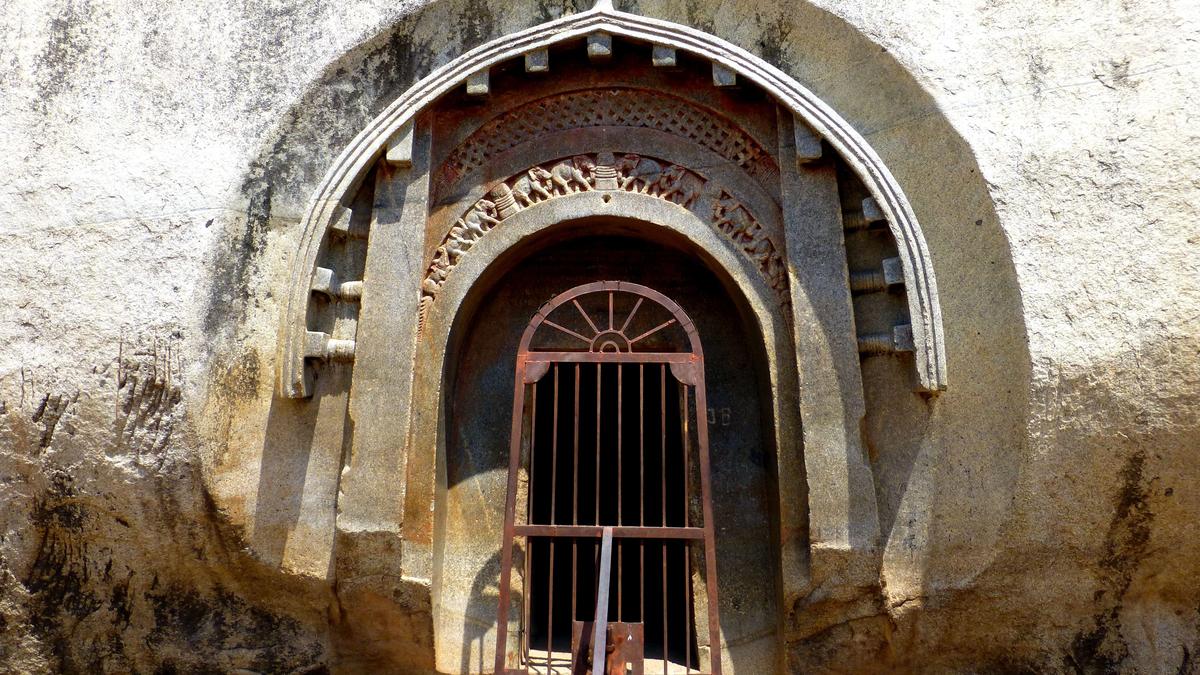
One of the most striking experiences near Rajgir in Bihar lies inside the Barabar Caves. The walls are polished to such perfection that they are like mirrors. These surfaces were carved and finished over 2,300 years ago, yet they still reflect light with startling clarity, as if time has barely touched them. This sheen, often described as Mauryan polish, hints at how the pillars of Maurya kings once looked — smooth, luminous, and authoritative.The Barabar caves are among the oldest surviving monuments in India, yet they rarely occupy public imagination. They stand overshadowed by the more celebrated Ashoka pillars, crowned with lions and inscribed with imperial messages. But the caves tell a quieter, more complex story.
Devdutt Pattanaik inside Barabar Caves
| Photo Credit:
Courtesy Devdutt Pattanaik
These are not monuments of conquest or governance; they were spaces dedicated to a group of hermits known as the Ajivikas. This is known because inscriptions in early Brahmi script are carved onto the cave walls. Ironically, the script appears rough, even intrusive, against the flawless polish of the stone, as if human language struggled to match the perfection of the surface it marked.