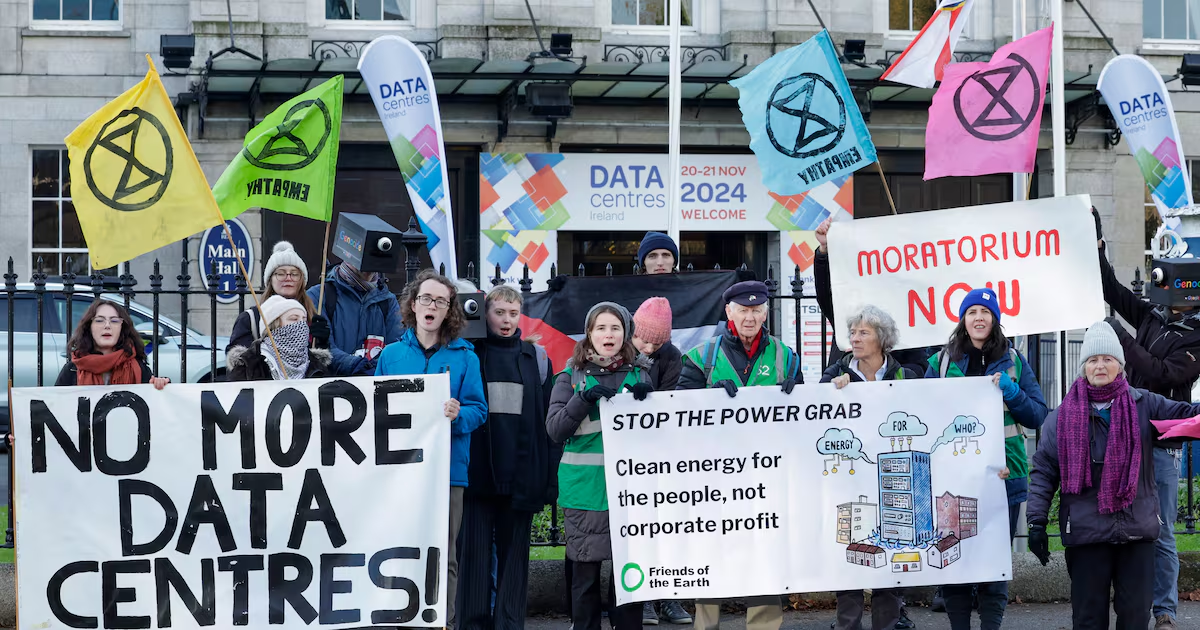
The hype around artificial intelligence (AI) emphasises the positives: AI will increase productivity and profits, make medical advances, accelerate breakthroughs in research, revolutionise education ... the list goes on. Some even claim AI will help solve the climate crisis.While AI is supposedly transforming society for the better, some privileged actors – including tech-bro billionaires and big tech companies – are reaping huge financial gains. The Irish Government is contributing to the AI hype by rapidly expanding the data centre infrastructure on which AI depends and by promoting the use of AI throughout Irish society. Ireland’s National AI Strategy aims “to make sure AI is here for good”, and Minister for Higher Education James Lawless argued in a recent opinion piece (written with the help of AI) that all Irish workers should be learning to use AI tools.But one important aspect of AI that big tech companies (and Government Ministers) do not appear to want us to learn about is its disastrous climate impacts. The data processing involved in every AI application requires energy-hungry data centres powered primarily by fossil fuels. At a time when worsening climate vulnerabilities require an urgent phase-out of fossil fuels, AI and its data centres are causing a devastating increase in polluting fossil-fuel use. The exponential and seemingly never-ending growth in energy demand is accelerating climate chaos and negating decades of climate policy designed to reduce both energy use and carbon emissions.The scale of AI’s energy demand is incompatible with a healthy, climate-stable future. Even if some data centres are powered by renewable energy instead of fossil fuels, the huge increase in electricity demand is destabilising energy systems, worsening energy poverty and exacerbating climate vulnerabilities among those already marginalised.The explosive growth of data centres around the world has eliminated the possibility of meeting the legally binding commitments of the international Paris climate agreement. Ireland, one of the data centre capitals of the world, is now home to more than 120 data centres, with more planned. Data centres, currently devouring 22 per cent of Ireland’s electricity, are projected to use 30 per cent by 2030. This mushrooming energy demand is straining the grid, reinforcing fossil fuel lock-in and contributing to the highest electricity prices in the EU. The surge in data centres is not only preventing Ireland from meeting our climate targets, but it is also triggering controversial proposals for Ireland to end its 1999 ban on nuclear power.[ Ireland should ‘examine seriously’ nuclear power option, says TaoiseachOpens in new window ]But why do we not hear more about the disastrous climate impacts of AI? Just as the fossil fuel industry strategically invested for decades in climate obstruction denying climate science, delaying climate policy and sabotaging climate action around the world, tech companies such as Amazon, Google, Microsoft, Meta, OpenAI and Anthropic downplay ecological impacts of their data centres and strategically invest in influencing policymakers, universities and the media to delay regulation aimed at protecting ecological health and the public good.The tech industry is also partnering with fossil fuel companies to develop AI tools to extract more fossil fuels quicker and cheaper. Once considered green, it is now clear big tech is not clean.Intentional obfuscation of the disastrous climate realities of AI is a necessary part of promoting the uncritical adoption of AI throughout society. The speed and intensity with which AI tools are being pushed on us create a distraction from consideration of ecological harms. In addition to electricity, data centres use huge amounts of water for cooling, and the massive warehouse-like buildings contribute to biodiversity loss as well as community disconnection wherever they are built.But who has time to think about climate, water, biodiversity and community when our governments, employers and educational institutions urge us to focus on learning how to use our new AI tools? Despite the industry’s efforts to squash concern about the devastating climate impacts of AI, resistance is growing here in Ireland and around the world. Across higher education institutions, faculty, staff and students within the Climate Justice Universities Union are challenging the narrative of inevitability and rejecting the uncritical adoption of AI in teaching, learning and research. Communities are organising to block new data centres. Journalists are calling out AI harms. Civic society organisations, including Friends of the Earth, An Taisce and others, are calling for a data centre moratorium and a pivot in national priorities away from big tech and fossil fuels. [ What the world can learn from Ireland’s battle to power data centresOpens in new window ]As climate damages and other harms of AI become more clear, the simple message that Irish Times columnist Fintan O’Toole offered at a recent Trinity College public event on AI resonates well: “Join the resistance!” Jennie C Stephens is professor of climate justice at the National University of Ireland Maynooth and Co-Convenor of the Climate Justice Universities Union.
Artificial intelligence spells a real climate disaster
Despite the tech industry’s efforts to squash concern about the devastating climate impacts of AI, resistance is growing
807 words~4 min read