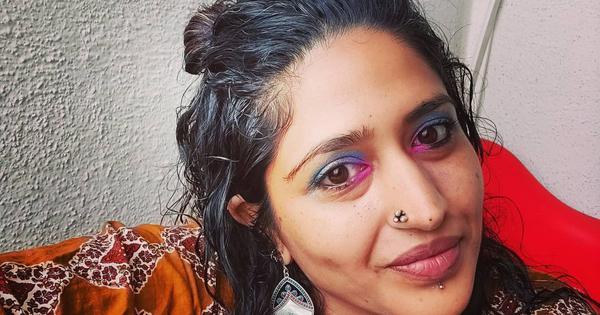
Sanch is good-looking. You can be as self-aware as you want but let’s not pretend: people who look and speak a certain way get treated better. She has cherubic cheeks, a neutral, aspirational Indian English accent and a broad, disarming smile. She is fair-skinned. And she knew how to wield it. She is also witty, righteous and fluent in the vocabulary of justice. She defended trans rights, sex workers, marginalised castes and animals with the kind of conviction that made people stop scrolling. And then there is her tragedy. Her life was already a slow-burning heartbreak. That’s the uncomfortable part to admit, how tragedy gets filtered through palatability. We’re more likely to want to save someone if they meet certain metrics. Do they look a certain way? Speak a certain way? Present with just enough vulnerability to feel noble but not so much it makes us squirm? Sanch hit all those notes. Social-justice Instagram is obsessed with deconstructing oppression like peeling an onion: remove the layers to reveal class, caste, colour, fatphobia, disability, chronic illness, mental health. But in practice, we still engage primarily with our class peers. The rest? The delivery person. The domestic worker. The auto driver. Even within our class, hierarchy thrives. Who speaks polished English? Who looks good while protesting? Who tweets the right take first? That’s why genocides happen with barely a murmur, why white school shooters aren’t terrorists, just “troubled”. Why an upper-caste woman’s rape floods headlines while a Dalit woman’s barely gets a whisper. Aesthetics, tone, class signalling: it’s all coded into our empathy. It’s shrunk. We’ve become fluent in the choreography of oppression but clumsy at the actual business of feeling it. bell hooks told us love is nothing without practice, but we’ve settled for performative tenderness, the kind that photographs well. Susan Sontag reminded us that seeing suffering does not guarantee an ethical response, that attention can slide into consumption. Kancha Ilaiah Shepherd pulled the tablecloth off polite tables where caste slips in, uninvited but always seated. Gail Omvedt mapped revolutions as lived, breathing struggles – work that has since reached newer, previously uninitiated audiences, even as it is thinned out, softened, and made legible through the language of shares, captions and comfort. We’ve grown articulate in the ways of pain, somewhere along the way, forgotten how to sit with grief without turning it into an accessory. Every day is either a self-flagellation of privilege or performative outrage. No one’s got time for complexity. No one’s got patience for repair. “That’s what upper castes are like, I guess. Only their oppression is relevant.”Sanch had texted me that in June 2023, while defending a friend from a marginalised caste. I agreed with her. But these conversations with Sanch weren’t surface-level. Not in the circles we swam in. These were the kinds of conversations that demanded you flay your ego, unlearn your schooling and question your place in every room you enter. We were both animal-rights advocates. Vegans. Sanch and a few other anti-caste vegans (a tiny faction of an already small minority in India) had a lot to say – sharp, needed stuff – about rejecting white/savarna veganism while still maintaining that nuance, caste analysis and structural critique mattered. They weren’t trying to win mainstream approval. They were trying to build an ethic that felt lived. The problem? Nobody likes vegan propaganda. I’ve always hated the standard playbook – the depoliticised, shame-bait, crying-cow videos served up as moral superiority. The mainstream vegan narrative is whitewashed, weepy and wildly disconnected from systemic violence. This is because it conveniently erases the people who actually touch animals for a living – migrant workers, Dalit labourers, people in slaughterhouses – whose exploitation runs parallel to the animals they kill. It preaches abstinence from meat without touching corporate supply chains, caste-based labour or food insecurity. It screams about animal cruelty but stays politely silent about indigenous food practices, subsistence hunting or the global south’s complicated relationship with survival and diet. It’s a narrative that demands purity but only from the margins. It forgives the Nature’s Basket shopper but shames the working-class eater. But animal rights have always mattered deeply to me and to many anti-caste activists who recognise how speciesism intersects with caste and labour and how we dehumanise entire groups. Sanch got that. She could argue it down to the bone. She had the receipts, the citations, the moral clarity. She’d point out how savarnas loved to show “solidarity” with Dalit people by eating meat – it was such a convenient, Instagrammable rebellion – but rarely would they trace the actual labour behind the leather industry, the caste lines that tether those who clean, who skin, who scrape. She’d peel it back further, showing how even within humanity we fracture ourselves, as if we were separate species, rejecting those we consider lowly, ugly, disabled, weird. If we can do that to each other, she’d ask, is it so surprising we do it to animals? Isn’t it, in fact, the same fight? At the same time, she’d roast PETA without mercy. She once laughed at one of their ads and said: “Look at this nonsense, don’t eat red meat or you’ll get erectile dysfunction, as if the moral crisis here is about your limp dick.” Even animal rights campaigns, she’d argue, have to pander to health fears and fragile egos to get humans to care. We’ll never get anywhere like that. Unless you are one of those WHATEVER, I’M EATING BACON RIGHT NOW reactionaries, you would not be walking out of those debates feeling smart. In July 2023, Sanch visited me in Bangalore. It would be her second and last visit to my house. She had flown in from Hyderabad. Back then, there were parts of her life that never quite added up but I told myself to file them under “not my business”. For example, she often made mysterious trips to Delhi, citing college applications or visits to friends. The college bit never fully tracked. She already had a political science degree from Jadavpur University. But after her father died, she said she wanted to start from scratch, study psychology, get a new undergraduate degree. In 2023, she moved to Hyderabad to enrol. A few months in, she claimed the college didn’t offer an honours programme and that she’d have to look into options in Delhi. I remember thinking: Isn’t that something you’d check before moving across the country? But Sanch had this cold, clipped energy when you asked specific questions. The kind of tone that made you feel like you were overstepping. And maybe I was, maybe I wasn’t. But with her, the line was always conveniently blurred. I brushed it off as insecurity. Confusion. A young woman navigating her path without parents or money. That made sense to me. The thing was, Sanch could be razor-sharp about other things. Her memory, her research and her opinions were always delivered with unnerving specificity. So, the lack of clarity here should’ve been a red flag. But that’s hindsight. Back then, her precision was her credibility. When someone can tell you, in vivid detail, about a small town in Assam, about a particular tea tribe, about how they exacted revenge on their landowners, it doesn’t occur to you to cross-examine them. One story stuck with me. She described a landowner who adored his dog, fed him three hearty meals a day and treated him better than the people who worked his land. One day, while the landowner was away, a man from the tribe poisoned the dog. Not for survival. Not for some strategic gain. Simply to witness grief on the face of a man who believed he could exploit humans but keep one creature safely in his affections. It’s the kind of story that sits in your gut the wrong way. Why did the dog have to die? But Sanch would make a case for it. This, too, she’d argue, was resistance. She’d admit she felt bad for the dog but insisted the point stood. At the time, I felt rattled yet oddly convinced. I didn’t push. I wanted to believe her. I tried to think that someone who could tell stories with this much precision was probably telling the truth about everything else, too. The specifics didn’t invite more questions. The specifics were the facts. And that was how the gaps stayed hidden. I used to think most people who were out to get you were looking for money. But with Sanch, the money was never for her. Every ask was framed as a donation for “the public”, often something as mundane as buying supplies directly off Amazon. She never hinted at wanting more from me, never pushed for anything odd or indulgent. She didn’t need to. She was – unfortunately – far too smart for a clumsy grab. She wasn’t running a quick con. She was playing the long game.Excerpted with permission Liar, Liar: The True Story of the Social Justice Scammer Who Faked Cancer and Death, Rheea Mukherjee, HarperCollins India.
True story: A victim’s memoir of how a scammer faked cancer and death to deceive thousands
An excerpt from ‘Liar, Liar: The True Story of the Social Justice Scammer Who Faked Cancer and Death’, by Rheea Mukherjee.
1,518 words~7 min read