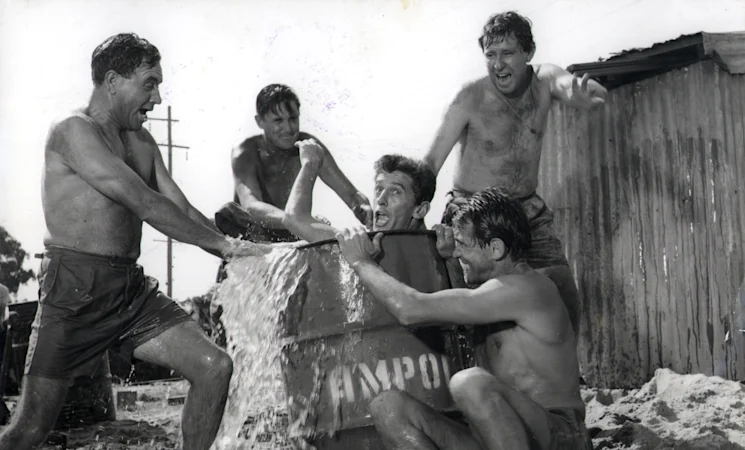
May 21, 2026 — 11:40amAngus Taylor was born in 1966.In that year there appeared on Australian cinema screens a curious comedy titled They’re a Weird Mob.A scene from They’re a Weird Mob.Age ArchivesIt was based on a bestselling book published in 1957 and authored by someone called Nino Culotta, a lovable Italian immigrant who arrived in Sydney and found work as a brickies’ labourer.He discovered the Australian vernacular was nothing like the English he’d learnt from a book, but after much struggle, Nino won acceptance by learning to shout “howyergoinmateorright?”The book ended with a message for other immigrants: they should count themselves fortunate and bury their previous lives.“There are far too many New Australians in this country who are still mentally living in their homelands, who mix with people of their own nationality, and try to retain their own language and customs,” Culotta lectures in the book’s final chapter.The premiere of They’re a Weird Mob at the State Theatre in Sydney on August 18, 1966.Fairfax Photographic“Who even try to persuade Australians to adopt their customs and manners. Cut it out. There is no better way of life in the world than that of the Australian.”Australian readers, about a million of them, lapped it up, and so did cinemagoers in the year Taylor was born.Why, here was a foreigner telling other foreigners that they’d found the greatest place on Earth and they’d better learn how to blend in.John O’Grady in 1959.Sydney Morning HeraldIt could be a textbook for One Nation supporters – and yes, Angus Taylor – today.Except the book wasn’t written by anyone called Nino Culotta.Its real author was a third-generation Australian of Irish descent named John O’Grady.Born in 1907, he’d never written a book until he took a bet and came up with They’re a Weird Mob.It was a fancy cultural deception: an old white Australian appropriating an immigrant voice to argue for assimilation, wrapping the message in comedy.Some critics were a wake-up when the book was turned into a film.The Monthly Film Bulletin of November 1966 observed drily: “Behind the rugged exterior and grating speech of the average Australian, there lies a heart of gold: or so would seem to be the cosy message of this rather patronising tale of how an immigrant makes good in barbarous Sydney (by marrying the boss’s daughter – how else?).”Australia has changed immeasurably since the 1950s and ’60s, but Angus Taylor seems rooted in the comfort of the period as he seeks to out-wrangle Pauline Hanson in the “we’re tougher than thou on immigration” stakes.Here is Taylor speaking this week of his vision for acceptable immigration, which he argues would cause no harm by refusing even permanent residents (who work, pay taxes and purchase property) the benefits he’d reserve only for those with citizenship.“We are a great country. I grew up in one of the greatest immigrant towns in Australia. I grew up in Cooma,” he told reporters in Sydney.“After the Second World War, we saw a wave of thousands and thousands and thousands of immigrants coming to that town to work on the Snowy Mountains Scheme.“It was a brilliant place to grow up, thick accents, lots of different food. We had great cappuccinos before almost any other town in Australia.“It was absolutely incredible. But these people committed to our country, and we committed to them. That is the picture of immigration that has worked for this country. It’s why we are one of the greatest immigrant nations on Earth, and we are deeply committed to that model.”Taylor, who grew up on a large grazing property at Nimmitabel about 40 kilometres from Cooma, certainly knew a bit about the Snowy Mountains Scheme.Taylor’s grandfather, Sir William Hudson, was the chairman responsible for the scheme until he retired in 1967, when Taylor was one. The scheme itself wrapped up in 1972, when Taylor was six.The child’s memory of cappuccinos, exotic food and jolly thick accents, however, is a limited telling of the immigrant experience.Almost all those immigrant labourers came to Australia because they were desperate to escape poverty in countries ruined by World War II. Many came from displaced persons’ camps as refugees.A demonstration at Bonegilla over the lack of work in July 1961. Age ArchivesWhen they arrived at Port Melbourne, wharfies and others loudly protested they would take Australian jobs. They were hurried out of sight and taken by train to migrant reception camps, principally Bonegilla near Albury-Wodonga, formerly used by the Army and surrounded by barbed wire.They were released when jobs became available. Men, whatever their qualifications, got a work stamp that read “labourer”. Women were deemed “domestics”.Many of them and their children suffered for years disparaging epithets like “dago” and worse.In 1952, when migrants were left for months without jobs in huts that were alternately freezing and sweltering, and served endless meals of boiled mutton, protests broke out at Bonegilla, as they did again in 1961. The unrest was deemed a riot. About 200 armed soldiers and several armoured cars were sent to put down the 1952 demonstrations.In the early 1980s, when authorities were poised to obliterate the physical history of the place by bulldozing the old huts, I sought out and interviewed scores of former migrant residents. (A number of huts were later saved to form the excellent museum now known as the Bonegilla Migrant Experience.)The migrants’ quiet side of the story was that the sight of barbed wire and armed soldiers was deeply traumatising to people who had left war-ruined Europe.Little wonder so many flooded to the Snowy Mountains Scheme, despite the hard, dirty and often dangerous work (121 men died in industrial accidents), bringing to Cooma thick accents, a love of coffee and food that was definitely not boiled mutton.And yes, most of them committed to Australia. They enhanced the Australian experience immeasurably, as immigrants continue to do.But Taylor’s immigration model comes from more than half a century ago, when Australia was a monoculture.It wasn’t so long ago that the Liberal Party thought Pauline Hanson’s One Nation was a very weird and nasty mob.Now Taylor is trying to emulate its anti-immigration approach, dressing it up with a misty-eyed nostalgia for an Australia long gone.From our partners
Angus Taylor takes shelter with a weird mob from a fictional past
Liberal leader Angus Taylor is resorting to misty-eyed nostalgia in his attempt to both emulate and outdo One Nation’s approach to immigration.
1,028 words~5 min read