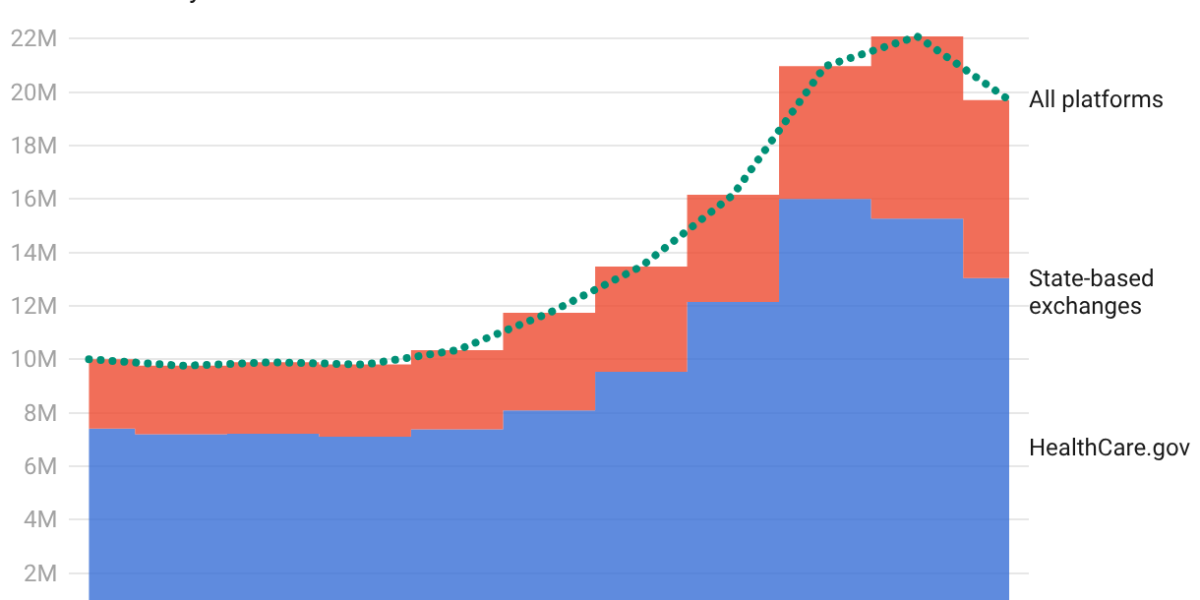
When open enrollment for Affordable Care Act plans closed for 2026, about 23 million people had signed up — over a million fewer than in 2025.That drop was mostly because Congress did not renew the enhanced subsidies which, for a lot of Americans, made buying marketplace insurance a lot more expensive. In recent weeks, state agencies have reported many people who did sign up initially haven’t been paying their premiums.A new analysis from the health policy nonprofit KFF estimated that by the end of the year, nearly 5 million people could end up dropping ACA coverage — a more than 20% decrease. Going into 2026, insurance companies knew a lot of people were likely to drop ACA coverage. It was clear that Congress was not going to extend the extra financial support many people had been getting to buy insurance on the marketplace.Matthew Fiedler, a senior fellow at the Brookings Institution, said they also had a good idea of who was likely to go without insurance: “Past experience shows that when premiums rise, healthier people tend to be the first to drop coverage,” he said.And when lots of people — especially healthy people — do drop coverage, what happens next is simple economics.“If there are fewer people in the marketplace to spread risk across, then insurers have to charge those smaller number of people more in order to provide the services that they're providing,” said Jennifer Sullivan, director of health coverage access at the Center on Budget and Policy Priorities.In fact, costs have already gone up. ACA premiums are nearly 60% more expensive this year than they were last year, on average.And with people continuing to drop out of the marketplace, Sullivan said the premiums are likely to go up again.“So people are squeezed right now, and could be squeezed even more next year,” she said.People who get health insurance through an employer are less likely to see their premiums go up significantly next year.But Sabrina Corlette a research professor at Georgetown University's Center on Health Insurance Reforms said hospitals and providers will likely see costs go up.“As more people become uninsured, they will forgo necessary care, they'll skip prescriptions, and they'll get sicker, and they'll end up in the emergency room,” she said.Hospitals will treat them and, in many cases, will end up footing the bill for those who can’t afford to pay.“As those costs go up for hospitals, these uncompensated care costs, they have to be passed on,” Corlette said.In many cases, she said, they will eventually be passed on to policyholders.
Nearly 5 million people could drop ACA coverage this year, pushing premiums even higher
KFF estimates a more than 20% decline, driven largely by the expiration of enhanced subsidies that made marketplace insurance affordable for millions.
424 words~2 min read