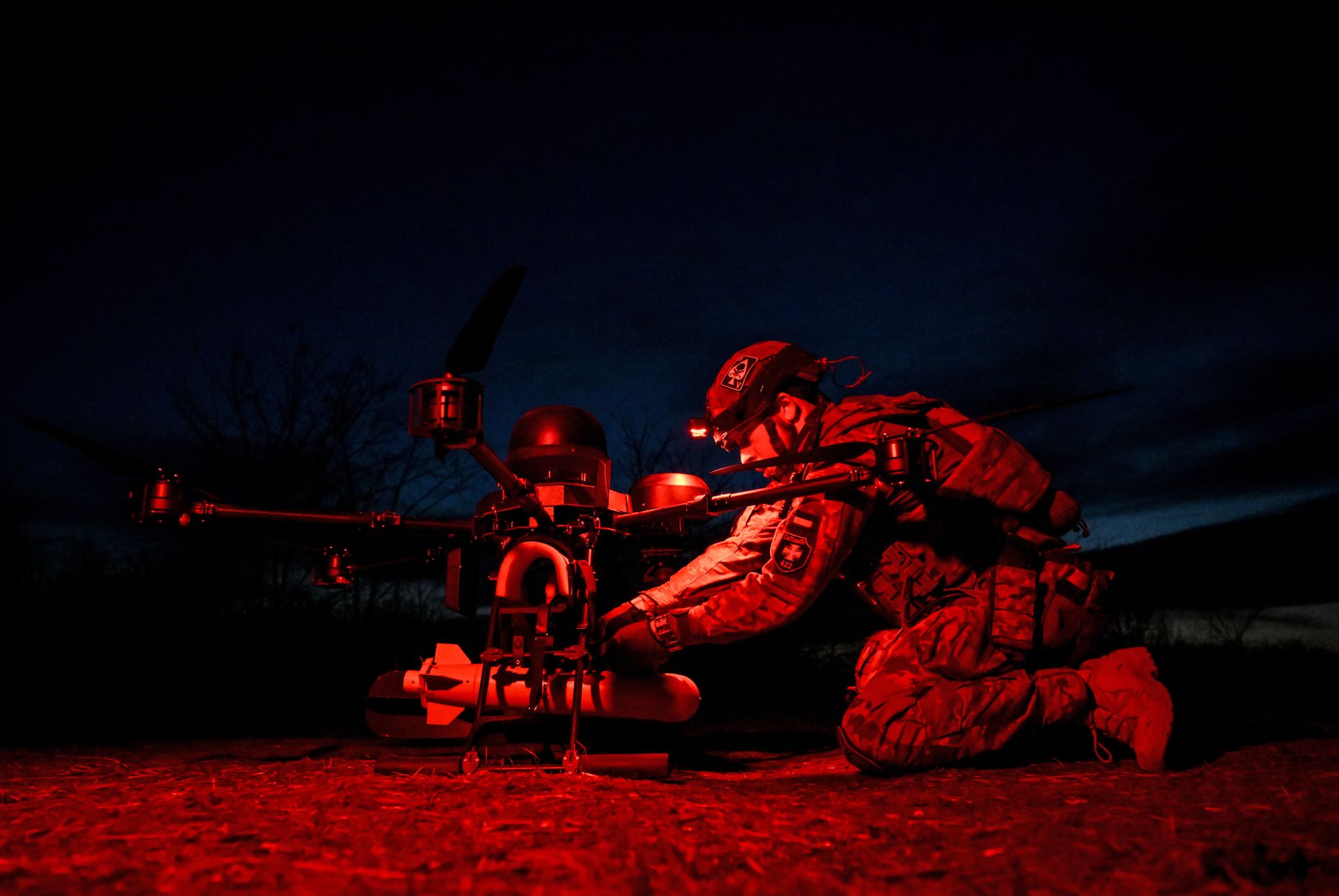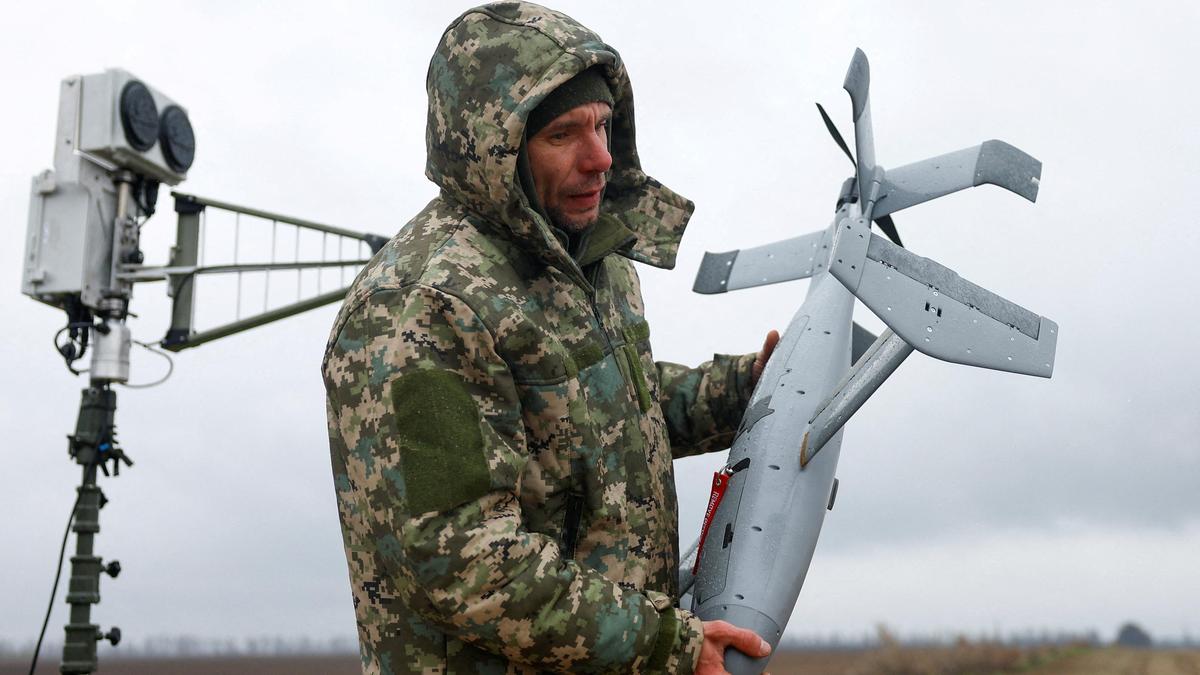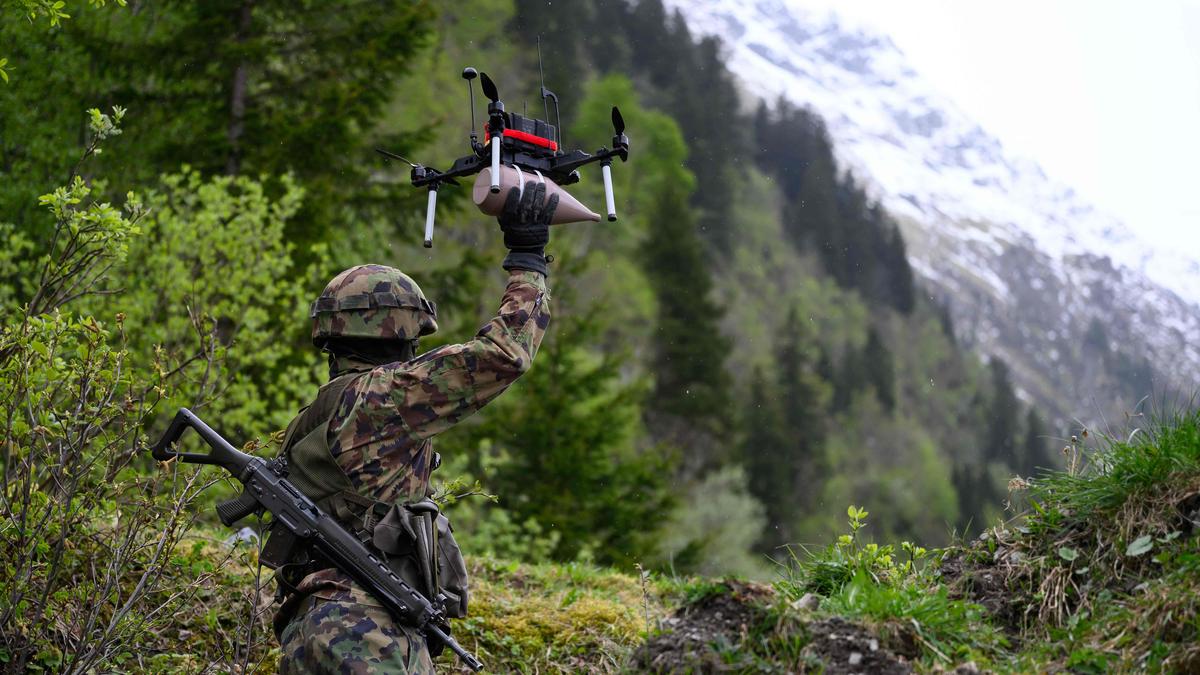
A Swiss soldier with a drone during a demonstration of procedures for deploying mini-drones in combat situations
| Photo Credit: AFP
Operation Sindoor started with a bang at 1.02 a.m. on May 7, 2025 and the surprise ceasefire at 3.30 p.m. on May 10, 2025, was akin to an “out-of-syllabus” event. On the first anniversary, discussion of the four-day engagement between India and Pakistan has been dominated by events concerning India’s long-range strikes on Pakistani terrorist and air force infrastructure; what has been missed out, however, has been the use by both sides of small unmanned aerial vehicles (UAVs), including loitering kamikaze munitions, colloquially referred to as drones.Drones have acquired an outsized image for three reasons. First, there is their aura of being relatively ‘unstoppable’ because their small size makes detection difficult. Second, their relatively low cost vis-à-vis a manned aircraft makes them very appealing to number-crunchers. Lastly, the fact that they do not place a combatant in harm’s way is an argument that undercuts most of their limitations. In the recent past, the advent of fibre-optic-guided first-person-view drones used by Hezbollah against Israel has further added to the hype.So, the question whether drones have revolutionised warfare needs a professional analysis vis-à-vis the basic tenets of warfare through a prism of doctrine and strategy.Doctrinal issuesThe first question is whether the arrival of drones represents a revolutionary change in warfare or merely an evolution enabled by new technology. Evolutionary developments merely enhance existing capabilities, whereas revolutionary technologies fundamentally reshape warfare by opening up new domains. The advent of the air domain was transformational because it revolutionised warfare. UAVs, however, are merely another weapon system — albeit one with unique advantages — that has evolved within the air domain. Second, since drones fly at low altitudes, some strategists have coined the term “air littoral”, suggesting the creation of another domain of warfare unique to drone operations. This is misleading because drones operate within a restricted airspace layer — from the ground up to the coordinating altitude, a pre-designated level that separates fast-moving conventional airpower from slower-moving assets such as helicopters and UAVs. This has forced surface forces to devise methods to protect themselves. In effect, as an essay in the Air & Space Forces Magazine argues, drones are not reshaping air warfare but are actually reshaping ground combat. The importance of attainment and maintenance of air superiority through manned systems, therefore, remains undiminished.Strategic considerationsFirst, the innovative strike by Ukraine, deep in the interior of Russia through drones inserted in specially constructed containers as part of its Operation Spider’s Web, points to a new strategic requirement of possessing good counterintelligence to thwart such long-term strategies in the adversary’s planning stage itself. In the event, the strategic air fleet of Russia had lost many costly assets.Second, such innovative use has shifted the boundaries of kinetic warfare hundreds of kilometres inland. This is akin to a cyberattack that can be launched by anyone, from anywhere in the world, against any target globally. Consequently, a new requirement has emerged to protect assets located deep within a nation’s interior on a 24X7 basis. Incidentally, the United States has introduced new laws restricting the purchase of land by foreign entities near military bases and critical infrastructure.Third, the field of unmanned flight is, in many ways, still developing. The integration of artificial intelligence will bring about an exponential increase in capabilities, leading to fully autonomous operations. Allowing a machine to make life-and-death decisions comes with enormous consequences, and a United Nations committee is currently examining the ethical and moral issues involved.Counter UAS strategyIn warfare, a new weapon brings in counter-measures and counter counter-measures. As more counter unmanned aerial systems (CUAS) are fielded, the drone threat would be addressable to a great extent.In Operation Sindoor, waves of individual drones that had been sent into India by Pakistan were neutralised by an integrated CUAS network. On the other hand, drone swarms that are being developed would be an integration of multiple drones to overwhelm air defence systems by sheer numbers. This is the next challenge, and counter-measures under development would basically be directed energy weapons such as the Israeli Iron Beam laser system which ensures rapid engagement at just $2-$3.50 per laser shot instead of the $40,000 to $50,000 per missile of its Iron Dome system.The Europeans are launching a drone-wall initiative which will use a layered mesh of detection and interception capabilities of drones of European Union member states. The U.S. is planning its Golden Dome system with space based and hypersonic interceptors to address incoming projectiles.It is good that India too is envisaging a nationwide terrestrial and space-based ‘Sudarshan Chakra’ to be in place by 2035 for addressing multifarious air defence threats. That is still at least a decade away and, therefore, such a system would require phase-wise operationalisation along with enormous and committed funding. It is imperative that New Delhi finds the monies to support it.Manmohan Bahadur is a retired Air Vice Marshal and a former Additional Director General of the Centre for Air Power Studies Published - May 21, 2026 12:08 am IST