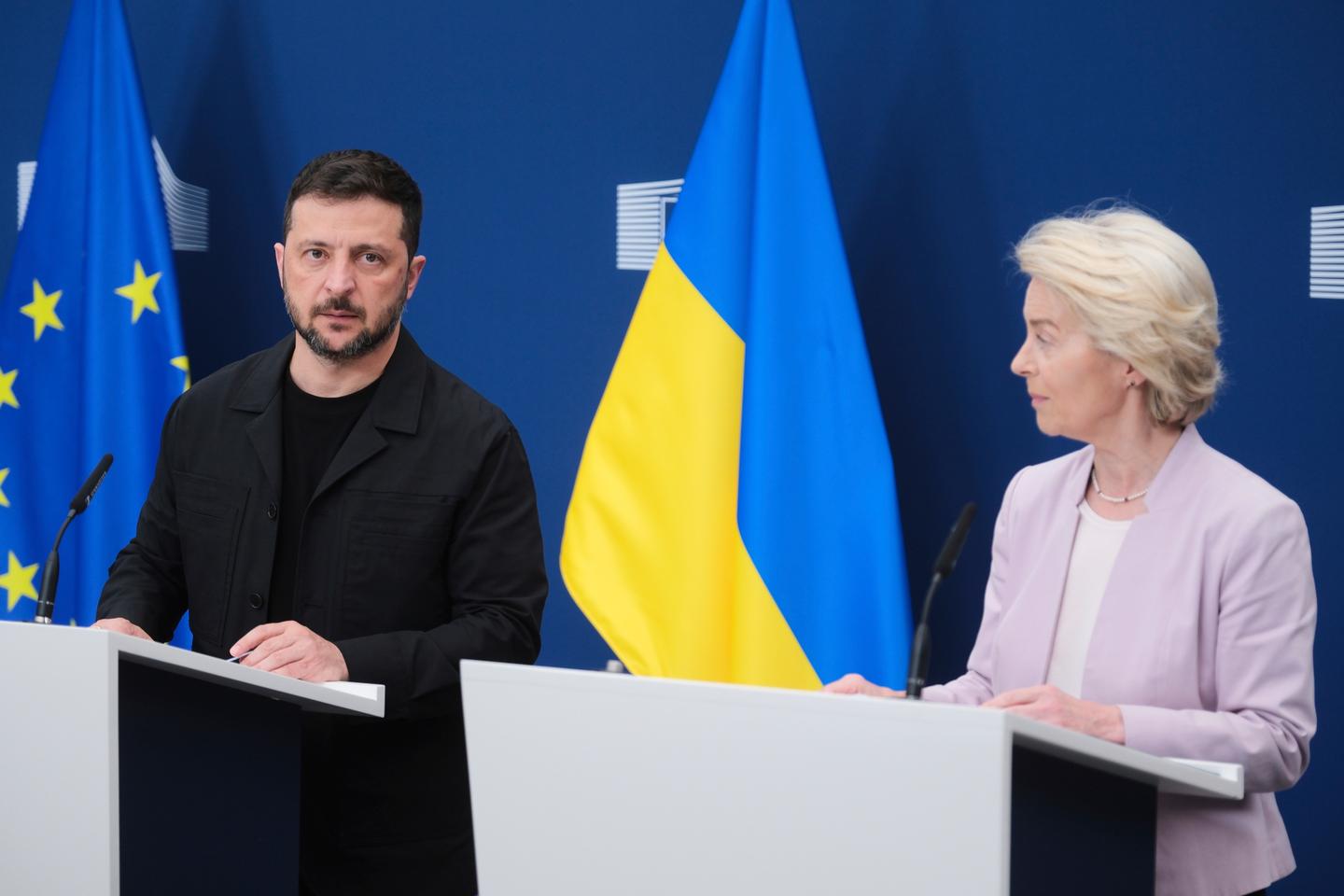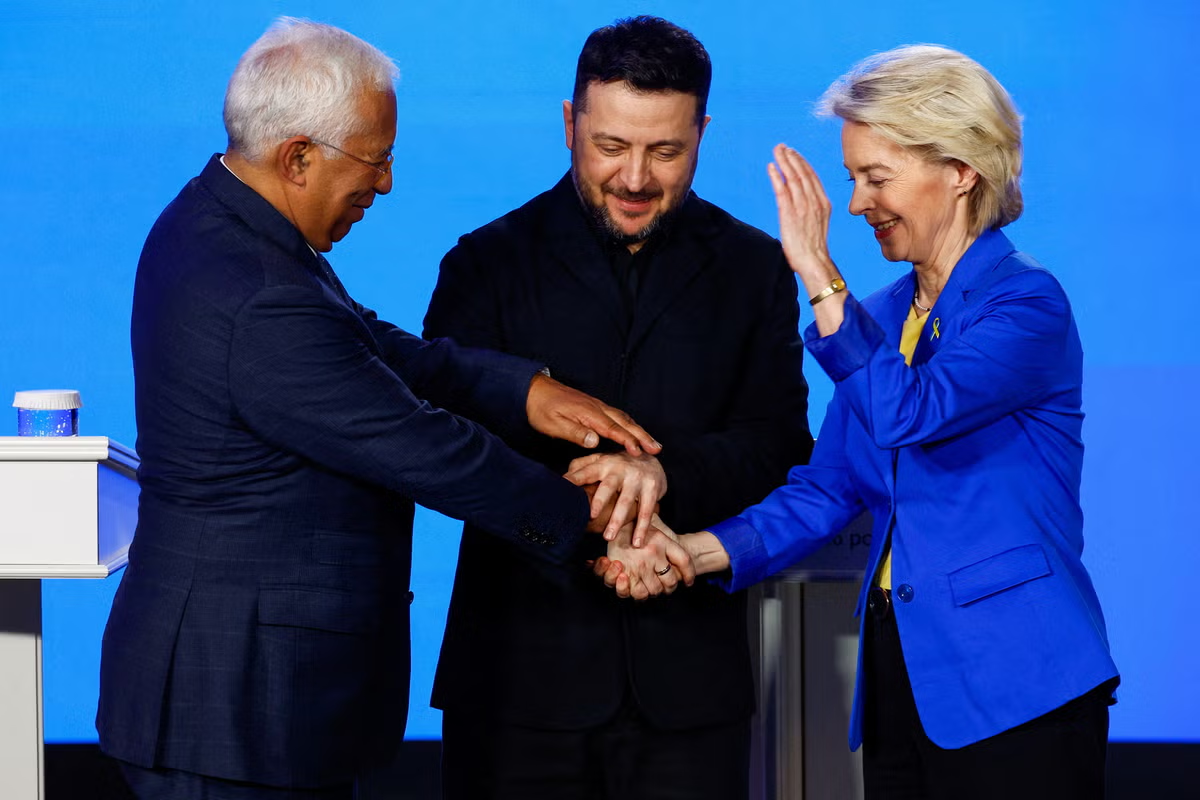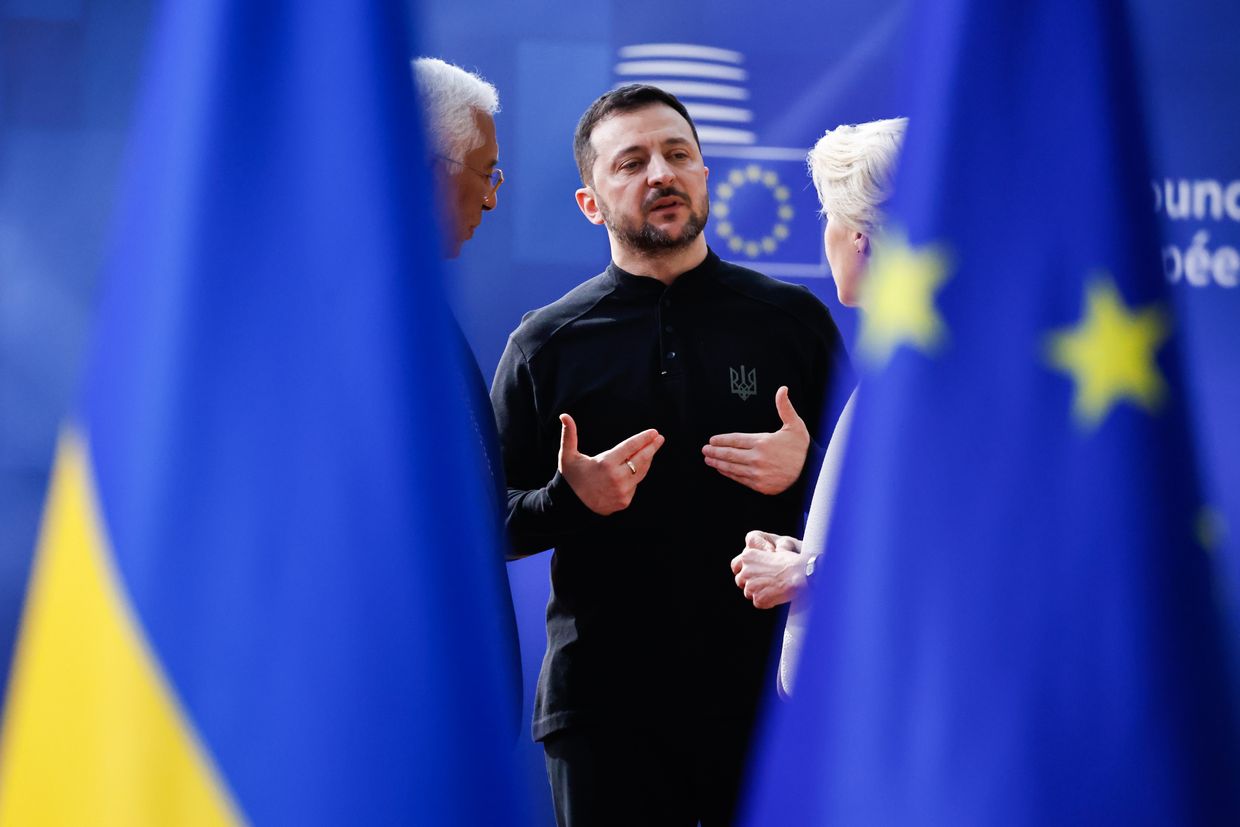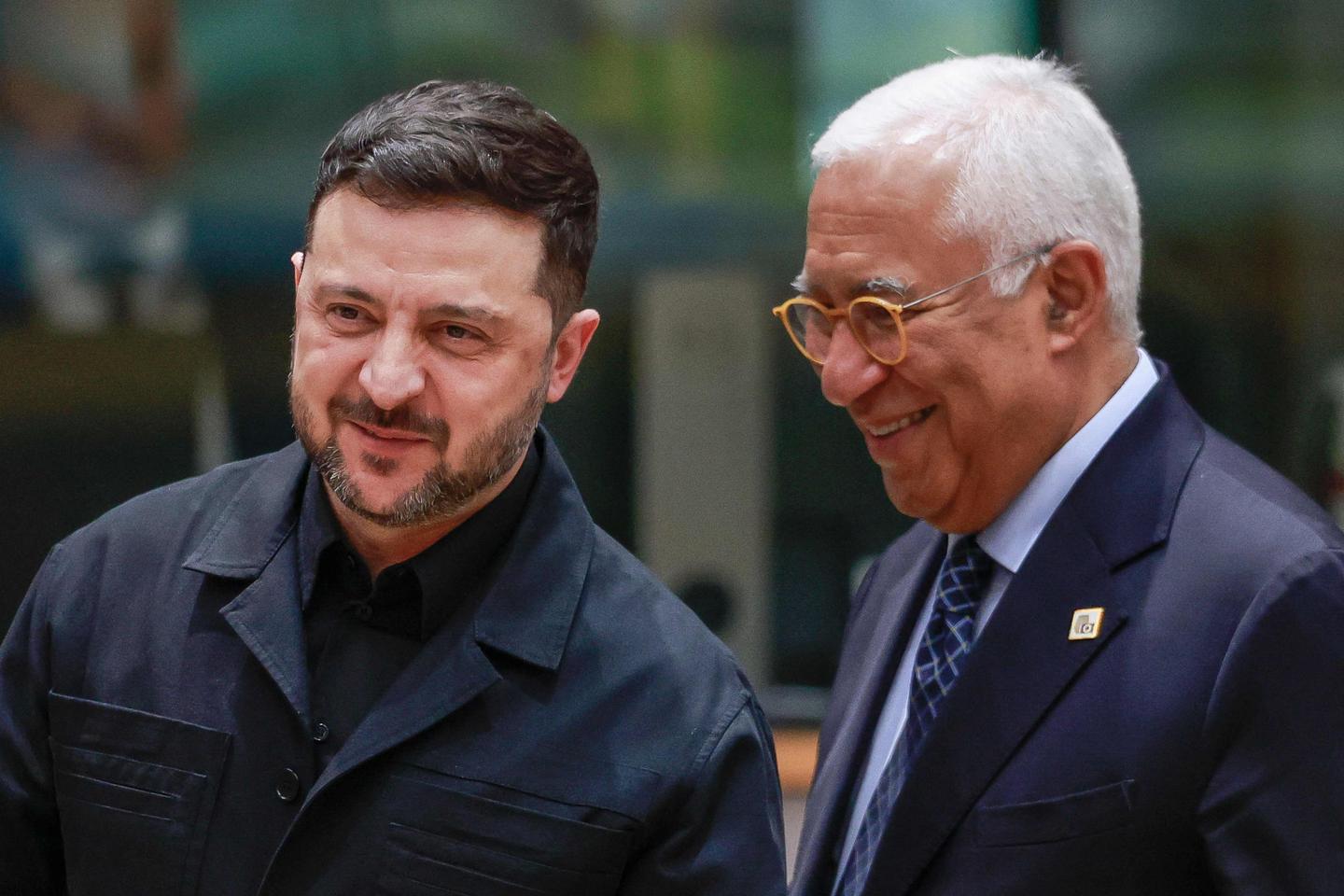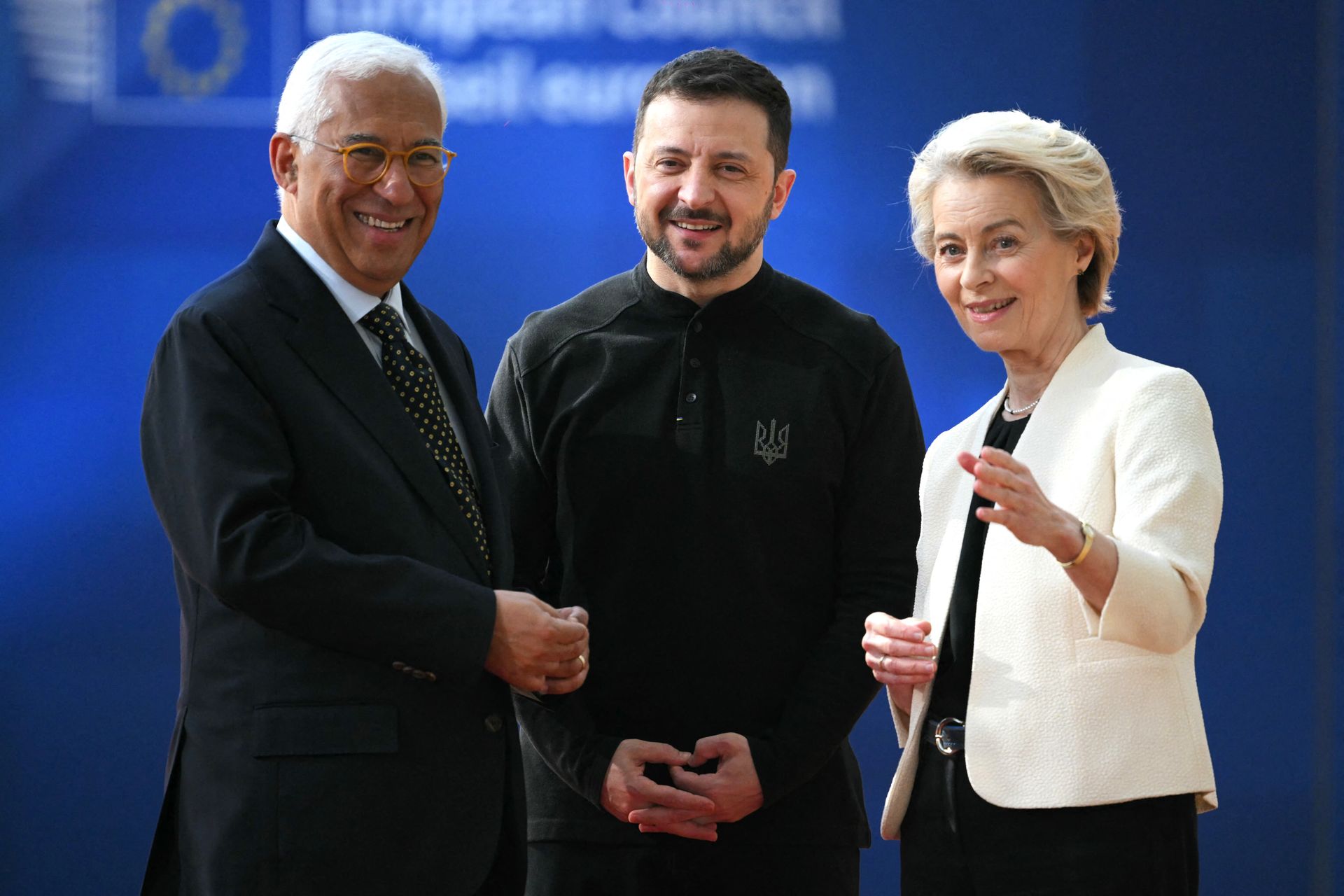
European Council President António Costa (L) and European Commission President Ursula von der Leyen (R) greet President Volodymyr Zelensky (C) at the EU headquarters in Brussels, Belgium, on March 6, 2025. (Nicolas Tucat / AFP / Getty Images)In April, EU leaders voted to grant the bloc permission to provide Ukraine with a 90 billion euro ($110 billion) loan, providing the lion's share of Kyiv's financial needs to both defend itself and keep the lights on. But that money comes with strings attached, and even then it isn't enough to cover all of Ukraine's needs.One of those strings was announced on May 20, with the European Commission telling Kyiv that it needs to improve its revenue collection through a series of unpopular tax changes to receive the first tranche of roughly $8 billion in macro-financial assistance.If successful, Kyiv can expect a first package of 3.2 billion euros ($3.7 billion) in June this year, the Commission said.The long road to approving the loanThe EU's top diplomat, Kaja Kallas, has always considered the 90 billion loan ($110 billion) a plan B. Plan A, for her, was the European Commission's proposal in late 2025 to repurpose the 185 billion euros ($215 billion) of immobilized Russian assets in the EU into direct financial support for Ukraine.The EU wanted to provide Ukraine with two years of financial planning security, until 2028, at which point there would be a brand new multi-year EU budget. The Commission's first proposal for that budget also includes 100 billion euros ($116 billion) in support for Ukraine.It also arrived in a new context, in which it became evident that the U.S. would no longer be providing any new assistance to Ukraine with the Trump administration in place. While Europe still hopes that other like-minded countries will step in to help, it has become clear that Ukraine's financial viability will, from now on, depend on Brussels.Belgian Prime Minister Bart De Wever in Berlin, Germany, on Aug. 26, 2025. (Andreas Gora - Pool / Getty Images)That plan A failed, with Belgian Prime Minister Bart De Wever the main voice of objection. De Wever feared that if the EU's move was challenged in court, Belgium would be financially and legally exposed, and possibly without backup.He set three conditions for dropping his objection, which did not get fully resolved at the time, namely:That EU countries immediately and collectively provide liquidity to cover the amount held in Euroclear, should sanctions on Moscow be lifted;That they share the burden of potential legal challenges;Other Western countries holding Russian assets commit to similar arrangements.So in December 2025, EU leaders quickly agreed on a plan B: a 90 billion euro loan to be raised for Ukraine on the world's capital markets, using the EU's own budget as a guarantee. Three countries opted out of being on the hook for the loan: Hungary, Czechia, and Slovakia, but that didn't stop Hungary from going on to play a spoiler role for another four months.The deadlock was broken following Hungarian Prime Minister Viktor Orban's brutal electoral defeat, which handed his pro-European opponent Peter Magyar a two-thirds supermajority in the next parliament.Where will the money go? And when?The 90 billion will not be handed over in a briefcase to be spent all at once. Instead, Brussels and Kyiv have discussed a disbursement plan intended to ensure accountability for spending and tie it politically to a broader reform agenda.Roughly 60 billion euros ($69 billion) of the total is expected to be attributed to defense needs across 2026 and 2027. However, only half of the loan — 45 billion euros ($53 billion) — to be awarded this year, from late-May, has been broken down into parts.For defense needs, 28.3 billion euros ($33.3 billion) will be granted in 2026. This money can be spent on basically any defense products. Zelensky is giving soldiers a pay rise, but that will not come out of this loan, as it is aimed at funding equipment.Ukrainian servicemen carry ammunition for a Polish-donated Krab mobile howitzer in the direction of Chasiv Yar, Donetsk Oblast, Ukraine, on Jan. 9, 2025. (Wolfgang Schwan / Anadolu via Getty Images)There is also a sourcing requirement that Kyiv has to take into account, which the EU is applying to all of its defense spending lines from now on. Namely: 65% of the value of components sourced in any defense products should come from the EU, the European Economic Area (which includes Norway and Iceland), or Ukraine.In practical terms, that means an all-American system is not, on first glance, eligible for purchase.However, Ukraine can request exemptions for this on the grounds of there being a lack of alternatives, or if there are valid speed and time bottlenecks that would undermine Kyiv's success on the battlefield. One such derogation was already requested and granted, for drones, where Ukraine is sourcing many cheap components from China.The other 16.7 billion euros ($19.4 billion) to be disbursed this year are for help with Ukraine's budget as a whole, and the funds are to be channeled through two "buckets" which each have strings attached: the Ukraine Facility, and Macro-Financial Assistance.For both funds, the EU is able to classify some uses of the money as incompatible, for example, due to corruption concerns. It will also be able to check if the 90 billion is being misspent in real time, with the EU and Ukraine administering the loan via a joint bank account to be held with the German Bundesbank.For payments from the Ukraine Facility, Kyiv needs to press on with its homework on EU accession requirements, particularly recommendations on the rule of law.And for Macro-Financial Assistance, Ukraine needs to stick with the reforms being proposed by the International Monetary Fund (IMF) — and now the EU. On May 20, the European Commission announced that Kyiv would have to improve its revenue collection to access the first tranche of around $8 billion in micro-financial assistance as part of the loan. A senior EU official told the Kyiv Independent that this is a move to keep the pressure up on the Ukrainian parliament stalling reforms. More reforms equal more money.And recent months have shown that such a push might be needed. The parliament has been slow-walking a range of EU and IMF reforms, and the government is no longer able to consistently summon the required majorities of lawmakers to vote.How successful that conditionality carrot will be remains to be seen. While the parliament passed several reforms in April, it has also failed to pass everything required in order to get the full tranches of earlier payments, which were also made via the Ukraine Facility.More holes than a Swiss cheeseEven assuming the best-case scenario, that Ukraine is able to get all of the loan and spend it according to its needs, there are still significant budgetary gaps that need to be filled in from somewhere.In April, the Kyiv Independent revealed that, even with the loan factored in, Ukraine is staring at a 19.6 billion-euro ($22.8 billion) gap in its defense budget for 2026.And the EU has been clear that the 90 billion loan is supposed to cover only two-thirds of Ukraine's needs in 2026 and 2027.One option could be to front-load the 2027 component of the loan already into 2026. There is nothing to stop that, as the EU and Ukraine discuss the terms of disbursement cordially, and milestones and goals can and do move.For example, the Ukraine Facility is bringing forward this year's goals on EU energy integration, where Kyiv is making progress, leaving potentially more difficult issues for later, such as environmental standards.
The EU approved 90 billion euros for Ukraine, now what?
In April, EU leaders voted to grant the bloc permission to provide Ukraine with a 90 billion euro ($110 billion) loan, providing the lion's share of Kyiv's financial needs to both defend itself and keep the lights on. But that money comes with strings attached, and even then it isn't enough to cover all of Ukraine's needs. One of those strings was announced on May 20, with the European Commission telling Kyiv that it needs to improve its revenue collection through a series of unpopular tax cha
1,797 words~8 min read