The icon indicates free access to the linked research on JSTOR.
With the rise of large language models, people are increasingly considering what it means to place our trust in “thinking” machines. In answering this question, we have a wealth of media references to draw from. Would a superintelligent AI become a threat to humanity like The Terminator’s Skynet? Can we ensure that chatbots follow Isaac Asimov’s Laws of Robotics? As Paul M. Abrahm and Stuart Kenter discussed back in 1978, people were thinking about these questions even earlier than Asimov. They point to what may have been the very first robot: L. Frank Baum’s Tik-Tok.
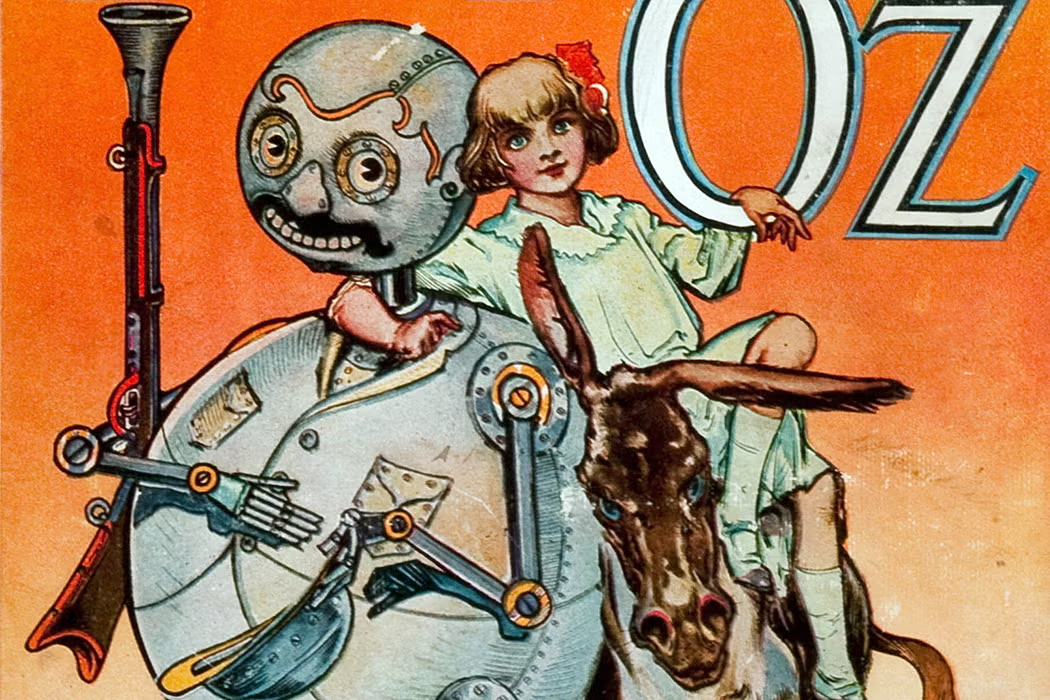
Tik-Tok first appeared in 1907 in Baum’s third Oz book, Ozma of Oz, described as a “mechanical man.” This was more than a decade before Czech playwright Karel Čapek introduced the word “robot” in Rossum’s Universal Robots. Abrahm and Kenter note that it’s hard to come up with a solid definition of a robot, but they set out to show that Tik-Tok aligns with the central tropes about them created in the decades that followed.
First off, Tik-Tok is a human-shaped but fully mechanical person, made of copper. He differs in his origin from the Tin Woodsman, who was once a “meat man” but gradually had his body parts replaced with metal ones—making him more a cyborg than a robot. And the two are treated differently, with Dorothy and other characters repeatedly questioning whether Tik-Tok is, in fact, alive.