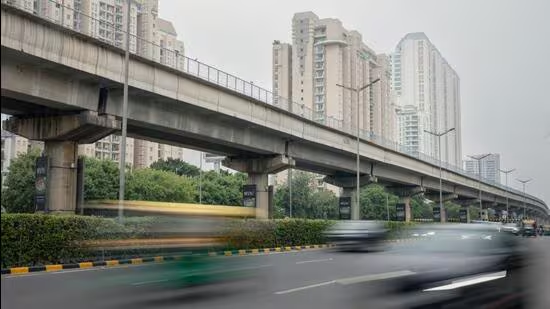
This year marks 35 years since India embraced large-scale economic reforms. India had been moving toward economic liberalisation since the 1980s, but the quantum jump occurred when the economy faced the prospect of a sovereign default and suffered the ignominy of shipping its gold to London as collateral for an emergency loan. There have been periodic downturns in India’s economic journey since. But the broad direction has only been upwards and onwards. We seem to be at the cusp of another such crisis at the moment. A terms-of-trade shock from the war in West Asia has combined with pre-existing capital flow headwinds to pose a balance-of-payments threat to the economy. There is no point in predicting how bad things can get. Theoretically, they can, is the point: financial markets often find self-fulfilling doomsday prophecies extremely seductive.Vehicles in the DLF Special Economic Zone in Gurgaon, India, on Monday, May 11, 2026. (Bloomberg File)Crisis management, on the economic front, is never not ugly. It can entail price hikes, austerity, and offerings to foreign capital, which entail super-normal profits and strategic giveaways etc. It is to be expected that different sides of the political spectrum will defend or criticise such actions. Most Indians are not old enough to remember the 1991 reforms, but they are old enough to remember the attacks Narendra Modi and his party made on the UPA government in the early 2010s about things such as the falling rupee and fuel price hikes. Its mirror image of sorts is playing out today with the BJP in power. Politicians will do what is expected of them. But it distracts us from the larger question.What is the root of the current crisis? What can be done to avoid a similar one in the future? This requires revisiting the evolution of structural levers of the Indian economy in the last three and a half decades.The nascent Indian state adopted a conservative attitude to its economic fortunes. Among all constraints, it prioritised the foreign exchange constraint the most. Memories of colonial subjugation, lack of a domestic industrial base and even food self-sufficiency made foreign exchange an extremely scarce commodity that ought to be spent extremely judiciously. This philosophy, along with what has justifiably been criticised as export-pessimism, translated into policies that entailed a broad-based supply constraint in the economy. From an industrialist wanting to import foreign machinery to research students going abroad to study, there was never enough foreign exchange available. It scarred a generation of Indians, especially the relatively privileged ones, who were not really worried about survival. These are the loudest voices defending reforms today.The 1991 reforms changed all this for good, albeit incrementally. From scotch whiskey to international credit cards to foreign machinery and components, everything is within reach in India today if you have the money (in domestic currency) to pay for it. The concomitant dollars, somehow, always appear on the other end. But there are no free lunches in the world, are there? So how did we go from a penny-scarce pre-reform era to a pounds-galore post-reform world?Did India become a trade surplus country, which now exports more than it imports? Things have moved in the opposite direction, and the merchandise trade deficit has actually increased since the reforms. Two things helped. A large number of Indians started earning dollars in return for services either through their companies or remittances which they sent back home from their places of work abroad. This filled a part of the merchandise trade gap. The remainder was filled by capital inflows: either the Foreign Direct Investment (FDI) or the Foreign Portfolio Investment (FPI) type. As long as the capital account is there to balance the current account deficit, you can spend as many dollars as you want without earning them.Once the ongoing war and its terms of trade shock has eased, the merchandise trade deficit should start easing. As of now, it looks later rather than sooner. The capital flow dynamic looks even less optimistic. JP Morgan’s Chief India Economist Sajjid Chinoy’s excellent note argues that unless India does more to make itself attractive to foreign capital (on the lines of countries such as Vietnam), it is unlikely to see a revival of capital flows in a high interest rate (in the US) world as capital can earn higher returns even in the core (home bases such as the US) than venturing outside. The invisibles (services and remittance earnings) success story on the current account is facing a generational technological shock headwind from Artificial Intelligence. Even if it sounds harsh to completely write it off, it is reasonable to say that the peak growth of invisibles foreign exchange earnings is now behind us.Logically speaking, this leaves India in a situation with two choices. Either reduce foreign exchange spending, creating a pre-1991 supply constraint situation or earn more foreign exchange through merchandise exports. The inherent philosophy in both choices is the same: thou shall not spend what you do not earn.35 years is a long time in the economic history of any country. Twenty-two of these 35 years were spent under just two governments: 10 under the Congress-led UPA and 12 under the current BJP government. The broad economic trend on external constraint has been the same under both: growing merchandise trade deficit; which increased to uncomfortable levels during terms of trade shocks, which has been sustained by rising invisibles surplus and capital flows. Whenever this balance is disrupted, crisis beckons.Accusations aside, the reality of three and a half decades of reforms is more sobering than satisfying. Rationality demands that the Indian state and its democratically elected custodians accept this fact instead of opportunistically grandstanding. They should make appropriate demands on both labour and capital to achieve what is required. This will not be an easy demand to make: from the first, politicians need votes, and from the second, political finance. Labour has become accustomed to prioritising immediate needs, such as cash transfers over future investments. Capital is interested in preventing rather than expediting creative destruction to make the economy more competitive.This is a classic case of democracy being in tension rather than unison with national interest. Bleeding-heart liberals will find this narrative unpalatable, but even a basic literacy in economic history tells us that utopian liberalism does not make national fortunes.
Terms of Trade: Reforms, reality and rationality
India marks 35 years of economic reforms amid rising trade deficits and a potential crisis, highlighting the need for structural changes to avoid future issues. | India News
1,048 words~5 min read