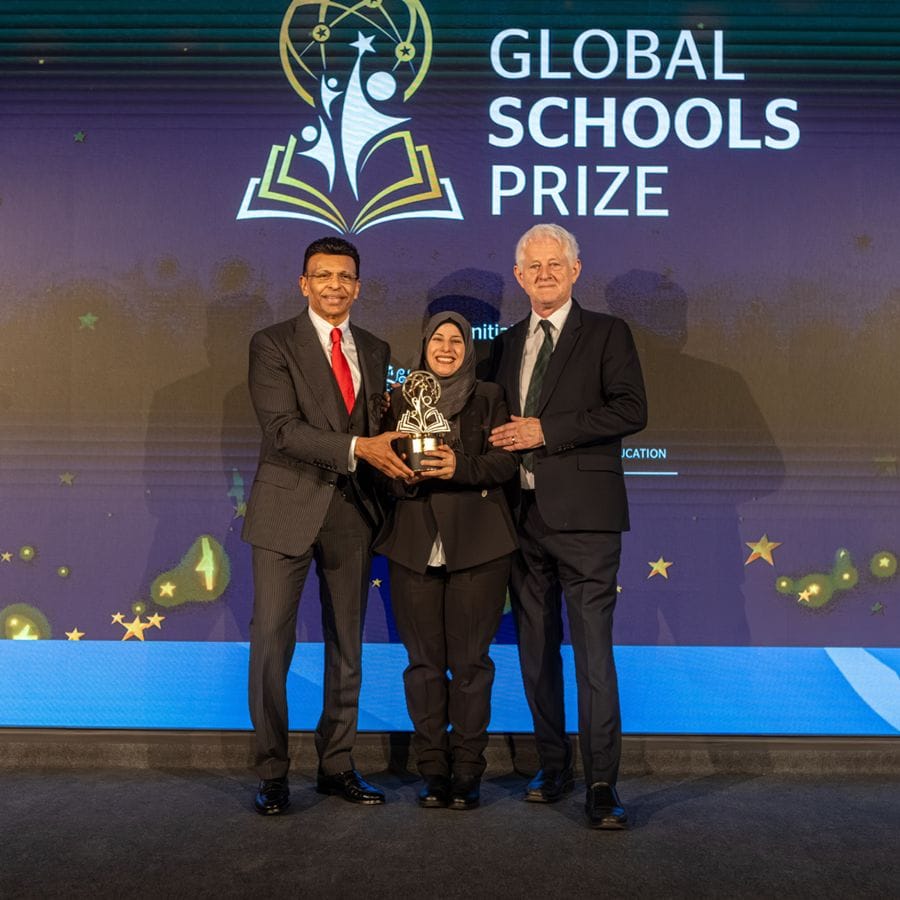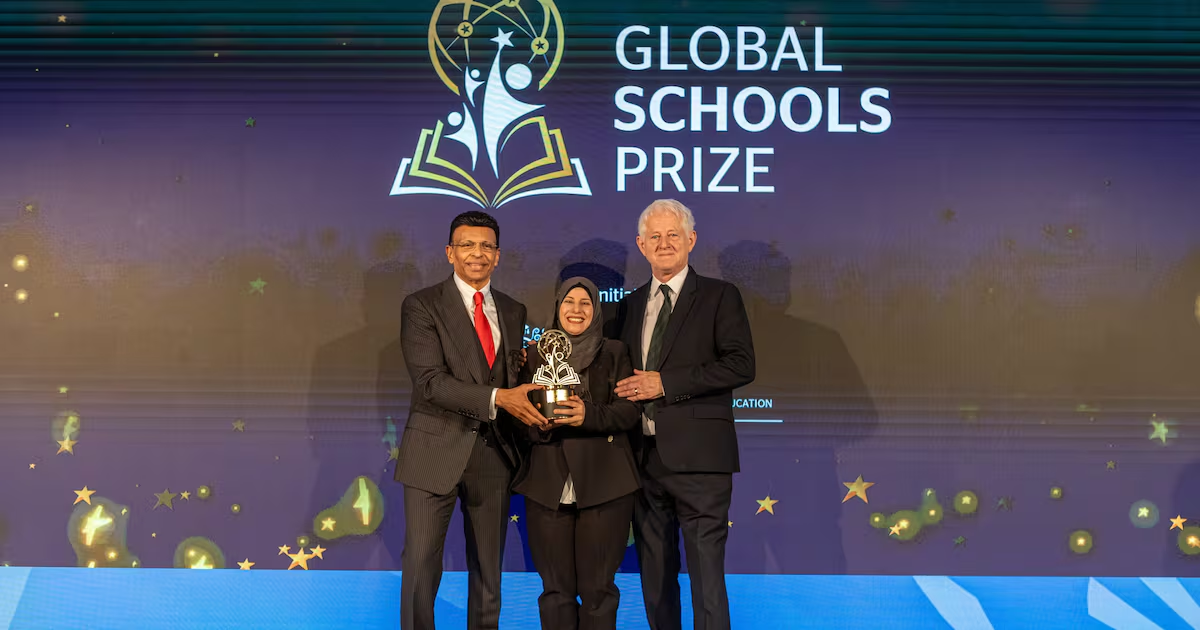
A Lebanese organisation offering an education lifeline to young refugees in its homeland and Syria is ready to increase its life-changing support after winning the $500,000 first prize in a contest run by the UAE-based Varkey Foundation.The Alsama Project, which has four educational centres in refugee camps in Beirut and a fifth in Homs in Syria, is looking to open two more centres after being chosen for the inaugural Global Schools Prize.The group was named the winner during the Global Education Forum in London, with the award being presented by Sunny Varkey, the prize’s founder, and Richard Curtis, a renowned screenwriter and film producer.Even during the conflicts that hit Lebanon in 2024 and 2026, the Alsama Project continued to teach its students daily.Opening up access to educationMeike Ziervogel, chief executive and co-founder of the Alsama Project, told The National that the organisation was “incredibly honoured” to have won the prize.“Half a million dollars will allow us to open more education centres in Lebanon and Syria,” she said. “That will permit hundreds of illiterate teenagers to reach university entry within the next six years.The Alsama Project has organised cricket matches in the Shatila refugee camp in Beirut. Photo: Alsama ProjectInfo“I think what really inspired the judges is that we’re truly having an impact with young people who are often totally neglected by so many organisations, by so many governments.”There are about 1,200 pupils at the organisation’s educational centres in the Shatila and Bourj Al Barajneh Refugee Camps in Beirut, where 40,000 Syrian and Palestinian refugees live, and in Homs. About 85 per cent of Syrian refugees in Lebanon are unable to go to school.Nine out of 10 pupils who join as 13 or 14-year-olds cannot read, write or carry out basic numerical tasks, but an accelerated curriculum means that within six months they have become literate and able to count. In six years – half as long as it normally takes – they are ready to attend universityMs Ziervogel, a novelist and publisher, helped set up the Alsama Project after moving with her husband from London to Beirut in 2018, with the aim of spending a year working with Syrian refugees in Beirut.In Beirut she met Kadria Hussein, a Syrian refugee, and they began teaching literacy to girls in the Shatila refugee camp. Many of these girls, still in their mid-teens, were already engaged to be married.These efforts to improve literacy and numeracy grew, in 2020, into the Alsama Project, which educates boys and girls. The project also organises sports matches, particularly cricket, and highlights the importance of gender equality.The first intake of pupils is now graduating from their education centres and, in some cases, are set to attend renowned universities abroad on full scholarships.The Alsama Project runs education centres in the Shatila refugee camp in Beirut. Photo: Alsama ProjectInfoChanging lives“All of these girls, they would say, ‘If Alsama hadn’t given us this opportunity, we would by now be married.’ Most would probably have two or three children,” Ms Ziervogel said.“The boys would’ve started working, collecting plastic from age four onwards. When they come to us, their trajectory, they would always have to do very difficult jobs.”Ms Ziervogel said many young people in the refugee camps in Lebanon live in “extreme poverty”. According to published figures, 58 per cent of the 660,000 Syrian refugee children in Lebanon have never gone to school.If they are back in Syria, many are in areas that have suffered severe destruction. About 8,000 schools in the country are said to have been destroyed.“Often the extended family share a small room,” Ms Ziervogel added. “They’re often victims of domestic violence, child labour, child marriage.“No one sends them to school. It’s often they who come and are totally self-driven … They see the opportunity and grab it.”A young refugee takes part in a cricket match organised by the Alsama Project. Photo: Alsama ProjectInfoInvesting in the futureThe funds from the Global Schools Prize will allow the Alsama Project to open two more centres and run them for a year, Ms Ziervogel said.“We’ll have to raise more money for continuity,” she said. “Our primary principle is to say to our students, ‘If you commit to us, we’ll commit to you.’ We’ve been working diligently to have a widespread funder base.”This month the Alsama Project was awarded $50,000 after being named as the Global Schools Prize’s winner of the Overcoming Adversity prize, one of 10 categories, from which the overall winner was chosen.“I was illiterate in a way that I saw everything around me, but I felt I was blind,” said Maram Alkhoder, 19, from the village of Deir Ezzor in Syria, who has recently completed her education with the Alsama Project at the Shatila refugee camp in Beirut after arriving in Lebanon in 2016.“Whenever anybody asked me a question, I felt very ashamed of who I was – a girl who couldn’t respond, a girl who was shy, a girl who was actually in a corner, a body without a soul.”Ms Alkhoder said the founders of the Alsama Project listened to the girls’ desire to be educated and, within a year-and-a-half, she was able to speak some English and could read and write. Now she hopes to study international relations at university and would like to become a diplomat.“I want the world to know about my village, to give them the opportunity of work … The only thing they want is the opportunity,” she said.Daring to dreamLouay Alkadro, 19, who arrived in Lebanon in 2017 after his family fled Raqqa in Syria, has also just completed his education at one of the organisation’s centres at the Shatila refugee camp.He hopes to study marketing at university abroad if he can obtain a scholarship, which he said would be preferable to his probable alternative of collecting plastic for 12 to 14 hours a day.“I’m graduating after suffering from war in Syria, from ISIS, from witnessing two wars in Lebanon … To celebrate my graduation, I think it’s going to be a big moment for me and for my family, who were with me for this journey,” he said.“ ... I’m continuing to find some sponsors, some scholarships, so I can go and achieve my dream.”Mr Alkadro said the organisation also helped him to see the importance of gender equality.The Global Schools Prize attracted about 3,000 applications and nominations from 113 countries.As well as the Global Schools Prize, the Varkey Foundation also supports the Global Teacher Prize and the Global Student Prize.Power of educationMr Varkey, the founder of the Varkey Foundation, the Global Schools Prize and Gems Education, offered his “huge congratulations” to the Alsama Project.“Your extraordinary achievement demonstrates the transformative power of schools, innovation against the odds, courage under crisis, and an unshakeable belief in every child’s potential,” he said.“Your work has created life-changing opportunities for teenagers excluded from education, while strengthening entire communities.”Mr Varkey said he hoped that recognition of the Alsama Project’s achievements would “inspire a global movement to scale the best ideas in education”.
Lebanese education group wins $500,000 Global Schools Prize for helping war-hit teens | The National
Alsama Project aims to open more education centres thanks to award from Varkey Foundation
1,165 words~5 min read