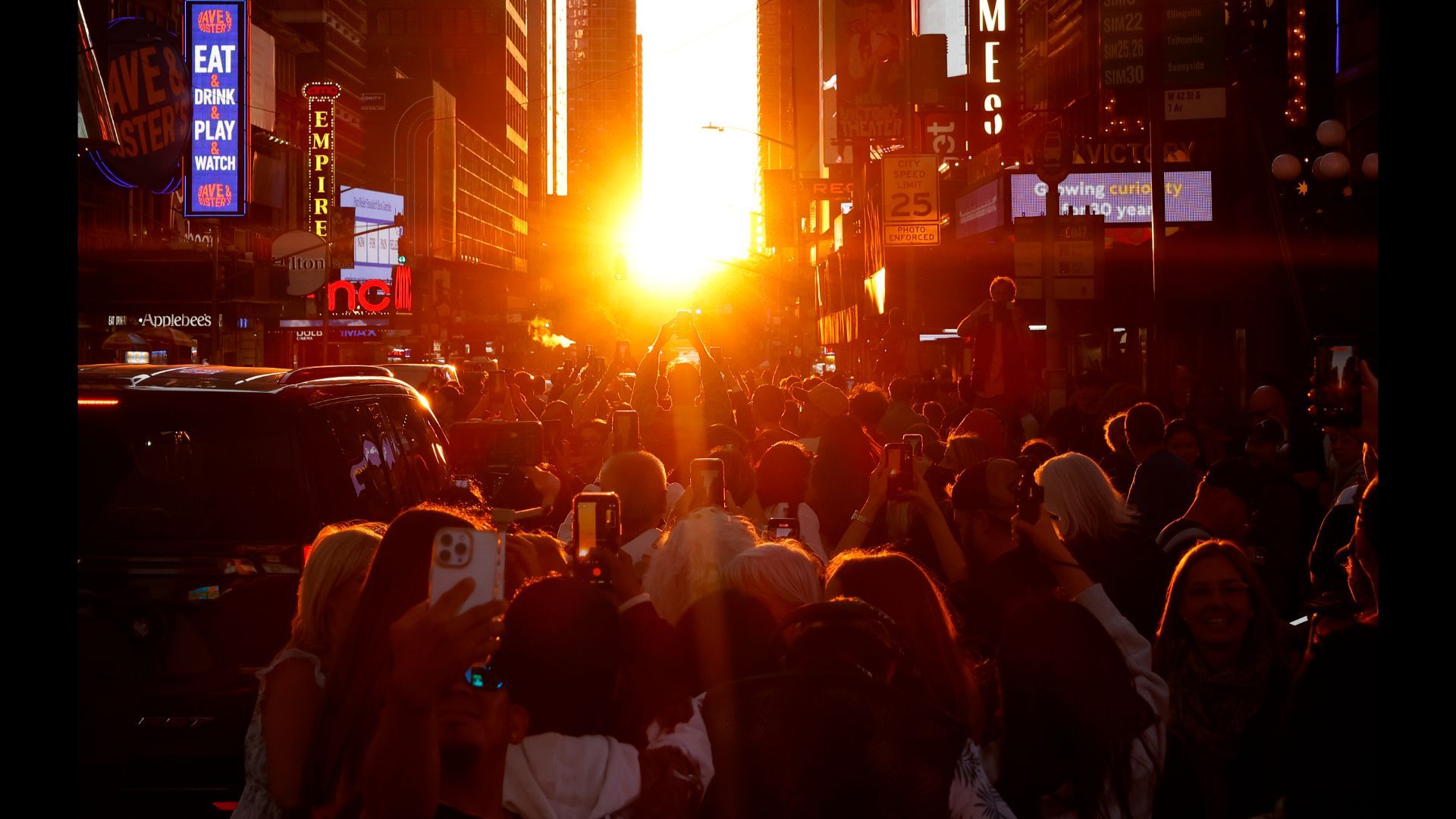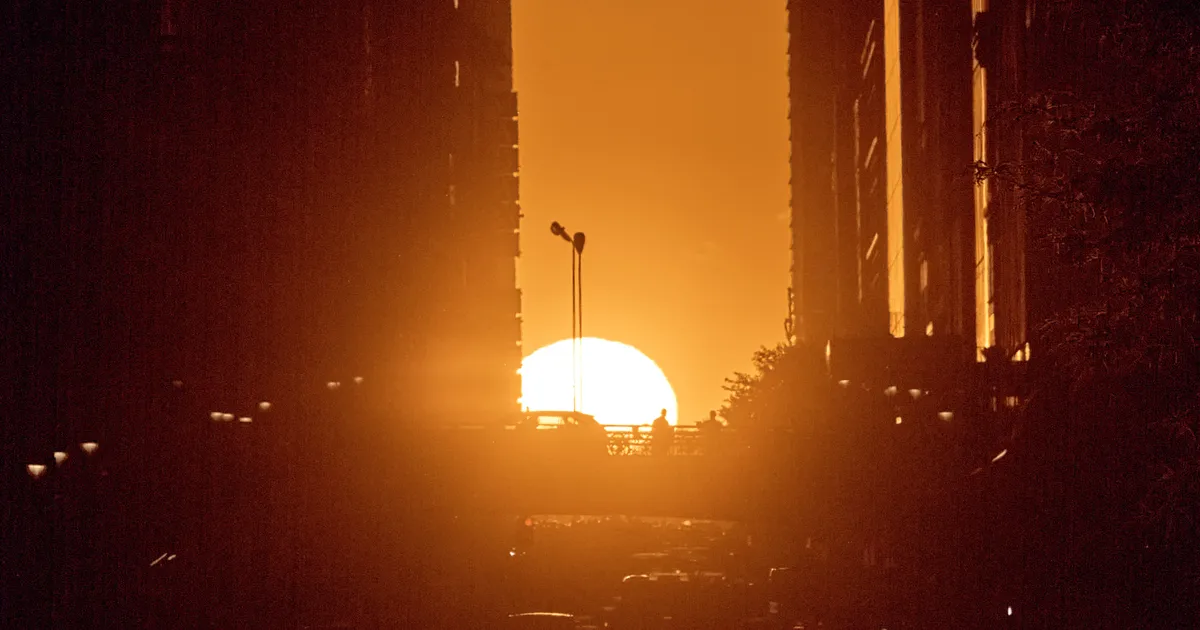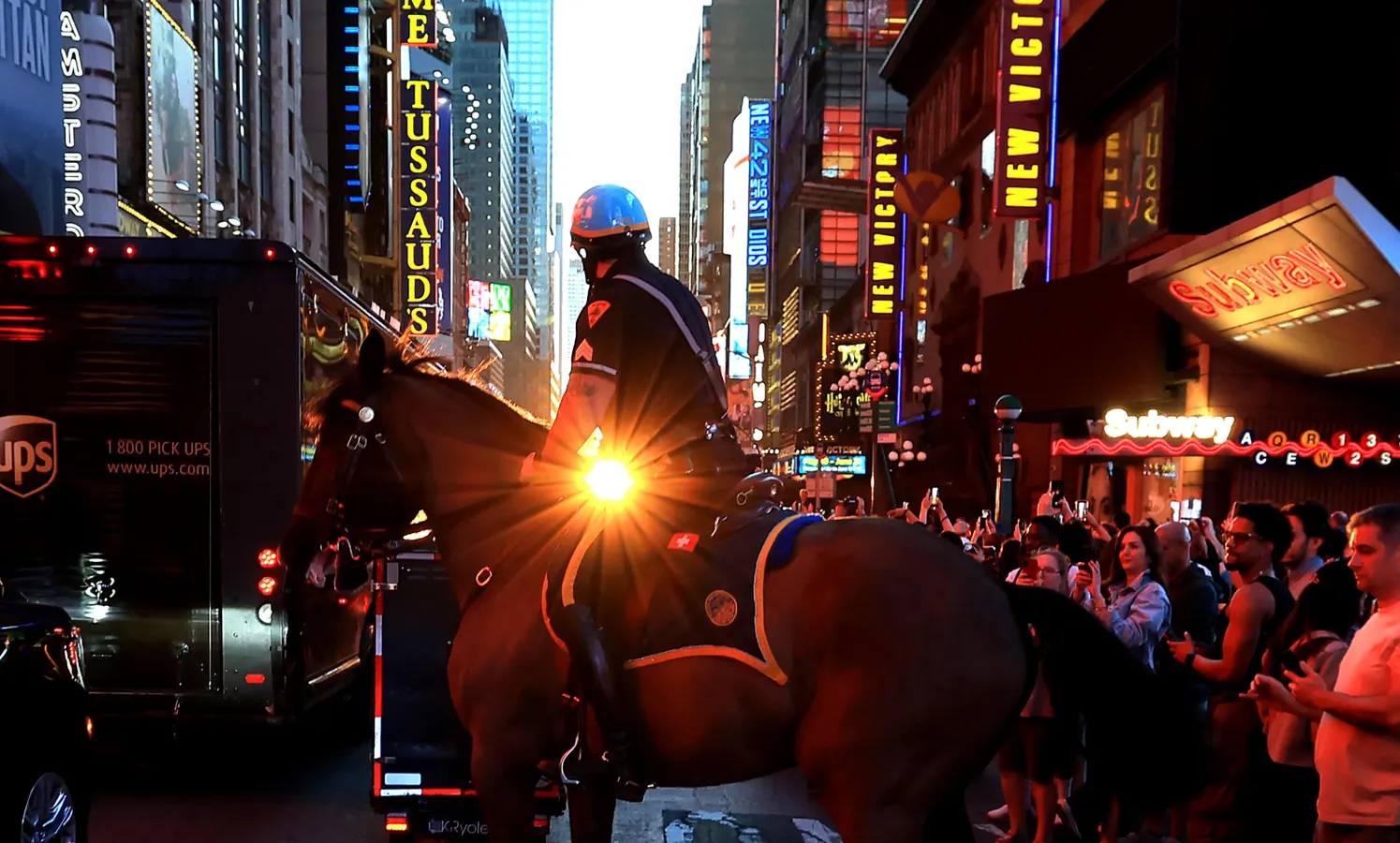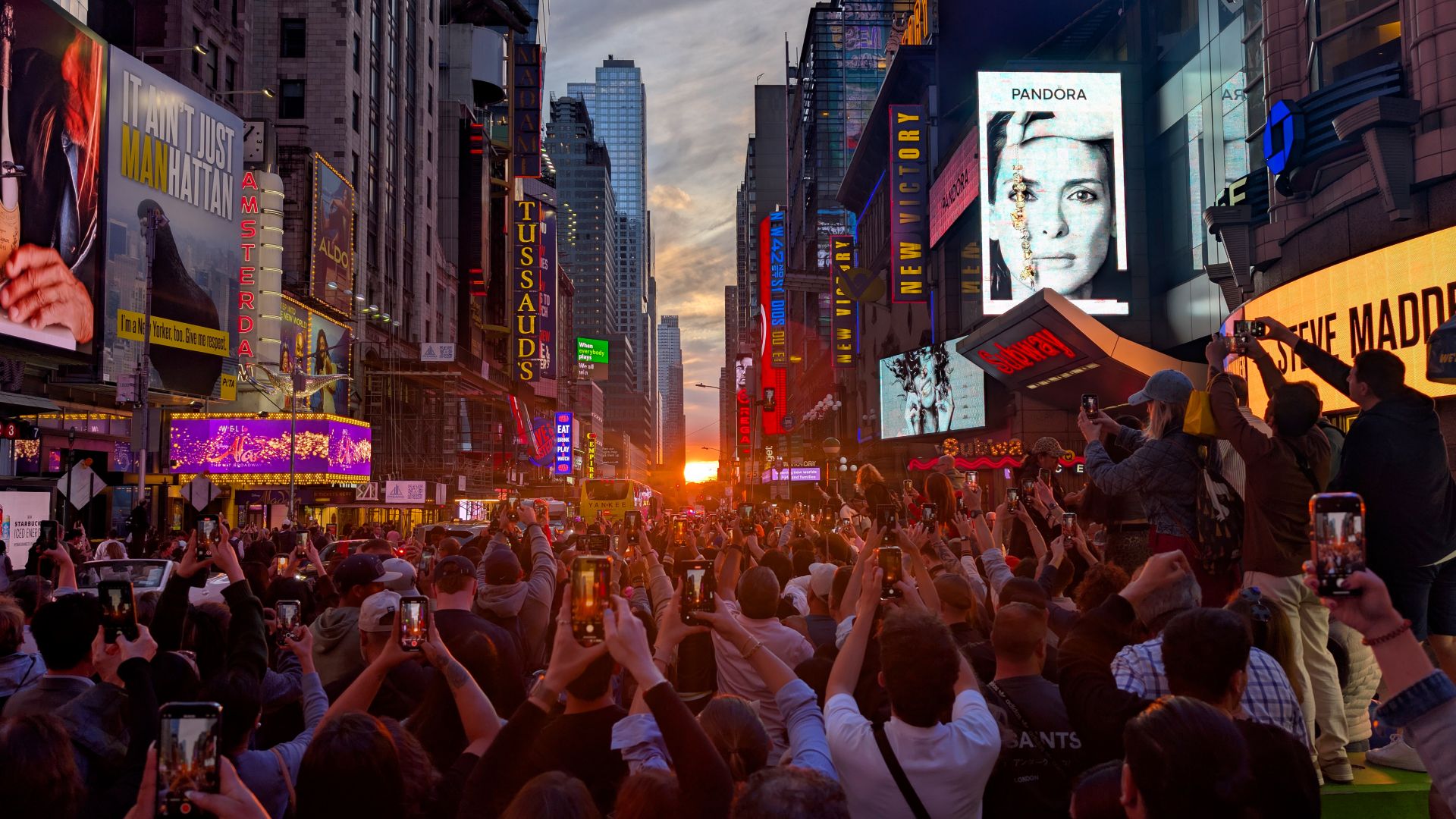
Manhattanhenge is a popular spectacle in New York City. This photo captures the May 29, 2025 event unfolding.
(Image credit: Gary Hershorn/Getty Images)
Twice each year, New Yorkers gather along Manhattan's cross streets to watch the setting sun perfectly align with the city's grid, creating one of the most striking urban skywatching events in the world: Manhattanhenge.In 2026, Manhattanhenge will occur on May 28-29 and on July 11-12. The best views are typically along 14th, 23rd, 34th, 42nd and 57th Streets looking west toward New Jersey.But why does Manhattanhenge happen in the first place? The answer lies in the unique layout of Manhattan's streets and the changing position of the setting sun throughout the year.Let's face it. If you live in New York City, where light pollution is among the worst in the United States, there aren't too many celestial sights that you can look forward to seeing. And yet, twice each year, people not only from in and around New York, but from across the country and even perhaps from around the world come to Manhattan to be mesmerized by an uncommon phenomenon that occurs near sunset.Around Memorial Day and again for a day or two around July 12, New Yorkers become intrigued by an unusual circumstance that allows the setting sun to be seen on many of Manhattan's east-west cross streets simultaneously, provided you have a clear view down to the New Jersey horizon. Indeed, it is not unusual on those special evenings to see people clustered on the corners of favored cross streets watching the setting sun as it aligns with Manhattan's canyons of brick, glass and steel, creating dramatic vistas. In recent years, the Manhattanhenge term has become very popular in pop culture, even being used for the title of a 2009 episode of the television series "CSI: NY," as well as official clips for the TV Land series "Younger" (Season 3).Enigma of StonehengeOf course, there are other places on Earth where the sun aligns with certain landmarks at specific times of the year. The most famous is Stonehenge, the Neolithic monument at Wiltshire in the Salisbury Plain of England, where on the day of the summer solstice, as seen from inside Stonehenge, the sun appears to rise directly above the so-called Heel Stone. It's an event that attracts thousands each year.Although we are certain that the massive upright stones that comprise Stonehenge took about 1,500 years to construct and that it probably once served as a burial ground, many mysteries about it still abound. More than half a century ago, British astronomer Gerald S. Hawkins (1928-2003) and co-author John B. White published a book, "Stonehenge Decoded" (Doubleday, 1965), which claimed that Stonehenge was used to predict a wide number of astronomical occurrences. While attracting a large following, the book also attracted some reputable scientific scholars who scoffed at its findings. All these years later, the issue remains a contentious one and the true nature of Stonehenge may forever be a mystery.The Gridiron of ManhattanSo far as Manhattanhenge is concerned, its origins are not nearly as mysterious. It is based on a design for Manhattan outlined in "The Commissioners' Plan of 1811" — for a rectilinear grid, or "gridiron" of straight streets and avenues which intersect each other at right angles. This design extends from north of Houston Street in lower Manhattan to just south of 155th Street in upper Manhattan. Most cross streets in between were arranged in a regular right-angled grid that was tilted 30 degrees east of true north to roughly replicate the angle of Manhattan Island.And it is because of this 30-degree tilt in the grid that the magic moment of the setting sun aligning with Manhattan's cross streets does not coincide with the June solstice, but rather with specific dates in late May and early July.While we say that the sun sets in the west, most times that's not exactly the case! Like the popular axiom, "A broken clock is correct twice a day," the sun sets precisely due west only twice each year — on the equinox days in March and September. But between the first day of spring and the first day of autumn, the position on the horizon where the sun appears to set (known as the azimuth) occurs somewhat north of due west. The azimuth of the sunset slowly shifts northward until the day of the June solstice; thereafter, it reverses course and shifts back to the south. On June 21, the sun sets at an azimuth of 302 degrees or 32 degrees north of due west.But for the setting sun to be seen from all of Manhattan's cross streets, its azimuth must be 300 degrees or 30 degrees north of due west. That happens twice — first as the sun is climbing toward the solstice in late May — and then for a second time after the solstice, as the sun migrates back toward the south in early July.And that first opportunity in late May is rapidly approaching.