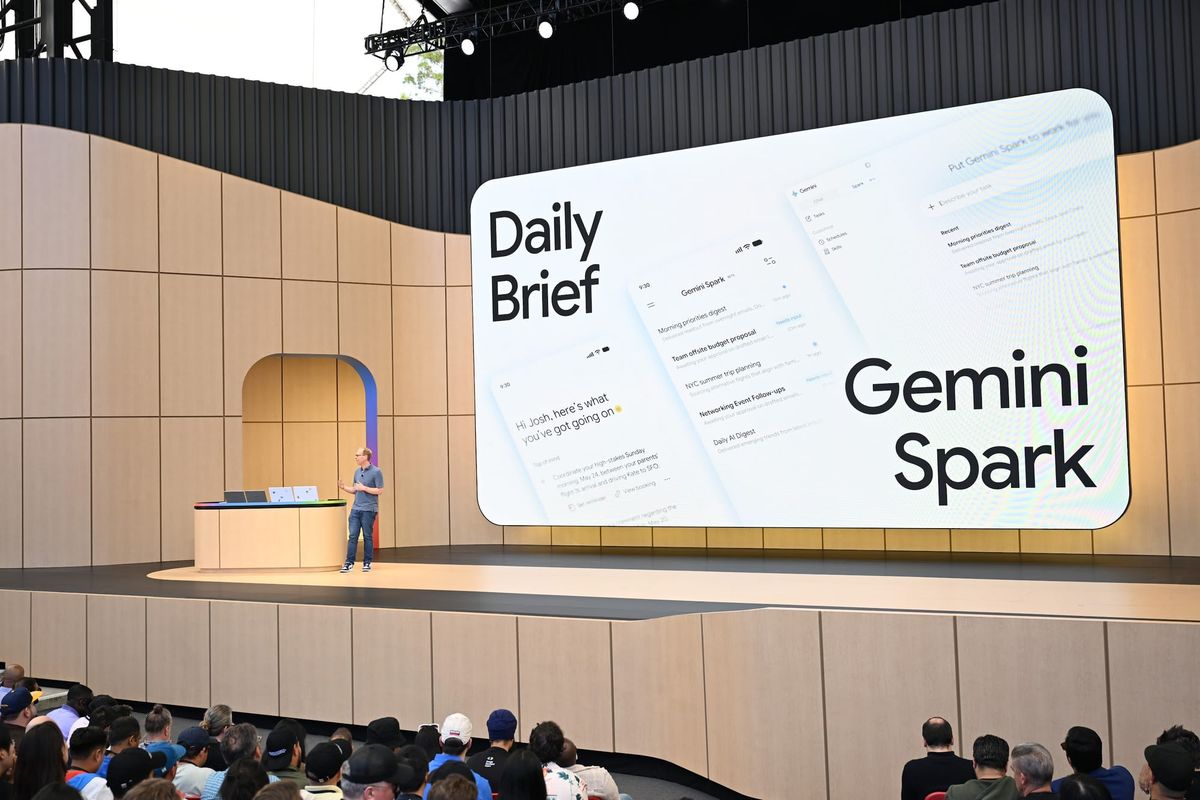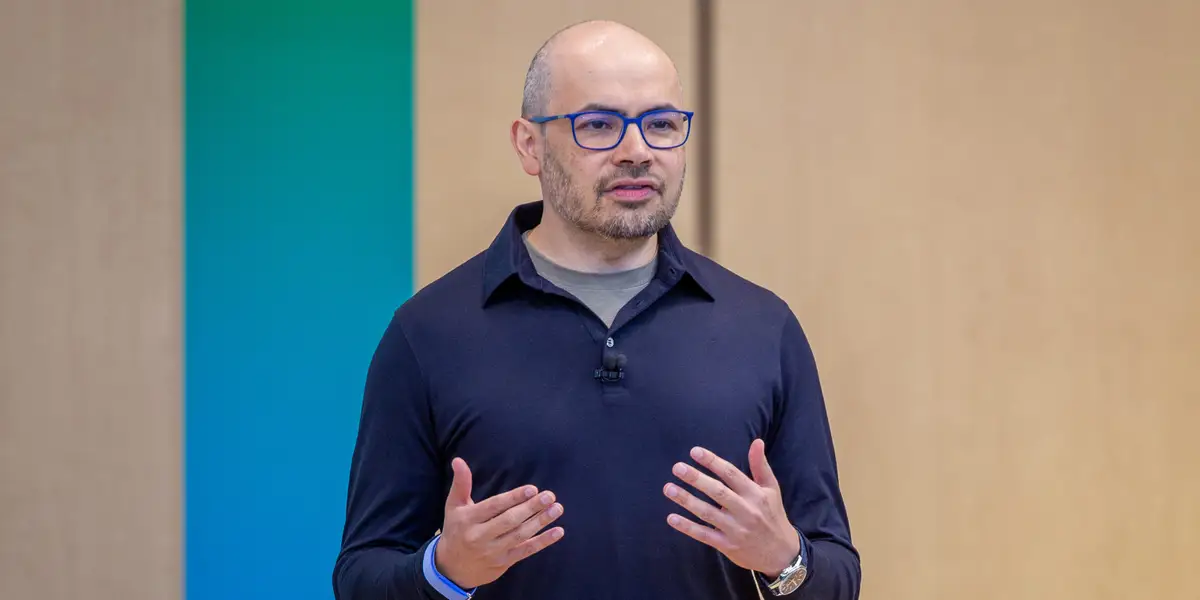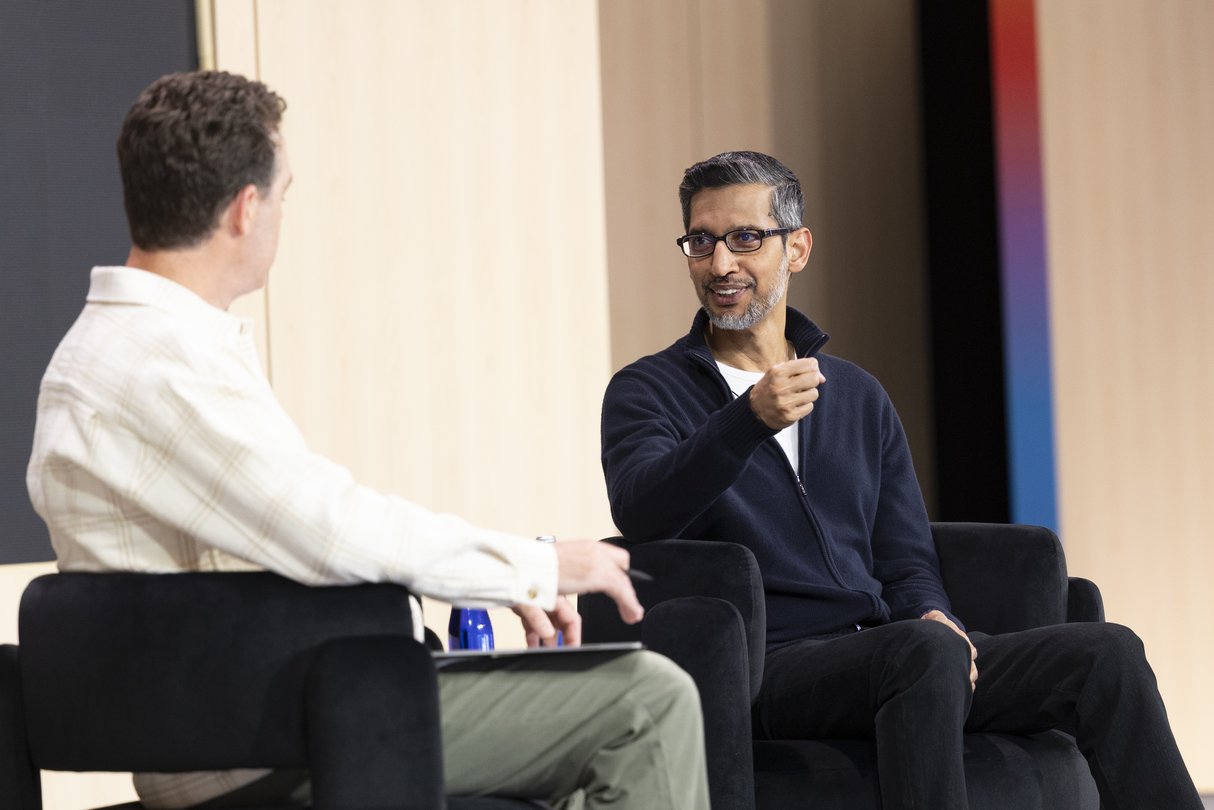
Some fun news: we're doing our first-ever Platformer live event on June 2 at Atlassian headquarters in San Francisco, and you can join us! We'll be announcing our guests shortly, but suffice to say it's gonna be a fun time. Only a few dozen tickets are available, so if you're interested I suggest buying one soon. Get all the details here.This is a column about AI. My fiancé works at Anthropic. See my full ethics disclosure here.Last week, I sat down with Aaron Levie, the CEO of Box, who made what I thought was a pretty strong case that jobs are just harder to automate away than AI companies keep telling us. Aaron's argument went something like: the last mile of human work — judgment, context, the messy parts — doesn't actually get automated anytime soon, and companies are about to have many more humans and agents working together, which means we can keep our jobs. I left that conversation pretty optimistic.This week, I wanted to put that optimism in front of somebody who has spent his whole career trying to measure — sometimes at the level of whole economies — what new technology actually does to work. James Manyika is a senior vice president at Google and Alphabet, where he runs Google's research and labs operations, along with a team the company calls technology and society — an effort to consider the broader consequences of AI systems like Gemini and develop Google's strategy around them.There's much to consider. As I discuss with Manyika in this conversation, seven in 10 Americans now oppose data center construction in their communities. And the message that many Americans have gotten about AI from the industry itself — first we'll take your job, and eventually we might kill you — clearly hasn't rallied many people to Big Tech's banner.Given his role, it's no surprise that Manyika takes a more optimistic view: jobs are harder to automate than Silicon Valley often gives them credit for, he says, and the process will unfold more slowly than some of more aggressive predictions that radiate out of other frontier AI companies. (This is a view shared by some of Manyika's fellow Google executives: DeepMind CEO Demis Hassabis warned Wired today that it may be a mistake to replace software developers with AI tools. “I think it's a lack of imagination—and a lack of understanding of what's really going to happen,” he said.)But unlike most Big Tech executives, Manyika developed his views during a long career outside Silicon Valley. A longtime McKinsey executive, Manyika co-authored a paper about the potential effects of automation on labor nearly a decade ago. He has since co-chaired the UN Secretary-General's high-level advisory body on AI and served as vice chair of the National AI Advisory Committee under President Biden.And so when leaders at rival companies like Microsoft and Anthropic insist that a significant portion of white-collar work is about to disappear, Manyika is skeptical."Some of those predictions were made two years ago — that in two years, 50% of jobs would be wiped out," Manyika told me. "Well, two years is up. Let's take a look. And anybody who makes that prediction for two years from now, I'm willing to take the bet." Highlights of our conversation follow. Highlights of our conversation are below, edited for clarity and length. We also hope you’ll listen to the entire conversation wherever you get your podcasts — just search for Platformer — or watch it on YouTube at youtube.com/caseynewton.And let us know what you think — we’re new to podcast production, and welcome your feedback at casey@platformer.news. Casey Newton: You did your PhD in AI and robotics at Oxford decades before AI became the biggest story in the world. What did you believe or see back then that most people were missing?James Manyika: I'll take you back even before that. I did my undergraduate degree at the University of Zimbabwe, and my undergraduate thesis was actually the first paper I ever published. Guess what it was on? AI — training and modeling an artificial neural network. There was a postdoc visiting from Canada who had worked as part of the Montreal–Toronto Geoff Hinton crew, and he suggested I should build a neural network for my undergraduate thesis. That was the very first thing I ever published, in 1993.Newton: Well before folks like me were spending every waking hour reading and writing about this. What captured your interest?Manyika: Two things. I grew up on Star Trek, so the idea of AI fascinated me. I watched 2001: A Space Odyssey. But I was also just intrigued by the idea that it would be possible to build systems that can do advanced cognitive tasks. So when I went to Oxford, I did my PhD in AI and robotics to continue pursuing this.Newton: You've since spent a good portion of your career trying to measure how technologies change economies. You spent a long while at McKinsey, where you wrote a paper called "Jobs Lost, Jobs Gained" almost a decade ago. Now you're inside Google, where you can see what happens when these tools actually land in workplaces. When you look at the debate we're having right now about the future of AI and jobs, where do you land?Manyika: It's such an exciting moment. The technology and its capabilities are expanding at an incredible pace. But when you try to translate that into what it might mean for work and jobs and occupations, I get a very mixed view. It's roughly what that paper said 10 years ago, which I think is still correct: there will be some jobs that decline, there will be jobs that grow, and most importantly — a third aspect — a lot more jobs will change.Whether you're looking at the aggregate economy, the sectoral level, or by occupation, you get a different mix of those three things happening. But all three things will happen. The research hasn't changed very much. The debate that people have is, what's the mix of those three things? As opposed to, are these three things going to happen.Newton: Let me name a dynamic that may be on some listeners' minds. You are now employed by one of the biggest beneficiaries of the current AI boom. How do you tell when you're hearing the labor economist in your head and when you're hearing the SVP at Google?Manyika: I hear both things. Less the SVP at Google — more so the AI researcher and computer scientist in me is extraordinarily excited about the pace of the technology. That part of me thinks, "Oh my goodness, this is going to be extraordinary, and it's going to happen very, very quickly."The labor economist part of me says, "Hang on a second — these things don't actually play out that quickly in the economy, and the dynamics are more mixed." So I almost hear two speeds proceeding here. I often think that as AI researchers, our community tends to overstate what happens in the labor markets based on what we're seeing on the technology frontiers. These are two very different conversations.Newton: At the McKinsey Global Institute, you found that about 50% of tasks would be automatable through AI, but only about 10% of occupations would be fully automatable. A few generations of AI later, does that ratio still sound right?Manyika: All of the pieces have been moving. At the task level, many more tasks are now possible to automate — that picture's moved pretty quickly. But if you look at the composition of occupations — the Bureau of Labor Statistics tracks somewhere between 850 and a thousand real occupations — and ask how many existing occupations have the majority, call it 90%, of their constituent tasks automatable, that number is still under 10%. Most researchers will still say that.How many tasks look like they're going to be hard to automate? Partly because AI can't do them yet, or because of coupled tasks where the weak link slows down the combination. If you take two tasks and can automate one of them, but they need to be done in a coupled way, you'll only go at the speed of the weakest link. Most jobs have these couplings that make full automation very difficult.One other thing that's moved is task duration. If you had asked in 2017, of the tasks possible to automate, some were very short — 30 seconds or a minute is about as long as you could predictably do a task in an automated way. Now we can do some of those tasks for up to four-plus hours. The task duration with reasonably predictable completion has made tremendous progress.Newton: So what I'm hearing is that if you measured the tasks that are automatable now, that number is trending much higher than 50%. But at the same time, the number of jobs you could fully automate is stubbornly holding in roughly the same place it was 10 years ago. What is your best explanation for that divide?Manyika: Part of the divide is that we now understand more fully that whole jobs have a much more complex mix of tasks, and this idea of weak links or coupled tasks matters a great deal in most occupations. If you look across the whole economy at most complex tasks, we can't automate most of them. So the question of which whole jobs you can automate more than 90% is still a relatively small number.Most of the debate among labor economists is whether in the next decade that number is more like 2 or 3% or more like 9 or 10%. I don't think anybody who's looked at whole-job automation would say it's 50% or any of these extraordinarily large numbers.That's why I come back to the view that three things will happen. Yes, there will be some job declines. But there'll also be jobs that grow — that's a function of existing jobs that grow in demand because the technology often changes the demand picture, and new jobs get created. We forget that David Autor and others have shown that if you went back to 1945 and compared to today, something like over 60% of the jobs we have in the economy today didn't exist back then, and many were introduced as a result of technological shifts that created the category.But the biggest effect is the jobs-changed part. The nature of the job itself shifts. This is what happened with bank tellers. This is what happens with radiologists. We still have the category "bank teller," but I can guarantee what a bank teller does today is not what a bank teller in 1970 did.Newton: I want to press on that optimistic picture. If that was all that happened in the next two or three years, I'd be breathing this deep sigh of relief. On the other hand, you have folks like Mustafa Suleyman at Microsoft saying he thinks that within 18 months, all white-collar work will be automatable. Dario Amodei at Anthropic is predicting very high unemployment as a result. When you look at statements like that, do you think those guys are wrong? Are they missing something?Manyika: I'll just say: let's take the bet. Some of those predictions were made two years ago — that in two years, 50% of jobs would be wiped out. Well, two years is up. Let's take a look. And anybody who makes that prediction for two years from now, I'm willing to take the bet.There's an extraordinary unevenness when it comes to things playing out in the labor markets that we forget. I live in San Francisco, and we've had driverless cars here for three years. But somebody in another city like Chicago has no idea what we're talking about. We often talk about the jaggedness of the technology — I think that's true. There's also jaggedness in the economy in terms of how this plays out. Don't get me wrong — I think it'll be faster than the Industrial Revolution, but it won't be as fast as the technology often suggests.I'm happy to have this conversation a decade from now.Newton: Let's bring it to Google. Since you've been there starting in 2022, what have you seen in terms of jobs lost, jobs created, jobs changed?Manyika: A lot of jobs are changing. What software developers do is changing a lot. People now work with agents, they manage agents, they pose questions, they spend less time doing bug fixes.Keep in mind that in this whole jobs conversation, we often forget what I'll call the demand elasticity of things. There are some activities where there's so much more we want to consume and do — we've just been limited by the ability to do that. Software development is one of those. The amount of software that could still be developed to build extraordinary things is very, very large. We haven't built all the software we're going to build. We haven't designed all the systems we're going to design.That won't be true for every activity. There are some activities where the demand is quite frankly limited — there's only so much of something the economy needs. In those cases, you'll see trade-offs between jobs lost and jobs gained play out in a demand sense quite differently.Newton: Even folks who agree with you on the big picture tend to worry a lot about the entry level. If you're talking to somebody graduating this June who says, "James, how do I approach the first part of my career?" — what are you telling them?Manyika: The future is actually pretty exciting. The economies are going to grow, and there's going to be lots of opportunities. But what it will take to prepare for those opportunities is dramatically changing.A decade ago, when people asked me what their kid should do, I'd ask how old the kid was. If they told me the kid was 18, I'd say they should learn to code. If they told me the kid was two, I'd say, "Hang on a second — you should think about what kind of skills are going to be important, because this AI thing is going to make a lot of progress."What we said at the time was correct but may no longer be true — that coding was going to be important in the mechanical sense of churning out lines of code. Now the systems are able to do that. That doesn't mean computer science as a field has gone away. When I studied computer science as an undergraduate, the coding part was just one slice of what I had to learn. I had to learn algorithm design and so much more. We may need to go back to that, because we're finding that it's the more broadly educated, skilled computer scientists who are a lot more interesting than the ones whose only claim is the ability to generate lines of code.One more thing. I was looking at the data the other day — the demand for software development jobs is actually going up. It's not that these jobs are going away, even in this moment. But the skills required are changing.Newton: This is another tension in Silicon Valley I'm quite interested in. Just within the past week, I've talked with you, Aaron Levie from Box, and Nikesh Arora, the CEO of Palo Alto Networks. Both Aaron and Nikesh said, "Please send me more engineers. I don't have nearly enough engineers for what I want." At the same time, it's earnings call season, and other CEOs get on the call and say, "Well, we're getting rid of 5% of the workforce to prepare for the AI future."Manyika: There's so much more going on than the AI effect. As somebody who's super excited about AI's impact on the economy, I'll say: not much has happened yet. I'm saying that both on the positive side and the negative side. On the positive side, at the economy level we've yet to see the productivity gains, which I'm looking forward to and excited about. But we also haven't seen much of the AI-driven labor impacts everybody's talking about.There was a paper — I think it might have been the "Canaries in the Coal Mine" paper — and what I found interesting was that the sharp declines they showed happened around October 2022. ChatGPT didn't come out until November 2022, and adoption didn't really happen in the enterprise space until maybe 2023. So if the sharp declines in entry-level hiring happened in October 2022, you'd have to believe something else was going on. There's now been analysis showing a whole bunch of monetary effects in the labor markets, plus leftover hangover stuff from COVID. There may be a tiny sliver that's AI-driven, but a lot more of it is driven by other macroeconomic effects.That's not to say we shouldn't worry about AI's labor market effects. We should. I just don't think they've happened yet at the scale anybody's concerned about.Newton: Let's move further into speculation. When I talk with folks whose jobs are beginning to change due to AI, it seems like an increasingly large part of their job is reviewing AI output. Whereas once they spent a lot of time manually writing code, now they spend more time reviewing it. The thing about reviewing work is it doesn't always scratch that same creative itch. Could job change wind up being a different kind of job loss, because some jobs that once felt very creative now just feel like tedious drudgery?Manyika: Yes and no. There's a fair amount of work that's now reviewing the outputs of these systems, making sure you're guiding them — "no, no, you're going down the wrong path, do this."I actually like this moment. You have to be creative about what systems you should be building, what questions you should be asking, which experiments you want to run. If you've got 10 agents working for you, what different directions are you going to send them in? What orchestrations are you going to run? What kind of tournaments do you want to run for your different agents to experiment in different ways and compare the results? The nature of the creative problem-solving is different.The creative part is exciting because it's going to be the scarce thing — the harder thing to do. I've seen this in our own teams. The teams in Google Labs creating these extraordinary new AI-first products spend some time reviewing what's come from these systems, but a lot of the time they're dreaming up new things to build.Newton: Let's shift to what you called an "AI divide" at Davos in January. We recently talked here about survey data showing that the people getting the most out of AI are already the ones at the top of the income ladder. Do you think AI is going to accelerate income inequality, or is there a way it can close that gap?Manyika: This is a fundamentally important question I worry a lot about. I'm excited about AI empowering people, economies, advancing science. But there's no law of economics or nature that says everybody will benefit, and everybody will have access. We've all seen enough instances in history where we do extraordinary things in the economy and in science and not everybody has access.Questions around access to infrastructure, tools, and technology are going to be so important in terms of making sure we don't exacerbate already-existing divides. That's why it's important to build more accessible models. We try to cover the whole Pareto frontier — we have very capable Pro models, then Flash models, all the way to our Gemma models, which are open access, open weights. That's part of our attempt to expand access — for developers, for users, and for the power of these technologies. That's why we work hard on things like language access and access for people with disabilities.Newton: Are there one or two policies you think would ensure these AI gains are broadly shared?Manyika: Multiple. Access to training and improving literacy. Often, people who are concerned about AI change their minds when they've had the experience of actually using a tool, so literacy will go a long way. Policies that make it easy to make investments in communities — in schools, in science, in infrastructure — would also make a big difference.I also think back to the question of work. I don't think we do enough training and skill building. I also don't think we do enough to help people in these transitions. When I ran the McKinsey Global Institute, one of the things that stuck with me was that one of the mistakes of the globalization era was that even though the so-called China shock in aggregate only impacted something like 4 million jobs — which in the scale of the US economy could be seen as not very large — if you're one of those people in those locations and occupations, it was everything. What we did in terms of safety nets, wage insurance, or transition support to help those workers, we didn't do anywhere near enough. That's a place where policy can make a big difference.If you ask me what keeps me awake at night about AI and work, it's not job loss — quite honestly, for the next decade it really isn't. It's these questions about how we support the transitions that work and workers are going to need to go through, and how we make sure companies like us, as well as employers and policy makers, keep that in mind as we navigate through this moment. That's what I worry about.Newton: There's a story as we record this today that 70% of Americans now oppose the construction of data centers in their communities. While they have some concerns about AI beyond the economic ones, I think a lot of the fear is rooted in the fact that if they were to lose their job today, there is not going to be some obvious government helper standing by to help them navigate into the next point in their life. It's interesting to think about what the conversation about AI would look like if the average American felt like there was a plan for them.Manyika: That's one of the things we have to do. We also have to think about AI's growing energy footprint. We have to make sure that as we build this infrastructure, it doesn't increase the cost of energy for people. We've made a pledge about bringing our own energy and not raising the cost of energy. But having confidence that there is a plan — which involves everybody — to support the transitions and changes that are going to happen in the labor markets is very important. That's what we may be failing to do.It doesn't help when we in the AI field talk about wiping out 50% of jobs. First of all, I don't think it's going to happen. The economic research and analysis mostly doesn't say that. We're probably impacting the possibilities of this technology having extraordinary impact by, quite frankly, scaring everybody — when in fact that fear is unfounded. Let's not confuse the pace of technological development with how quickly this plays out in the economy.Newton: In 2023 at the UN, you co-led a project called "Governing AI for Humanity," which laid out an ambitious vision for global governance of AI. Three years later, have we made progress, or are we moving backwards?Manyika: We haven't made much progress. Because of the nature of what that body was doing, we were engaged with all 190-some countries of the world, and attitudes towards AI were very different around the world. People in the so-called Global South — in Asia, India, Africa, Latin America — were generally more positive about AI and its possibilities. Of course, they had concerns around infrastructure and access. Western Europe and the US are probably the most negative, which is kind of interesting.There are some basic things we should all agree on: this technology should be based on fundamental human rights and respect for international law; we should think about both possibilities and harms, not one or the other; and everyone should be able to participate in both the development and use of this technology. At the time, there was general agreement among the vast majority of countries on these basic principles. The question became: how do we put this into practice? That's the process that's taking much longer.One thing I learned from that process that's fascinating: in discussing the risks from this technology, they're the ones you might expect — misapplication and misuse. But many members of the body, especially from the Global South, insisted on adding "missed use" as a risk.Newton: As in not using it?Manyika: Yes — not using it as being an actual risk. That actually got written into the recommendations. The idea was: there are some people who live in places, countries, and communities where the risk of not using AI is far greater than their current circumstances. They may live in a country, or even in the US in a county, where access to specialist doctors is very low. If you ever looked at the map of the US at the county-by-county level, I was amazed at how different access to expertise in healthcare is. There are some counties where certain types of expertise just aren't there, and some counties where you have 10x the number of oncologists.For some communities and some countries, the risk of missed use is actually quite high. So often when I hear people say AI is not good enough, I ask: compared to what? If I have access to Stanford Medical Hospital — I live in San Francisco — yeah, it may not be as good as that. If I'm in a place where I don't have access to the world's best oncologist or the best doctor, I'd ask: compared to what?Newton: You could apply the same questions to driverless cars.Manyika: Yeah. If you say they're not safe, I'd say, compared to what? We already know in the case of Waymo, for example, that the incidence rate is 30 times better than your typical human driver. Now, this isn't to say AI is perfect. This technology still has lots of gaps, lots of issues, and we have to work on that. But when we think about the impact on society, we should think both about the risks and harms and the beneficial impacts. We should solve for both.I often find that when I'm with a group of people who are doomers, I find myself trying to paint the other side — the exciting possibilities. And vice versa: when people are so optimistic that this is going to change everything, I say, hang on a second, what about these complexities? What about these risks? We should be comfortable enough to hold both things in mind.Newton: Let's talk about something that's giving you optimism. You spend a lot of your time at Google working on science. You and Demis Hassabis wrote in Fortune in February that AI is already changing how more than 3 million researchers are working. What's happening in the near term that might actually change someone's mind about whether they want more AI in their life?Manyika: Most people know of AlphaFold — Demis and John Jumper got the Nobel Prize for that. What's extraordinary is that as many as 3.5 million researchers in over 190 countries are now using it, working on a whole range of things. We have many AlphaFold-style breakthroughs in materials science, structural biology, and high-energy physics.We're also seeing advances in already-useful technologies in health. We just published the results of a year-long study where we had over 200,000 patients in the UK with the National Health Service looking at breast cancer detection. The study, published in Nature, showed that we can do more accurate screenings assisted by AI, and we can detect earlier. We have examples like that in several cancer categories, tuberculosis, and diabetic retinopathy.Other areas have to do with crisis response — flood forecasting, wildfire prediction. Our flood forecasting work, from a cold start two and a half years ago, now covers 150 countries where more than 2 billion people live, with six-plus days of advance notice.Google has had a genomics program for the last 10 years. Most people don't know this. The tools built in that program enabled the completion of the human genome sequencing — the last 8% that hadn't been done since 2001 — and the creation of the first pan-genome reference. The science work has been proceeding quietly for a long time. We still need to be very thoughtful about the potential bio risks from this technology, but the potential for AI advancing science is already quite real, and there's even more of it ahead of us.Newton: When you imagine the average knowledge worker in 2030 — or just one specific knowledge worker — what do you think their job is going to look like?Manyika: Let me take science as an example. Many more scientists are going to be doing a lot of in silico research — exploring all the possibilities of structures, biological molecules, or target designs for drugs — and then doing validation in the lab. That changes the picture. Science has historically relied a lot on hypothesis. That's not going to go away, but we're going to have so much more of this kind of generative possibility, and then validating in the lab.Scientists are also going to be able to connect ideas beyond their own disciplines. We published a paper on arXiv called "Co-Scientist" where you can compare ideas from multiple disciplines. As a scientist, you're no longer constrained to just what you know in your own field. You can explore ideas in many more papers, theories across the board, and then bring them all together with agentic systems and construct experiments.Take AlphaFold. Scientists used to spend three or four years working on one protein, doing X-ray crystallography to figure out the structure. Now they can just look it up in AlphaFold. Sure, there's still validation to be done, but you're starting in a very different place. The range of diseases you can study is much wider. The reason we have researchers in 190 countries using AlphaFold is because before, if you were in a country where you didn't have a lab, you had to wait until somebody had figured out the structure of the protein you needed to study. Now you just look it up.You're going to see that kind of change in the nature of work across many occupations. Newton: My last question was going to be: if I had you back in a year, what is the single number or fact we would track to see whether the worldview you presented today was valid? But I think we already have it, because you told me right at the top that we're not going to see 10% of jobs automated away in the next year.Manyika: I don't think we will. I'm happy to take bets.Newton: It is a bold bet, and it's what I want to hear. James, thank you so much for joining us today.Manyika: Thanks for having me, Casey. If I could say one last thing — one of the challenges on the optimistic side is that a lot of what I mentioned in science and societal implications is going to be indirect for most people. You're going to get a flood alert on your phone telling you to get out of the way, and you'll say thank you to whoever sent it. You won't say, "This wasn't possible before AI, but now it is." You're going to get a great cancer screening and you'll say, "Great." Many of the beneficial impacts that are already becoming real, most people don't experience as directly as AI. We have to work on that part, too.A MESSAGE FROM OUR SPONSORBecome an AI-native team with RovoAtlassian Rovo is AI that knows your projects, code, and people so it can bring context (and guardrails) to every workflow.And because Rovo lives where your teams already work, it doesn’t just find the answers — it helps you do the work.See how Sprout Social is becoming an AI-native team with Rovo.Learn more.FollowingIt's AI everything at I/OWhat happened: Google I/O began in Mountain View on Tuesday with as clear of a theme as the developer conference has ever had — in this case, all AI everything all of the time. Announcements at the event were expectedly Gemini-heavy, with new models and agents coming in a variety of modes, products, and prices.As to the models: first, there's Gemini 3.5 Flash, the successor to Gemini 3 Flash, which launches today and is faster and more capable than its predecessor. (It's notable how the consumer hardware's longtime mantra of “thinner, lighter, faster” has ported so directly to AI.)Then there’s Gemini Omni Flash, which Google describes as “like Nano Banana, but for video.” Omni Flash can generate AI videos using a wide variety of inputs — text, photo, or video. Google says it’s good for more precise video editing and creating consistent characters.We were impressed by a video CEO Sundar Pichai shared depicting a marble run with accurate physics, a domain where models have historically struggled. Google envisions Gemini Omni Flash as an initial part of Gemini Omni, “a new agentic experience and custom tools” where models will eventually be able to “create anything from any input.” (Might we suggest Google begin work on Gemini Omni Alchemist, which would generate gold from a variety of inputs, including lead).Gemini 3.5 Pro is set to come out next month.Elsewhere, Daily Brief, an agent that gives you a “personalized morning digest,” is on its way — promising to soon fulfill our prophecy that AI is coming for Platformer’s job. While this feature has been within reach for those willing to set up Claude Code for many months now — we’ve dabbled with such agents ourselves — a more accessible, polished version could be more disruptive to inbox-based businesses than anything we've seen to date. (A more considered take on this one, which should also loop in the new "Ask YouTube" feature, to follow sometime soon.)What else? Gemini Spark is Google’s OpenClaw competitor. It runs in the background 24/7 doing personal-assistant stuff like managing your inbox and planning your trips. (It's also hosted in the cloud, so you don’t even need to buy a Mac Mini.) Google says Gemini Spark “operates autonomously, but always under your direction.” (While managers of AIs and humans alike have long desired assistants that do everything independently but also exactly how they’d prefer, we’re not convinced Gemini Spark has squared that circle.) It arrives for people with the more expensive Google AI subscriptions next week.Our take: Today marked Google's effort to take AI agents from their current niche market of “OpenClaw bros posting for X clout” into something resembling true product-market fit. User interfaces matter a lot for AI tools. Before ChatGPT became very famous, OpenAI’s Playground provided access to similarly capable LLMs; but it was the intuitive ChatGPT interface, which puts you in conversation with a fine-tuned “AI assistant,” that launched the first wave of mainstream AI adoption. I think a lot of companies, including Google, are hoping to be the company that creates that moment for agents. Google is particularly well-positioned to do this. But we’ll have to see a lot of testing — and proof Gemini Spark won’t leak our social security numbers — before such dreams become reality.What people are saying: On X, early testers of Gemini 3.5 Flash had good things to say. Wharton economics professor Ethan Mollick said 3.5 Flash was “Very fast for a flash model and very capable, though not as powerful as a full frontier model.”Box CEO Aaron Levie found that 3.5 Flash has roughly 20% performance gains over Gemini 3 Flash for several of his company’s work task evaluations. “Incredible to see the continued performance gains,” he said. (On that evaluation, it’s about on par with Anthropic’s Claude Sonnet 4.6)On Bluesky, Bloomberg opinion columnist Dave Lee was finding it “REALLY hard to follow the branding around Google's AI products.” He said, “I want to make an image. That's NanoBanana. Or is it Google Pics? No, it's Google Flow. And Gemini Omni is multi-modal, I think.” Which Omni? “That's Omni Flash. Or is it? Where am I? Is that Eric Schmidt? BOOOOOOOOO.”AI policy researcher Dean Ball remarked on Google I/O’s eschewing of AI benchmark graphs in favor of demonstrating “real-world capabilities usable to actual consumers.”Verge reporter Jay Peters was more skeptical about these capabilities. He wrote that it seems like Google “wants to do everything for you, all from a search box.” But “the fun of the internet is actually doing the work to find stuff, even if it’s sometimes frustrating, difficult, or time-consuming.” Given he’s “spent years honing my own email management system,” he’s not sure he wants Gemini to start doing it for him.And if Google does al the web stuff for you… what will happen to those of us who create the rest of the Internet? “Google doing everything also means a lot of the web that Google relies on collapses under it,” Peters wrote. “If Google Search doesn’t send traffic to publishers or websites who need visitors to make money” — and instead people are, say, reading Daily Briefing — “what will Search learn from, and where will it point people to?”In an interview with the NYT, Gary Rivlin author of history of GenAI AI Valley, said that Google “just have this reach that few, if any, companies on Earth have” — because so many people are familiar with their products, they is so much more surface area for consumers to start using their AI. “If I had to put a wager on the biggest winner of A.I., I would say it’s Google,” he said.More I/O announcements: A major overhaul of the search box brings AI further into results. OpenAI announces it will support the SynthID watermarking standard. Antigravity (a Claude Code rival) hits desktops. Gemini has 900 million MAUs. Pics is an image generation and editing app for the enterprise. Voice-based conversational features for Docs, Gmail, and Keep (but not til summer.) A "universal shopping cart" that works across all Google products. Gemini for Science.— Ella MarkianosThose good postsFor more good posts every day, follow Casey’s Instagram stories.(Link)(Link)(Link)Talk to usSend us tips, comments, questions, and your AI jobs bet: casey@platformer.news. Read our ethics policy here.
Google's James Manyika is betting that doomers are wrong about AI and jobs
Tasks are getting easier to automate — jobs aren't. What now?
6,424 words~29 min read