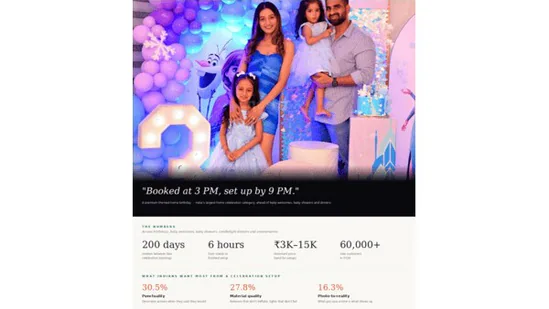
Inside 1.5 lakh bookings, nine years of data, and India's quietest consumer shift — from venue to living room, from planned to same-day, from Mickey Mouse to Tiffany blue.India’s Celebration Market Is Going Last-Minute as Quick Commerce Reshapes Birthdays & Baby ShowersSomewhere in a 2-BHK in Indirapuram tonight, a husband is paying ₹2,499 for a balloon arch and a "Happy Anniversary" backdrop to be installed in the 90 minutes between his wife leaving for the gym and returning home. A floor above, a young mother in Whitefield is booking a Tiffany-blue-and-pearl setup for her son's third birthday — the same son whose first birthday, two years ago, was a Tom-and-Jerry-themed affair in a banquet hall with 90 guests. In Lucknow's Gomti Nagar, three sisters are splitting the cost of a "Welcome Home Baby" decor package for their bhabhi, who lands from Singapore tomorrow morning with a four-month-old in her arms booked six hours ago, scheduled for delivery at 5:30 AM.None of these celebrations would have looked like this five years ago. Most of them wouldn't have been outsourced at all.A new analysis of over 1.5 lakh bookings made across 3.5 lakh-plus customers and platform users over nine financial years — drawn from the proprietary dataset of experiential decor and gifting platform CherishX.com — offers the first granular look at what is quietly becoming one of urban India's most under-reported consumer categories: the professionally produced, home-based celebration. Not the wedding. Not the destination birthday. The Tuesday-evening surprise. The Saturday-morning godh bharai. The 11:58 PM midnight cake-cutting that has to be set up while the birthday person is brushing their teeth.What the data reveals is a behavioural shift sitting at the intersection of four larger forces — the post-COVID retreat of the celebration back into the home, the democratisation of "event production" beyond the wedding industry, the Instagram-and-quick-commerce reshaping of what an Indian Tuesday is allowed to look like, and the willingness of young Indian families to pay a stranger to make their living room photograph well.A celebration every 200 daysThe single most striking number in the dataset is this: among customers who book CherishX more than once, the median time between the first and second booking is approximately 200 days. Roughly six and a half months. Twice a year, the same family — usually the same person doing the booking — has another reason to call professional decorators home.That rhythm tracks closely with what India's broader consumption data has been hinting at. Bain & Company's How India Shops Online 2026 report, produced in collaboration with Flipkart, notes that private consumption growth has accelerated from 8 percent in 2022–24 to 10.5 percent in 2025, with discretionary spending re-accelerating sharply after a post-Covid lull. The third edition of the CMS Consumption Report, drawing on transaction data from 1,46,000 business points serviced by CMS Info Systems, finds Indian consumers "striking a balance between the experience economy and the goods economy" — no longer choosing between a new microwave and a memorable evening, but quietly budgeting for both.The CherishX data adds something those macro reports cannot: a clock. A 200-day cadence. That is the operational tempo of joy in an urban Indian household in 2026.From 3,000 to over 60,000: how the audience for paid joy grew twentyfoldIn the platform's first operational year, it acquired roughly 3,000 first-time customers. In FY26, that number was over 60,000 — a twentyfold expansion in the size of the annual audience for what is, fundamentally, a discretionary purchase. Roughly 21 percent of all customers come back for a second occasion, and within cohorts that have had 36 months or more to mature, that return rate climbs to between 28 and 32 percent.Those are not the numbers of a fad. They are the numbers of a habit forming.Birthdays remain the single largest occasion category, followed in volume by baby welcomes, baby showers, candlelight dinners and anniversaries — with a fast-growing long tail of housewarming, haldi, bachelorette and wedding-night setups. The growth is not, importantly, concentrated in the metros alone. Lucknow, Jaipur, Kolkata and Chennai now feature alongside Delhi NCR, Bengaluru, Mumbai, Hyderabad and Pune in the platform's daily booking flow, which spans 15-plus Indian cities. Deloitte India's 2025 report with the Retailers Association of India, India's discretionary spend evolution: A roadmap for brands, notes that Gen Z and millennials, who account for 52 percent of the Indian population, are driving this shift — fuelling demand for premium brands, sustainable products and personalised experiences. Anand Ramanathan, Partner and Consumer Industry Leader at Deloitte India, observes in the same report: “India's consumer landscape is undergoing a fundamental transformation. The surge in discretionary spending, expanding digital commerce and increasing access to credit are redefining the rules of engagement for brands.”The lived translation of that sentence, in a Jaipur drawing room, is a ₹3,999 jungle-themed setup for a two-year-old, paid for on UPI at 11:46 PM the night before.Instagram changed what a Tuesday looks likeAsk a thirty-year-old in Bengaluru why she is spending ₹4,500 to decorate her own kitchen for her husband's birthday on a Wednesday, and you will not get a sentimental answer. You will get a strategic one. The celebration now exists in two places — in the room, and on the grid.The single largest cultural variable in the rise of the home celebration economy is Instagram. More precisely, Reels. A category of moment that, ten years ago, was marked with a phone-camera photograph and a copy-pasted "Happy Birthday Babe ❤️" caption is today produced with the visual grammar of a small commercial — backdrop, fairy lights, name cutouts, balloon orchestra, a slow-motion candle-blow that lands at 4.7 seconds. "Reel-worthy" has quietly become a planning criterion, sitting alongside budget and guest count.This is why the celebration calendar has densified. It is not just first birthdays and tenth anniversaries that now warrant a setup. The CherishX dataset shows growing booking volume around what one might call the long tail of the relationship — monthsaries, "just because" surprise dates, promotion celebrations, a partner's last day at a job, the day a couple's dog turns one. These are not occasions that demanded professional decoration even five years ago. They demand it now because the resulting Reel is the point."What we are watching, in our data, is the slow unbundling of celebration from the calendar," says Mayank Singhania, Co-Founder, CherishX.com. "It used to be that the calendar told you when to celebrate – birthday, anniversary, festival. Now Instagram tells you. Any moment that produces a good 15-second clip is, by definition, worth marking. The platform is doing to the small celebration what television once did to the big one."From Tom & Jerry to Tiffany blue: how Indian celebration themes globalisedThe clearest evidence that the home-celebration economy has matured beyond novelty is what people are now asking for.In FY17, the dominant themes on the CherishX catalogue read like a list of Cartoon Network reruns: Mickey Mouse, Tom and Jerry, Doraemon, Chhota Bheem, generic princess pink. Customers wanted a setup that signalled "child's birthday" in the broadest possible register. The aesthetic ambition was legibility.The 2026 catalogue is a different document. Korean pop has arrived in force — BTS, BLACKPINK and broader K-pop palettes now have dedicated booking codes. Anime is the fastest-growing themed cluster, led by Naruto, Demon Slayer and Studio Ghibli aesthetics; for many Gen Z customers it is the only acceptable theme for a 21st-birthday surprise. Streaming-driven themes — Stranger Things, Squid Game, Wednesday — appear in the data within weeks of a season release.The most telling shift, however, is among adult customers. Luxury-brand aesthetics — Tiffany blue and pearl, Hermès orange with structured ribbon, Ralph Lauren equestrian green-and-cream, Chanel black-and-white, Versace gold — have become the dominant ask for anniversaries, milestone birthdays and proposal setups in metros and tier-2 cities alike. Customers cannot afford the bag. They can absolutely afford the aesthetic. A balloon arch in Tiffany blue and pearl, set against a custom acrylic name plaque, runs about ₹6,500 — roughly one-eighth the price of the cheapest object the brand actually sells.The pattern is unmistakable. Indians have started borrowing the visual codes of global luxury and applying them to the personal celebration. The arbitrage is aspirational, not financial.The premium-and-last-minute paradoxTwo trends in the data, until recently, would have looked contradictory. They are now happening simultaneously.The first is the premiumisation of decor. The fastest-growing booking segment is no longer the entry-level ₹1,499 setup. It is the ₹5,000– ₹15,000 premium-themed band — luxury aesthetics, custom signage, premium-grade balloon stock, layered backdrops, neon name cutouts, fairy-light installations. Millennials and Gen Z customers are paying meaningfully more per occasion than their predecessors did, and they are doing so for setups that will be visible for, on average, four hours.The second is the collapse of lead time. Same-day and next-day booking volume has risen sharply over the past three years. A meaningful share of bookings on a typical weekend in Delhi NCR or Bengaluru is now placed within twelve hours of the scheduled setup time. Midnight surprises, in particular, are routinely booked between 6 PM and 9 PM the same evening.The driver of both, paradoxically, is the same: quick commerce. Five years of Blinkit, Zepto, Swiggy Instamart and ten-minute Zomato have rewired the urban Indian expectation of fulfilment. If groceries arrive in ten minutes and an iPhone arrives the same evening, a balloon arch arriving in six hours feels generous, not rushed. Indians have stopped associating last-minute with low-quality. They expect premium delivery at premium speed."Five years ago, our operations were built around a 48-hour lead time," says Ichchit Agarwal, Co-Founder, CherishX.com. "Today, more than half of our weekend bookings arrive within twelve hours of the setup. We have had to rebuild the entire chain — vendor allocation, material dispatch, route planning, last-mile coordination — to deliver a ₹8,000 setup in six hours with the same execution quality as one planned two weeks ago. Quick commerce did not just train the Indian consumer to expect speed. It forced the rest of the industry to build for it."What Indians actually want from a celebration setupCustomer-feedback data, often the most candid record of what consumers truly value, offers a clarifying lens. Across CherishX's review collection — which captures responses from 22–25 percent of orders, a high rate for an Indian consumer service — three themes account for the overwhelming majority of what customers care about:30.5 percent care most about timing. Indians want their decorator to arrive when they said they would and finish before the guest of honour does. In a country where "we are on the way" can mean anything from 10 minutes to 90, punctuality is now a measurable celebration variable.27.8 percent care most about material quality. Balloons that don't deflate by the second photograph. Backdrops that don't sag. Fairy lights that don't fail at the cake-cutting.16.3 percent care most about the website-photo to reality match. What you saw is what should show up. The Instagram economy has trained an entire generation of buyers to demand visual truth-in-advertising from a category that historically operated on improvisation.Together, these three signals describe a market that has matured past novelty. Indian families are no longer impressed by the idea of a professionally decorated living room. They want it executed with the precision of a Zomato order and the polish of a Sabyasachi lookbook.The democratisation of "looking like something"Perhaps the most sociologically interesting finding is one that does not appear as a single number, but emerges across the dataset: the price-tier where celebration setups concentrate is roughly ₹3,000– ₹15,000, with the premium band increasingly pulling the median upward. That range is meaningfully lower than a restaurant dinner for a family of six in a metro. It is roughly equal to the cost of a mid-tier saree or a pair of branded sneakers. It is, crucially, an amount that a dual-income couple in their late twenties or early thirties can spend twice a year without rearranging their finances.This is the price band at which "looking like something" — the photograph, the moment, the surprise that lands — stops being the preserve of high-budget weddings and trickles down to the everyday calendar. CherishX's catalogue of over 2,000 standardised celebration packages exists because that band of spending now sustains an industry.It is also why the geography has expanded. A balloon-arch-and-cake-table setup in Lucknow's Hazratganj costs roughly what it costs in Delhi's Lajpat Nagar. The aesthetic ceiling is national. The aspiration is, increasingly, identical.A category nobody is calling by its nameIndia's gifting market was valued at USD 75.16 billion in 2024, projected to reach USD 92.32 billion by 2030 according to TechSci Research's India Gifting Market report. But that headline number bundles together corporate Diwali hampers, festival sweets, and personalised mugs — and it almost entirely misses the home-celebration-as-a-service category, because the dominant data sources predate it.What the CherishX numbers suggest is that a parallel category has quietly emerged, sitting between traditional gifting (an object you hand over) and event management (a venue you book). It is the production of a moment at home, on a budget, on a schedule, with a 90-minute setup window. It has its own unit economics, its own customer behaviour, and now, its own measurable cadence."We didn't set out to discover a market," Singhania adds. "We set out to make it easier for one person to surprise another. Nine years later, the data is telling us that something larger has happened. Indians have started treating the small celebration as something worth paying a professional for — and they have started doing it often, last-minute, and at premium price points. That's a generational change, and it's still in its early innings."What this means for the next few yearsThree implications stand out for anyone watching the urban Indian consumer.First, the occasion calendar is densifying. As children's first birthdays migrate from grandparents' homes to professionally decorated drawing rooms, as anniversaries become a setup rather than a dinner, and as Instagram-driven micro-occasions adopt the visual grammar of bigger celebrations, the number of "events" in a typical urban household is going up, not down. The 200-day cycle is unlikely to lengthen.Second, tier-2 cities are catching up faster than tier-2 incomes. The willingness to spend ₹4,000– ₹8,000 on a one-evening celebration is, in the data, indistinguishable in Jaipur and Pune. The aesthetic gap has closed.Third, the most important durable shift is emotional, not economic. Indian families are gradually unbundling celebration from venue, from extended family logistics, and from the all-or-nothing scale of the wedding. They are choosing smaller, more frequent, more designed moments. They are paying for it cheerfully. And — as the 21 percent return rate suggests — they are coming back.If the 2010s were the decade India learned to spend on the once-in-a-lifetime celebration, the late 2020s appear to be the decade it is learning to spend, gently and repeatedly, on the everyday one.With contextual data from CherishX, Bain & Company's How India Shops Online 2026 (with Flipkart), Deloitte India's India's discretionary spend evolution: A roadmap for brands (with RAI), the third edition of the CMS Consumption Report, and TechSci Research's India Gifting Market report.Pull-quote callouts (for HT layout)"Celebration in urban India is being slowly unbundled from the calendar. Instagram now tells you when to celebrate." — Mayank Singhania, Co-Founder, CherishX“A 200-day cadence. That is the operational tempo of joy in an urban Indian household in 2026.”"Quick commerce did not just train the Indian consumer to expect speed. It forced the rest of the industry to build for it." — Ichchit Agarwal, Co-Founder, CherishXOver 60,000 new customers in FY26, against roughly 3,000 in the platform's first year — a twentyfold expansion in the audience for paid joy.FAQsQ1. How often does an average urban Indian family hold a professionally decorated celebration?Based on CherishX's analysis of over 1.5 lakh bookings across 3.5 lakh-plus customers and platform users, the median time between a customer's first and second booking is approximately 200 days — meaning roughly twice a year for repeat customers. The blended repeat rate is 21 percent, rising to 28–32 percent for cohorts with three or more years of maturity.Q2. What occasions are Indians most likely to book home decoration for?The five largest occasion clusters at home are birthdays (adult and children's), baby welcomes (welcome home, naming ceremonies), baby showers including godh bharai, candlelight dinners and surprise dates, and anniversaries — with the first, fifth and tenth anniversaries showing the highest density. Beyond these, housewarming, haldi, bachelorette and wedding-night setups make up a fast-growing long tail. Instagram-driven micro-occasions have become one of the fastest-growing modifiers across all of these categories over the past three years.Q3. How much does professional home celebration decoration cost in India?The dominant price band for home celebration setups in India is ₹3,000– ₹15,000, with entry-level setups starting around ₹1,499 and premium themed productions going beyond ₹30,000. The mid-band roughly equals the cost of a restaurant dinner for a family of six in a metro. Premium decor luxury-brand-aesthetic and themed setups in the ₹5,000– ₹15,000 band — is the fastest-growing segment.Q4. What do Indian customers care about most in a celebration setup?According to CherishX.com customer feedback data: 30.5 percent prioritise punctuality, 27.8 percent prioritise material quality, and 16.3 percent prioritise the match between online product images and on-site execution. Together these three themes account for the majority of all customer expectations.Q5. What are the most popular celebration themes in India in 2026?For kids, K-pop, anime (Naruto, Demon Slayer, Studio Ghibli) and Korean drama aesthetics have largely replaced legacy themes like Mickey Mouse and Tom & Jerry. For adults, luxury-brand-inspired palettes — Tiffany blue, Hermès orange, Ralph Lauren equestrian, Chanel monochrome — have become the dominant ask for anniversaries, milestone birthdays and proposal setups.Q6. Are home celebrations growing faster in metros or tier-2 cities?Both. CherishX operates in 15+ Indian cities including Delhi NCR, Bengaluru, Mumbai, Hyderabad, Pune, Chennai, Jaipur, Kolkata and Lucknow. Tier-2 cities have shown some of the steepest growth in first-time bookings over the last 36 months, with broadly comparable willingness to spend at the ₹4,000– ₹8,000 setup level.Q7. Why are Indians booking decoration setups at the last minute?The expansion of quick commerce — Blinkit, Zepto, Swiggy Instamart and ten-minute delivery — has reset urban Indian expectations of fulfilment speed. Same-day premium-decor bookings now form a meaningful share of weekend volume on platforms like CherishX, with customers comfortable placing ₹5,000– ₹15,000 orders within twelve hours of the scheduled setup time.Founder bylinesMayank Singhania, Co-Founder, CherishX.comIchchit Agarwal, Co-Founder, CherishX.comSources citedBain & Company, How India Shops Online 2026 (in collaboration with Flipkart)Deloitte India + Retailers Association of India, India's discretionary spend evolution: A roadmap for brands, 2025CMS Info Systems, CMS Consumption Report, third editionTechSci Research, India Gifting MarketNote to readers: This article is part of HT's paid consumer connect initiative and is independently created by the brand. HT assumes no editorial responsibility for the content, including its accuracy, completeness, or any errors or omissions. Readers are advised to verify all information independently.Want to get your story featured as above? click here!
India’s Celebration Market Is Going Last-Minute as Quick Commerce Reshapes Birthdays & Baby Showers
Inside 1.5 lakh bookings and nine years of CherishX data: how quick commerce, Instagram and luxury aesthetics rewrote the urban Indian celebration.
3,153 words~14 min read