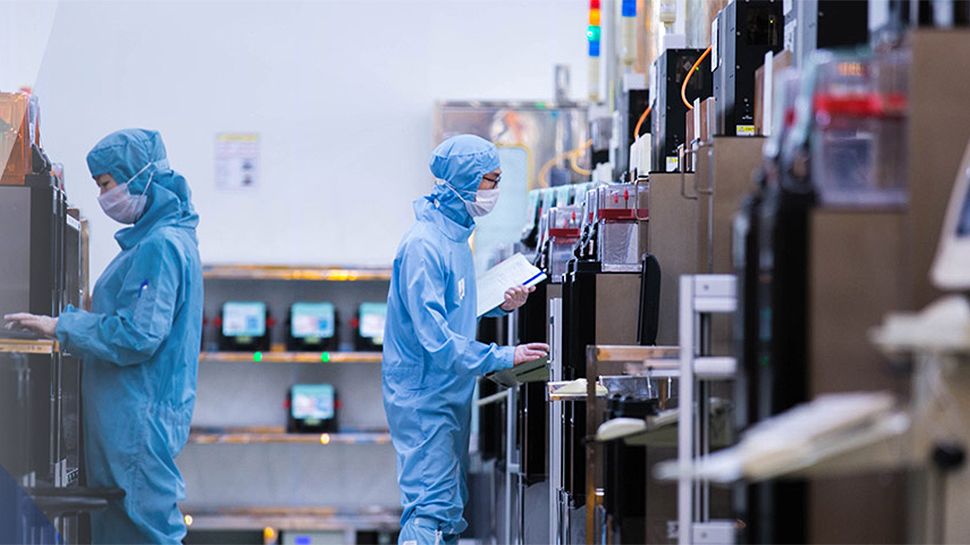
(Image credit: SMIC)
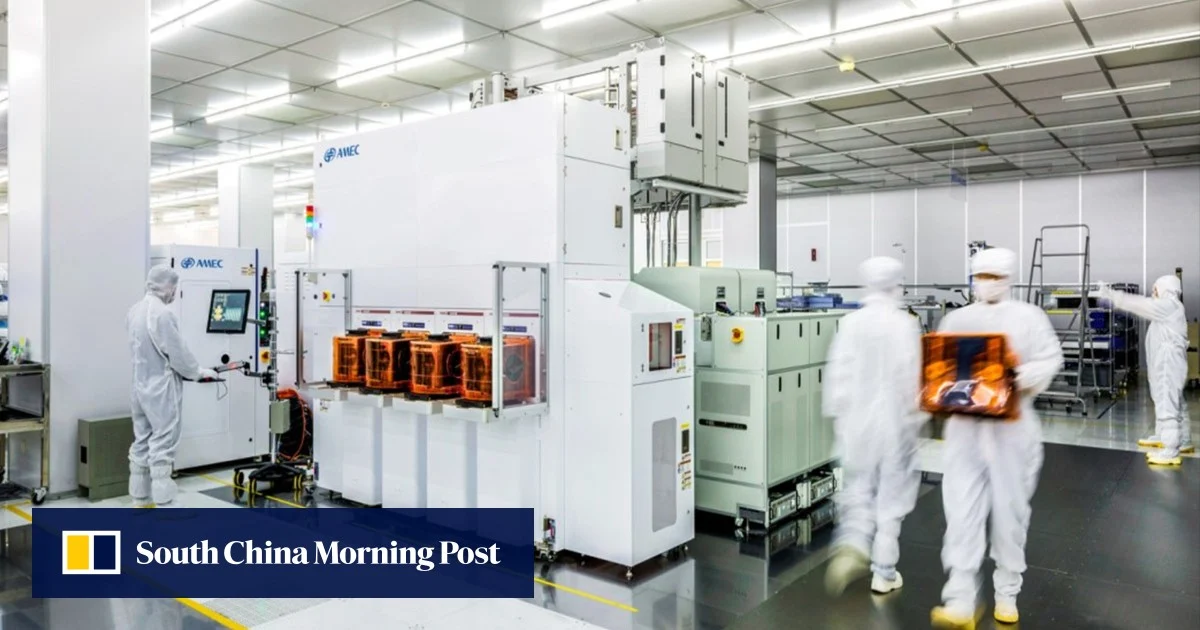
SMIC founder Richard Chang and AMEC chairman and CEO Dr. Gerald Yin appeared together on CCTV's Dialogue program on May 17th to make a coordinated case for Chinese chipmakers to give homegrown equipment more production-line trial time, according to DigiTimes.The strange joint TV appearance came days after Chinese industry figures told Securities Times that the next three to five years will determine whether domestically built tools can move from functional prototypes to equipment that meets the yield, throughput, and uptime demands of volume manufacturing.Record revenues, falling marginsChina's equipment industry grew incredibly fast last year. AMEC, the country's leading etch-tool maker, reported full-year revenue of $1.74 billion USD (12.38 billion RMB), up 36.6% year-on-year, with net profit totaling around $310 million (2.11 billion RMB), up 30.6%.Naura Technology, the broadest-line domestic supplier, posted $3.91 billion (27.14 billion RMB) in revenue across just the first three quarters, while Piotech, which specializes in thin-film deposition, roughly doubled its nine-month revenue to $617 million (4.22 billion RMB). ACM Research, the U.S.-listed cleaning-equipment maker with the bulk of its operations in Shanghai, booked $901.3 million for the full year, up 15.2%.Despite these lofty revenues, margins moved in the opposite direction: AMEC’s full-year 2025 gross margin fell 1.9 percentage points to 39.2%, with the third quarter alone dropping 5.8%, and ACM Research's gross margin slid from 50.1% in 2024 to 44.4% in 2025. The pattern was consistent across the sector.This squeeze is coming from domestic competition rather than foreign pressure. With U.S., Japanese, and Dutch export controls restricting shipments of advanced tools to Chinese fabs, domestic vendors are competing fiercely with each other for orders that previously went to Applied Materials, Lam Research, and Tokyo Electron; Needham & Co. analyst Charles Shi recently told Nikkei Asia that this internal price war is the primary driver of margin erosion.Chinese fabs are now thought to be sourcing roughly 35% of their equipment domestically, up from about 25% a year ago. Beijing's informal target for new fab construction is 50% domestic content, a threshold that YMTC's third Wuhan fab has reportedly already cleared, but the gains are concentrated in mature-node tool categories. Etch localization at mature nodes sits at roughly 50% to 60%, and resist stripping exceeds 80%. According to data from Ijiwei thin-film deposition runs from 20% to 30%, and lithography sits below 5%.A public appealThe Chang-Yin CCTV appearance was ultimately a strange, public, state-sanctioned appeal to Chinese fabs. Chang argued that domestic equipment can’t improve without real production-line trials and said fabs should start with small wafer batches of up to 100 wafers before scaling up to limit the risks of early adoption. Meanwhile, Yin said that Chinese customers still default to foreign tools out of habit, and even new systems from the world's largest equipment vendors typically require two to three years of tuning when first deployed at leading fabs.Industry-standard timelines for qualifying a new etch or deposition tool on a leading-edge production line run 18 to 24 months from installation to qualified production status. The process tests reliability, particle contamination, process drift, and throughput under sustained operation, not just whether the tool can produce a working wafer under controlled conditions.An example highlighted by Yin is that of AMEC, which, in December 2023, decided to enter the large flat-panel display equipment segment, a category he said was previously 100% imported. The tool in question weighs roughly 150 tonnes and measures 15 by 15 meters, but AMEC reportedly built a working prototype in 12 months, met a customer's next-gen specifications four months later, and shipped the tool to a production line within 18 months total. Needless to say, those claims haven’t been independently verified and shouldn't be taken at face value.AMEC also claims SMIC has purchased at least 800 of its tools, a figure Chang cited on the same broadcast, and that its etch technology is used in TSMC's supply chain at nodes from 65nm down to 5nm and 3nm. TSMC hasn’t publicly confirmed the scope of AMEC's role in its production lines, however.Recent disclosures show that SMIC faced yield losses tied to equipment maintenance and validation stalls in 2025, the exact production-line qualification problem Chang acknowledged on CCTV. The foundry has reportedly acquired some foreign tools that are sitting idle because spare parts and field service from sanctioned suppliers are no longer available under normal terms.Still no lithography solutionNone of China's equipment progress addresses the most critical chokepoint: lithography. Shanghai Micro Electronics Equipment (SMEE), the only Chinese supplier of lithography scanners in any volume, produces a 90nm-class ArF system. While a 28nm-class tool has been reported in development, it’s not confirmed in mass production, and details are scarce.One project to watch, however, is the Shanghai Yuliangsheng immersion DUV scanner under test at SMIC. That tool, linked to Huawei-backed SiCarrier under the codename "Mount Everest," resembles ASML's Twinscan NXT:1950i from 2008, two product generations behind the NXT:2000i used in current 7nm and 5nm production. SMIC is thought to be targeting the Yuliangsheng tool for its 28nm production flow in 2027, but sub-10nm lithography on purely domestic equipment is unlikely before 2030.In Q3 2025, 42% of ASML's system sales by revenue went to Chinese customers, confirming that Chinese fabs are buying DUV scanners as fast as current export rules allow. But Washington is working to narrow this window further, with the MATCH Act, which was introduced last month. It names and designates the likes of AMEC, Naura, Piotech, ACM Research, SiCarrier, and SMEE, among SMIC, YMTC, Hua Hong, CXMT, and Huawei, as “Covered Facilities” and would impose a country-wide prohibition on exporting DUV immersion lithography tools to China.The House Foreign Affairs Committee passed the bill 36 to 8 in late April after removing a proposed ban on cryogenic etch tools, which would have affected Lam Research and Tokyo Electron. The DUV immersion ban remains in the bill as it heads toward a Senate floor vote. As of the time of writing, it’s currently sitting in a Senate Committee.China criticized the legislation less than a week before the duo’s state-sanctioned television address to chipmakers. The broadcast itself is ultimately best viewed as part of Beijing's response: a coordinated message that domestic fabs need to accelerate qualification of Chinese-built alternatives before the remaining supply lines are cut.