1. ChangXin Memory Technologies Inc. (CXMT), a Chinese DRAM chip manufacturer, achieved profitability in the first quarter of 2026 due to soaring demand from AI data centers, which led to a chip shortage and price increases. The company's financial turnaround marks a challenge to foreign dominance in the memory chip market, where companies like Samsung, SK Hynix, and Micron have long held sway. [para. 1][para. 2]2. In the first quarter of 2026, CXMT reported a net profit of 33 billion yuan ($4.8 billion) on revenue of 50.8 billion yuan, a sharp reversal from a net loss of 2.8 billion yuan in the same period of 2025. The data, disclosed in an updated IPO prospectus, underscores the impact of rising demand from AI data centers on the company's performance. [para. 3]3. Despite the profitable first quarter, CXMT had accumulated losses of about 36.7 billion yuan by the end of 2025, driven by heavy spending on expanding production capacity and upgrading production lines. [para. 4]4. The global memory market is experiencing an upswing as investments in AI data centers have surged since mid-2025, triggering a DRAM chip shortage. In Q1 2026, DRAM contract prices jumped 93% to 98% year-on-year, and TrendForce projects a further 58% to 63% increase in Q2 2026. [para. 5]5. The chip shortage shows no signs of easing, as the AI industry's development outpaces expectations and intermediaries continue to stockpile inventory, according to Zhao Haijun, co-CEO of Semiconductor Manufacturing International Corp., China's largest contract chipmaker. [para. 6]6. Founded in 2016, CXMT is preparing for an IPO on Shanghai's STAR Market, aiming to raise 29.5 billion yuan to upgrade its technology and production lines. In Q4 2025, CXMT was the world's fourth-largest DRAM maker by sales, holding a 7.7% global market share, per research firm Omdia. [para. 7]7. The company's main products include DDR chips for computers and servers, and LPDDR chips for mobile devices. Its customers include Lenovo Group, Xiaomi Corp., and Oppo Co. Ltd. [para. 8]8. In November 2025, CXMT launched its first domestically developed DDR5 chips, designed for cutting-edge AI computing servers and systems. These chips achieve speeds up to 8,000 Mbps and a maximum single-die capacity of 24 gigabits, with seven module types for servers, workstations, and PCs, and have already been supplied to Lenovo for use in personal computers. [para. 9]AI generated, for reference only
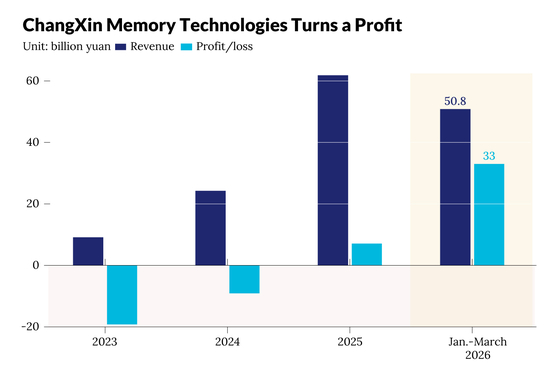
Memory Shortage Works Out for Chinese Chipmaker CXMT
Driven by an AI data center boom and surging memory prices, the company returned to profitability in the first quarter of this year, giving a boost to its Shanghai IPO plans
390 words~2 min read