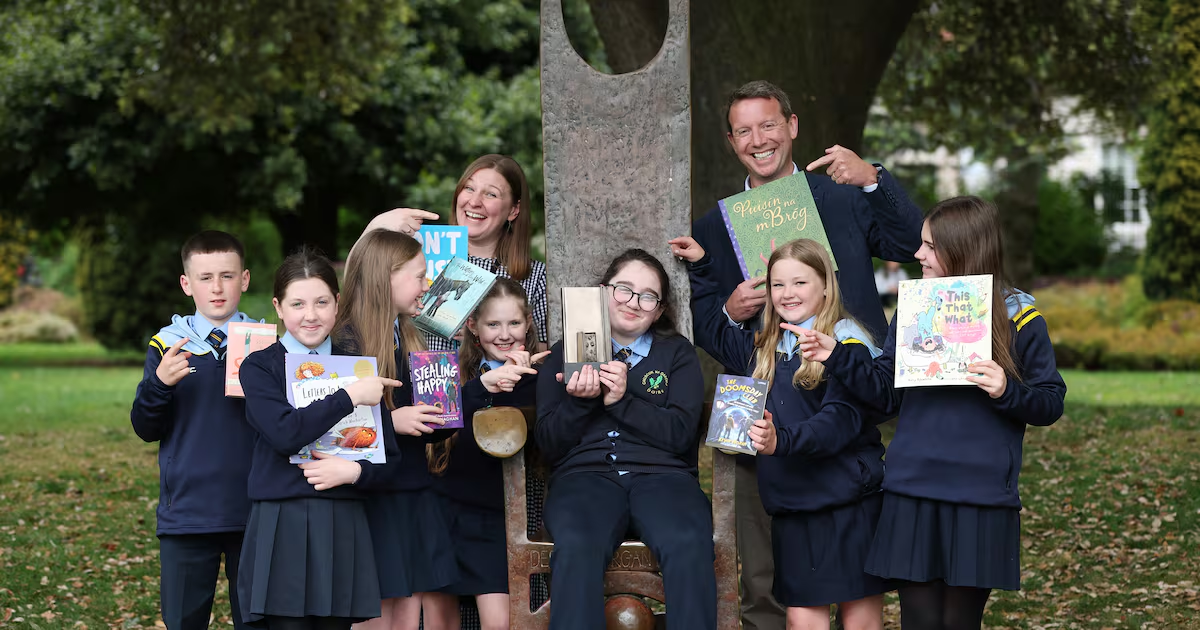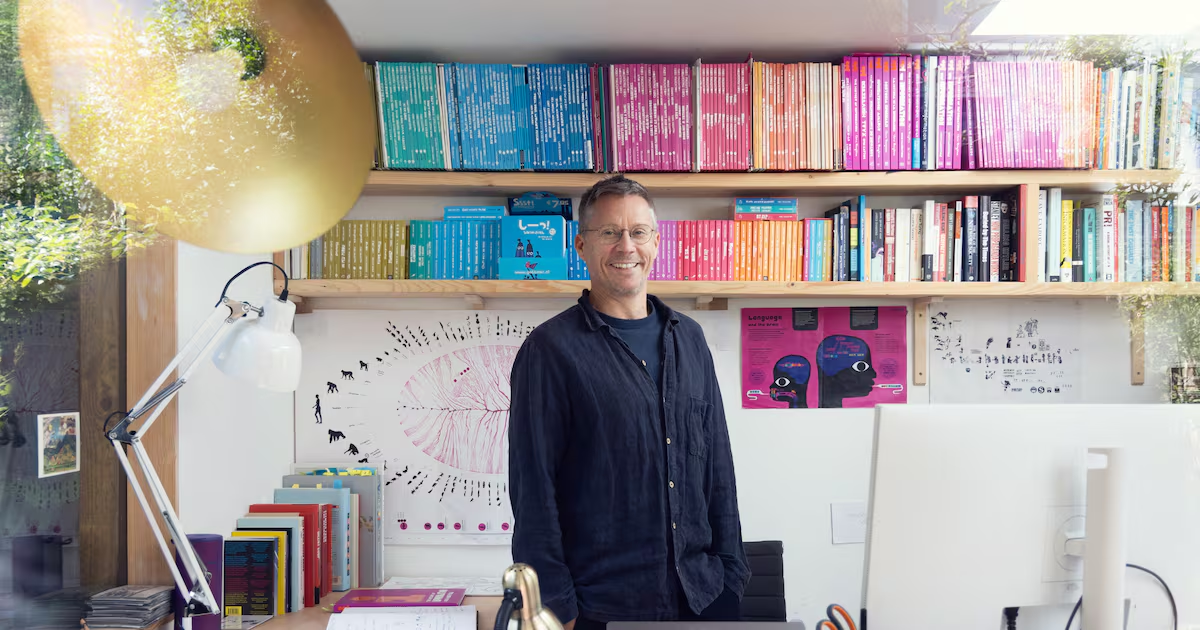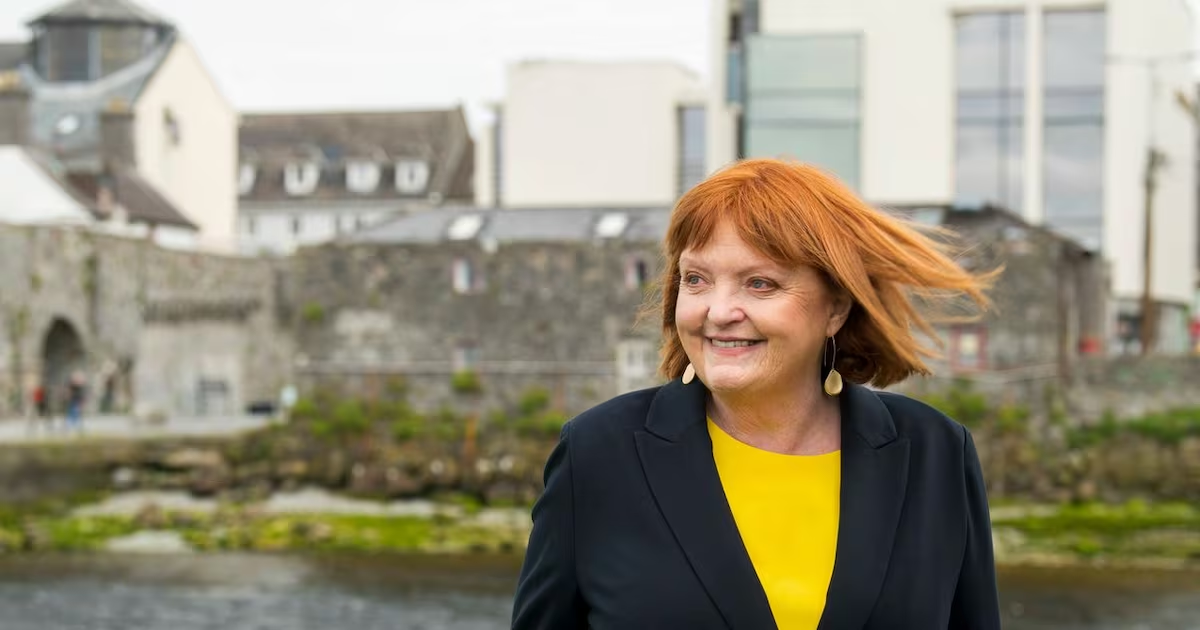
Paddy Donnelly and Trish Forde have history. Donnelly, one of Ireland’s busiest picture book makers, has met Forde many times in the eight years since his first book was published. Forde, meanwhile, published her first book in 1990, and has penned almost 30 titles in Irish and English in the years since. Forde is also the outgoing laureate na nÓg, the most prestigious accolade an aspiring children’s writer might dream of, and it was in the community Forde built among Irish writers for children that the pair became good friends. One of the big projects of Forde’s three-year tenure as laureate, which will come to an end two days after we speak, was the Whole Wild World Bus Tour, which brought authors and illustrators around the country, meeting children in rural schools all along the Wild Atlantic Way. Donnelly, who loves doing live events for children even more than he loves making books for them, was a passenger on the bright, busy bus on dozens of occasions. Together, they are veterans of the road trip: bumping up and down narrow country roads and along closed-off streets to bring books to young readers.Just the week before our shared conversation, Forde was on the road to visit a school on Rathlin Island for one of her final engagements, to speak to children at what must be one of the smallest schools in Ireland. “There we were,” Forde recalls, with the drama of the natural storyteller, “three authors – Eoin Colfer and Oliver Jeffers, two of them the biggest names in Irish children’s literature, were there too – in this tiny school with just nine little ones.” In her telling the adventure sounds like something from a children’s storybook – Arthur Ransome’s Swallows and Amazons, maybe, or any of Enid Blyton’s finder-outer tales – only the protagonists are a group of middle-aged authors instead of a team of children, transported on a boat journey to a mythical place populated only by puffins and a small group of children. Donnelly knows Rathlin well. He grew up across the bay from the island in Ballycastle, and has set several of his picture books there, including The Upside Down Island, which was published by O’Brien Press earlier this spring, and The Golden Hare (2024), which was inspired by the island’s mythology. Donnelly has visited the island school several times, and together he and Forde describe with an easy camaraderie the vital importance such encounters with children play in the encouragement of a love of reading. “The whole idea behind the bus,” says Forde, “was to get out to these sorts of remote places, where kids often miss out on author events: to make sure everybody gets a twist. We are a small enough country, so it is an achievable thing, to reach kids in these very isolated places, and you just can’t underestimate the effect that a live event can have on a child. Often, meeting an author, it is the first time a kid will have even thought there was a human being behind the book.”Donnelly says it took him by surprise when he began doing author visits to school just how impactful his presence was in the classroom. He recently returned to a school in Brussels, where is based, which he first visited a few years ago. “I went into the playground, carrying my books and my drawing gear, and I was like this celebrity coming in with this box of magical stories. They remembered everything. They told me all about the stuff we drew last time, and there were a couple of new kids, so the others started reciting the story of the first book I read to them, to catch them up. It was amazing, from me just reading to them once, how much stayed with them.” Paddy Donnelly. Photograph: Karen Eloot Neither Forde nor Donnelly remembers encountering an author when they were young readers. “There just wasn’t really a community the way there is now,” Forde says, “and there weren’t as many people writing for children.” Her own most-loved book was JRR Tolkien’s The Hobbit, and she was also a ferocious reader of fairy tales. Sinéad de Valera’s volumes for children were a favourite, but so too were Lady Gregory’s, which were collected without young readers in mind. While Forde never gave a thought to the writers of those much-loved books – “You just wouldn’t really know anything about the authors” – the work itself “definitely influenced what I would write later. Reading The Hobbit, I remember being totally blown away, thinking someone can make up a whole world not just a story, and that was really what I wanted to do with The Wordsmith” – which was published in 2015, as Forde’s first novel in English for children. [ Do you need me to draw you a picture? Book illustrators demand equal statusOpens in new window ]“It is set in the future, where there is only one community of people left,” she says, “and – like Tolkien did – I had to create a whole world for the reader.” The mythological influence of the Irish fairy tales, meanwhile, permeated her picture books and still does, as she explains later in our conversation.Donnelly also doesn’t remember meeting an author as a child. “I actually didn’t really encounter any authors until I started writing books myself,” he says. However, like Forde, his childhood literary touchstones have become a reference point for many of his books. He pulls off a copy of his absolute favourite from a bookshelf behind him: a copy of Run with the Wind by Tom McCaughren, cover faded and tea-stained, well-thumbed pages curled, and an inscription from his mother on the first page. “This was it for me,” he says. “I remember reading it over and over again, reading with a torch under the bedclothes when I should have been asleep. I remember every detail, and I can even see where I was when I was reading it. It absolutely formed what kind of books I would go on to write.” Indeed, Donnelly’s 2022 picture book Fox and Son Tailors was directly inspired by the family of foxes that star in McCaughren’s much-loved series, and – seeing how much children enjoyed telling him how much they enjoyed his work – he decided to write to McCaughren, to let him know that his books were the books that made him the writer he is. “So I told him how important his book was to me, and that I had a new book coming out, and the launch was happening in Dubray Books on Grafton Street, and he replied, and said ‘I will be there’, so I did get to meet him in the end.”The Island of the Bees It was accident rather than design, however, that thrust Donnelly and Forde together for their first collaboration, The Island of Bees, published this month. Forde had submitted a new story to her publisher, about a hive of bees that comes to the rescue when a community is threatened by a monster. “I wrote to them and told them I had rewritten this Irish legend about these bees leading a boat to land, and they liked it and we went all the way through to contract ... when I realised it wasn’t based on a myth at all. I couldn’t find [a version of the myth] anywhere, so obviously I must have heard a bit of something – there was definitely a lot of folklore around bees when I was kid: my grandfather kept bees and he used to tell the bees any important news, or if there was a death in the family – but I couldn’t find any corresponding myth so I must have just made it up.” No matter: the story has a wonderful legendary feel, a sparky central character, and an ecological message that resonates strongly with the contemporary moment. Unbeknown to Forde, Donnelly was the illustrator her publisher matched her with: as per standard industry practice, the writing and illustration were commissioned independently. “The thing is,” Forde says, “even though I knew Paddy and his work really well, the great thing about writing a picture book is that the illustrations always surprise you: they add these beautiful little touches that you never thought of, make the world that you just invented with words into something else altogether.”For his part, Donnelly explains that his job as illustrator was to “make the story real for the younger kids who can’t even read yet. For those kids, the visual world might be the whole world.” And yet, while the words and illustrations need to work together, “they are not necessarily telling you the same thing”.Forde chips in with a glint in her eye: “I have recently come to the realisation that the illustrations are actually telling you the truth of what’s really happening. They are concrete, where the words can lie or deceive you or tell you something different. Like ‘Trish would never steal a cookie’, but then you see her in the picture with her hand inside the jar.” It is a resonant image, and I can see the wheels turning in both Forde and Donnelly’s minds as our conversation comes to an end and they head back to their desks: that sounds like a good starting point for a story.The Island of the Bees is published by Puffin
The art of children’s books: ‘The words and pictures are not necessarily telling you the same thing’
Author Patricia Forde and illustrator Paddy Donnelly have formed a special collaboration on The Island of Bees
1,569 words~7 min read