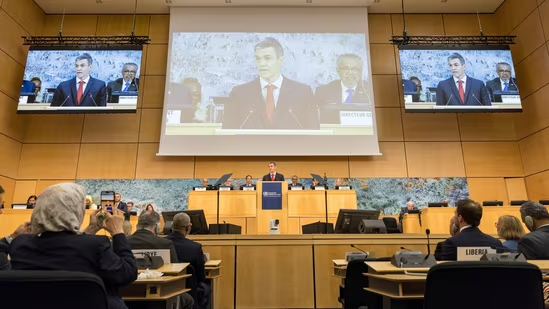
Three years after the World Health Organization (WHO) declared an end to the Covid-19 global health emergency, and as it scrambles to mount a response to a fresh Ebola outbreak, member states remain deadlocked on the question of how the world will share the pathogen samples and genetic data needed to develop vaccines and treatments for the next pandemic.Negotiations on the Pathogen Access and Benefit Sharing (PABS) system, the unfinished annex of the WHO Pandemic Agreement adopted in May 2025, again ended inconclusively at the 79th World Health Assembly in Geneva. (REUTERS)Negotiations on the Pathogen Access and Benefit Sharing (PABS) system, the unfinished annex of the WHO Pandemic Agreement adopted in May 2025, again ended inconclusively at the 79th World Health Assembly in Geneva. Member states have agreed to continue under the Open-Ended Intergovernmental Working Group (IGWG), according to people familiar with the matter.At the core of the impasse is tension between developed and developing nations. Developed countries have pressed for rapid, and in some formulations anonymous, sharing of pathogen materials and digital sequence information into the global system. They have resisted requiring users — pharmaceutical companies, genomic firms, and other commercial and non-commercial recipients — to sign enforceable standard contracts with the WHO setting out their access and benefit-sharing obligations. Developing countries argue this would oblige them to surrender pathogen data with no enforceable guarantee that vaccines and treatments built on that data would be made available to them.Also Read: How to minimise the cost of a falling populationThe PABS system is the last-mile annex before the Pandemic Agreement can be opened for signature and ratification. Article 12 of the agreement commits parties to placing access to pathogens and benefit-sharing on an “equal footing.”According to the non-profit Third World Network, the developed-country bloc — the European Union, Norway, Switzerland, the United Kingdom, Australia, Canada, Japan and South Korea — has increasingly sought to portray developing countries as responsible for the impasse. Developed-country delegations have framed their stand as one of urgency, flexibility and pragmatism.“The effort to portray developing countries as responsible for the current deadlock ignores the reality of these negotiations,” said Guilherme Faviero, director at the AHF Global Public Health Institute. “Key developed countries have repeatedly delayed progress and remained unjustifiably resistant to common-sense proposals intended to operationalize equity.”Unresolved issues include vaccine, therapeutic and diagnostic set-asides during public health emergencies of international concern; production and supply licences; and monetary contributions tied to revenue from PABS materials.Developing countries are seeking these through enforceable standard contracts and user registration.
WHO’s pandemic pact paralysed over pathogen sharing
Member states have agreed to continue under the Open-Ended Intergovernmental Working Group (IGWG), according to people familiar with the matter. | World News
419 words~2 min read