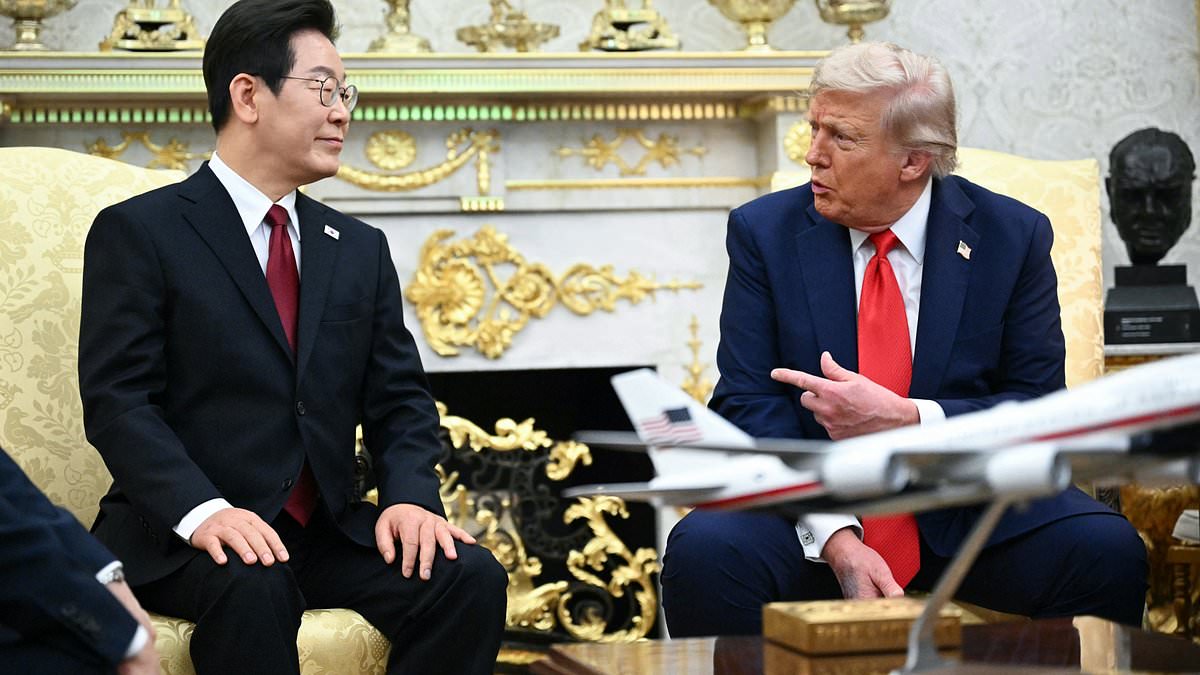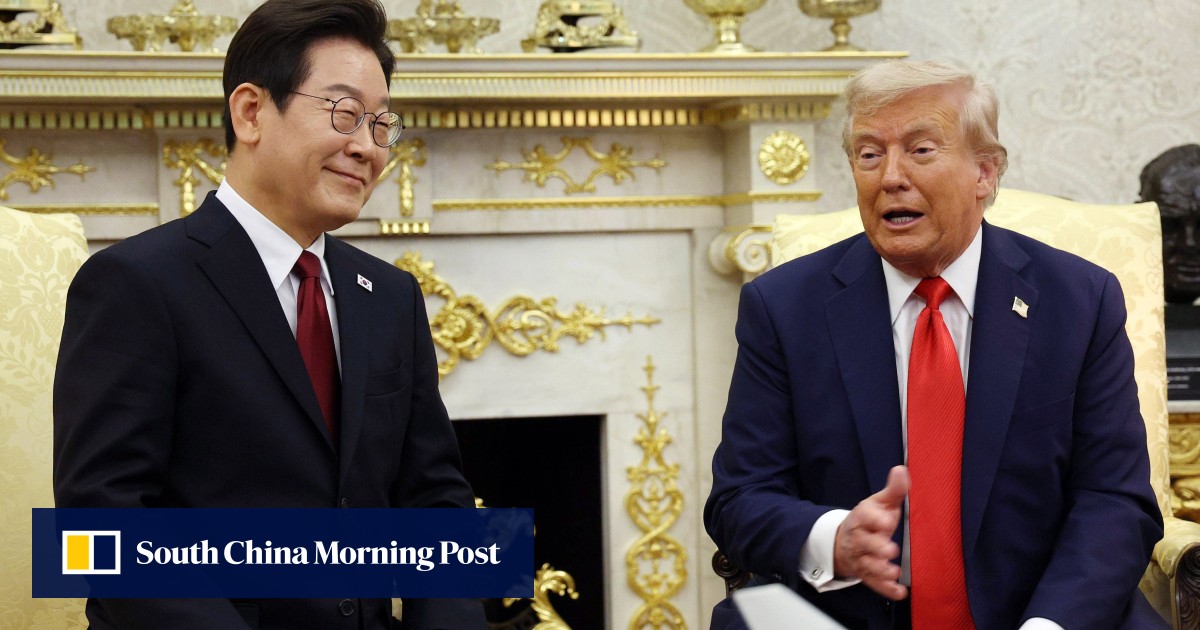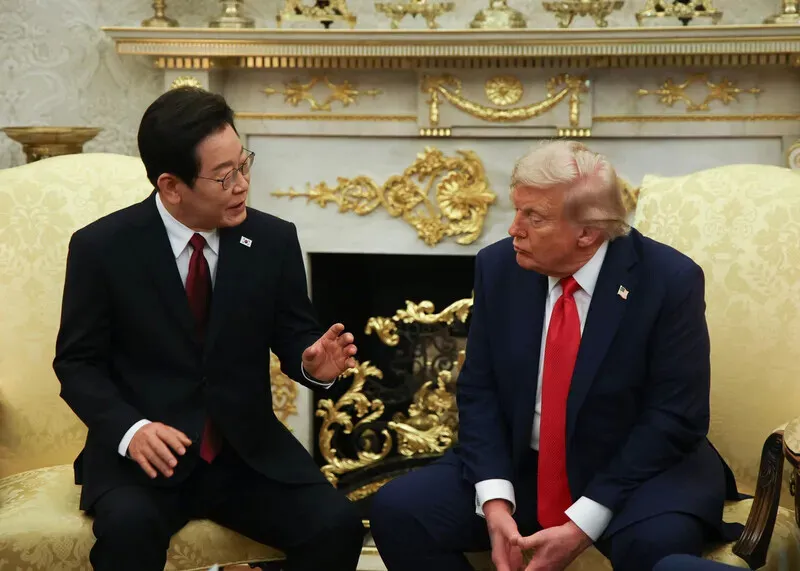
President Lee Jae Myung of South Korea speaks to US President Donald Trump in the Oval Office on Aug. 25, 2025. (Yonhap)
By Kwon Kim Hyun-young, director of the Women’s Reality Research InstituteDuring his summit with South Korea’s president in August, US President Donald Trump made a reference to the “comfort women” issue between Korea and Japan. “Japan wants to get on, but Korea [is] very stuck on [the issue],” he said. South Korean President Lee Jae Myung responded, “I visited Japan beforehand to settle the issues that you may be worried about.”There is only so much one can discern from fragments released by the press, but we can be sure of the following three truths: firstly, Trump used the term “comfort women” to describe the victims of Japan’s wartime sexual slavery system; secondly, this issue was credited as being the source of conflict between South Korea and Japan, as South Korea is refusing to let go; thirdly, Lee stated that the issue was “settled” before the his sit-down with Trump thanks to his summit with the leader of Japan. I first need to address the fact that “comfort women” is a euphemism coined by Japan, the country which created the exploitative system it refers to. The international community does not recognize the “comfort women” issue as one of wartime prostitution, but as a sexual slavery system administered and maintained by a state.Gay J. McDougall, a UN special rapporteur, declared in a 1998 UN Human Rights Report presented in the 50th session of the Sub-commission on Prevention of Discrimination and Protection of Minorities, that “comfort women” is a “euphemistic term” used by the very actors who have caused harm and who seek to minimize the nature of human rights violations, and recognizes the issue as one pertaining to the situation of “systematic rape, sexual slavery and slavery-like practices during armed conflict.”As such, “wartime sexual slave” is a more accurate term to use. Some victims refuse to label themselves as “comfort women,” or find the term deeply hurtful. That is why we use scare quotes to indicate that we do not endorse the use of this phrase. This is not only limited to when the term is written, but also when it comes up during conversations, as it is customary to make air quotes when saying the term out loud. This is a rule invented through much trial and error, born from understanding the psychological pain of those involved. Trump made no air quotes when using that term. I certainly don’t expect him to be sensitive to human rights issues or have a modicum of gender awareness, so this is hardly surprising. This does, however, highlight what Trump’s simplistic rhetoric chooses to ignore: a rhetoric that allows no complexities.The simple way in which he refuses to give any context or explain himself while repeating certain words in plain sentences to emphasize what he wants is an approach that has an objective that resonates with the wrongdoer in this situation.South Korea, meanwhile, was identified as the troublemaker causing the discord between it and its neighbor. Trump used the words “fixated” and “stuck” to demonstrate how South Korea is still grappling with this problem while Japan wishes to move on. Both words signify a state of incapacitation and entrenchment. The Korean media translated those words as something close to “obsession.” While entrenchment describes a state of being stuck between two options, being obsessed with something refers to a more emotional or subjective state of clinging to something and being unable to let go.From a victim’s perspective, the word “obsession” implies a reversal of the power relationship between the perpetrator and victim in this scenario, whereas entrenchment describes the current political difficulties besetting them. No matter how you look at it, the latter is the better option, so I asked a journalist friend of mine why the Korean media chose to use the term “obsession.”While making it clear that this was his personal opinion, he said that it was probably because that was the simplest word to use in that situation. It’s easy to think that simple words are more inclusive. However, this often renders futile the ethical and political struggles involved in conveying complex situations that are difficult to express in simple terms.I do not mean to say that Lee ought to have challenged or corrected Trump on his choice of words during the summit. Lee went so far as to say, “I visited Japan beforehand to settle the issues that you may be worried about.” Despite the definitive way with which he made that statement, in that moment, I was not filled with second-hand embarrassment or humiliation. Some are even praising Lee for shrewdly tapping into a century’s worth of sycophantic diplomacy. It was a moment in which I felt the strengths of pragmatism and moderate conservatism. I also agree with the point that certain aspects of Lee’s character propelled him to face that situation head-on. That being said, we need to remember those who are being shunned. Those worried about the victims of the Japanese military sexual slavery system are not Trump, but the victims themselves and those who stand by them. They are not entrenched or incapacitated. Politics keeps leaving them behind. That, more than anything else, is what worries me.Please direct questions or comments to [english@hani.co.kr]