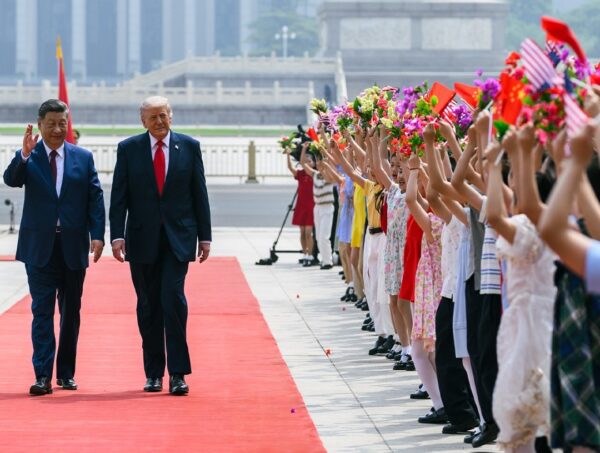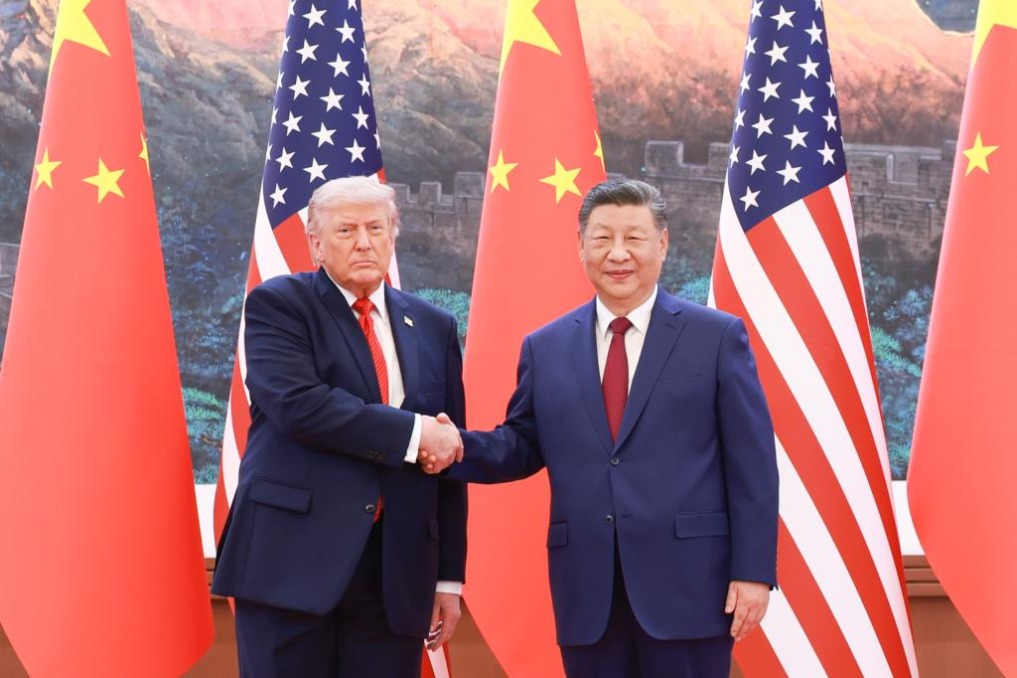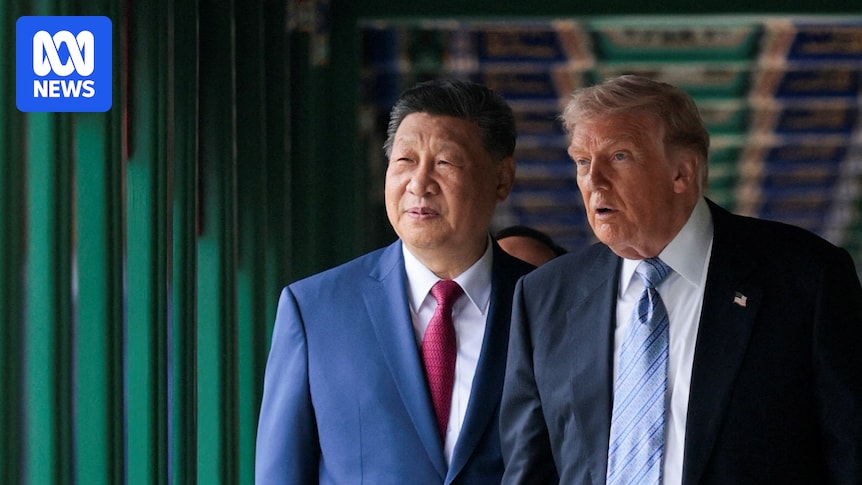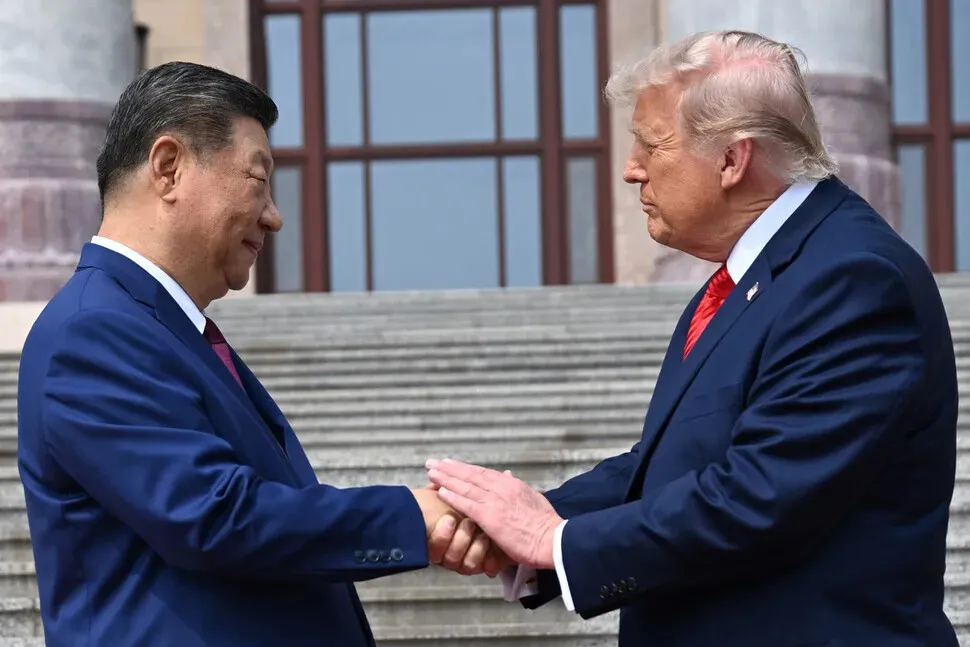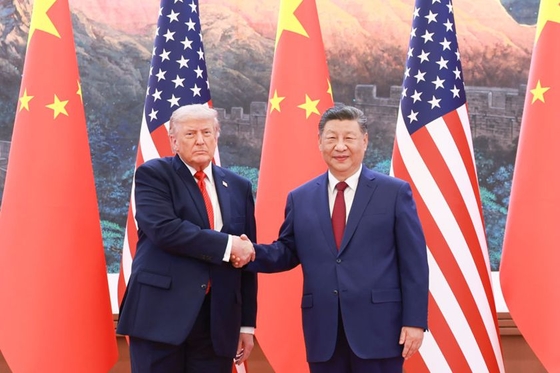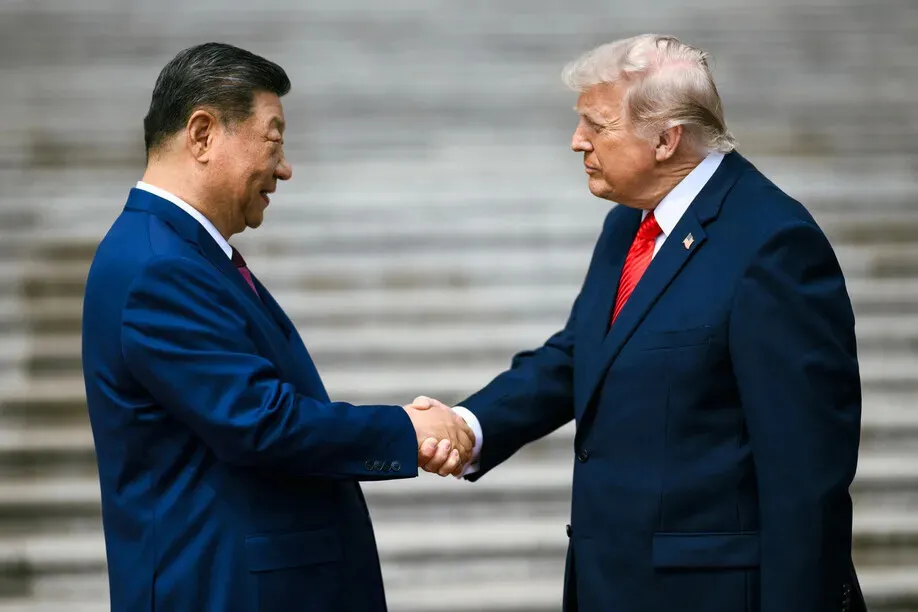
President Xi Jinping of China shakes hands with President Donald Trump of the US during a welcome ceremony at the Great Hall of the People in Beijing on May 14, 2026. (UPI/Yonhap)
The US has agreed to form a “constructive relationship of strategic stability” with China as proposed by Chinese President Xi Jinping during his summit last week with US President Donald Trump in Beijing.Washington’s acceptance of Beijing’s proposed framework for bilateral relations marks a significant shift after years of the US pressuring China on multiple fronts as its “strategic competitor.” Attention is now turning to whether Sino-US relations will enter a phase focused on strategic stability.In a fact sheet released Sunday containing the outcomes of the summit, the White House said that Trump and Xi had “agreed that the United States and China should build a constructive relationship of strategic stability on the basis of fairness and reciprocity.”During their summit, Xi had proposed such a relationship based on cooperation and competition within limits as a new direction for bilateral ties. By advocating the pursuit of mutual stability given the potential consequences of a conflict between their two countries, he projected China’s image as a superpower on par with the hegemonic US, competing in an even match.The Chinese leader on Friday said Trump agreed to set such a relationship as a new direction for bilateral relations, but Trump had made no mention of this new framework when remarking on the outcomes of the summit. Amid uncertainty over whether the US agreed to this vision, the White House officially confirmed in its fact sheet that the two sides had reached a common understanding on the direction of their relationship.This is a shift in Washington’s response to proposals from Beijing. After taking office 2012, Xi proposed a “new type of great power relations” emphasizing equal status with the US and demanding respect for its position on matters such as Taiwan, but the US rejected this.With Trump now facing political and economic pressure both at home and abroad as the war with Iran drags on, he appears to have opted for the path of strategic stability in relations with China.Wang Yong, a professor at the School of International Studies of China’s Peking University, told the Hankyoreh that this was a stronger-than-expected outcome from the summit. “This shows that China has risen to a position where it cooperates and competes with the US on equal footing,” he said. The White House on Sunday said the two presidents reaffirmed their shared goal of a nuclear-free North Korea. US Trade Representative Jamieson Greer also told ABC that day that Trump and Xi “both agreed that the goal on the Korean Peninsula remains denuclearization.”The Trump administration also highlighted the summit’s economic achievements, such as China’s agreement to purchase more American agricultural products and the launch of bilateral boards for trade and investment. The White House said China pledged to buy at least US$17 billion worth of American agricultural products each year between 2026 and 2028.The White House said this was separate from China’s pledge in October last year to buy American soybeans. Beijing also agreed to “restore market access” for over 400 US beef facilities and to cooperate with US regulators to lift all restrictions on such facilities. The two countries also announced that they would establish separate boards for trade and investment. Regarding the ongoing war in Iran, Trump and Xi also agreed that Iran must not be allowed to possess nuclear weapons and urged Tehran to reopen the Strait of Hormuz, while stressing that no country or entity should be allowed to impose tolls in strait.Yet it remains unclear what measures China promised to take to keep the strait open. According to Greer, Trump was “very focused on making sure that they didn’t provide material support to Iran. That’s a commitment he obtained and confirmed.”By Lee Jeong-yeon, Beijing correspondent; Kim Won-chul, Washington correspondentPlease direct questions or comments to [english@hani.co.kr]