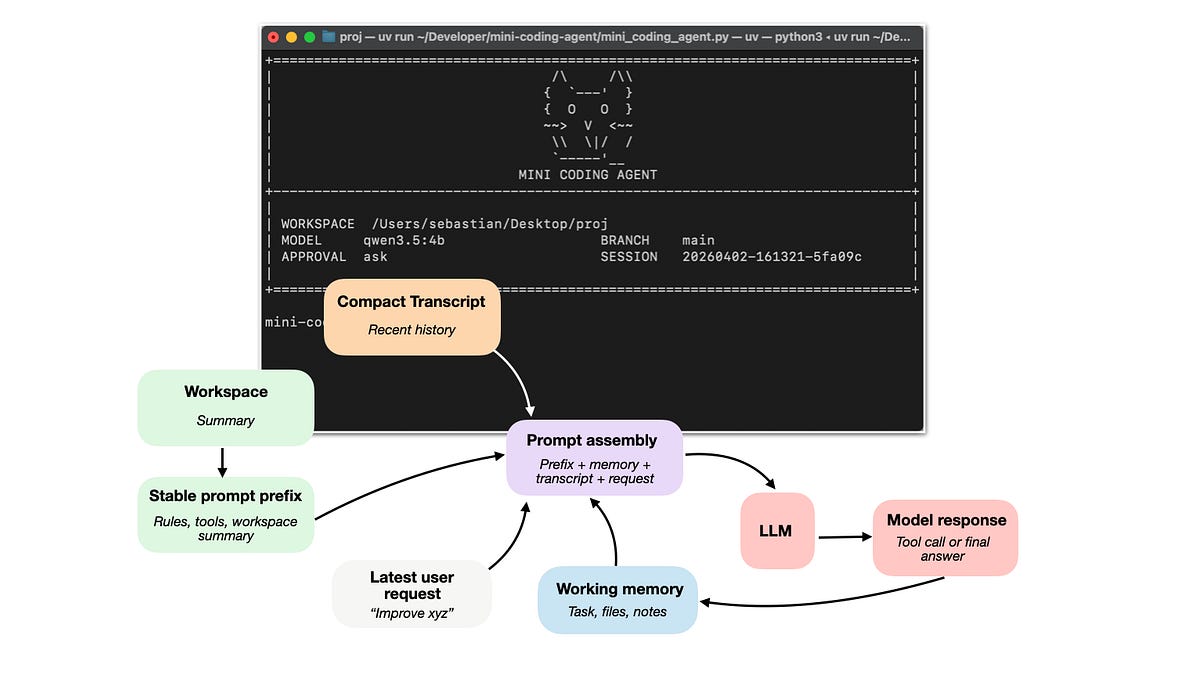
In this article, I want to cover the overall design of coding agents and agent harnesses: what they are, how they work, and how the different pieces fit together in practice. Readers of my Build a Large Language Model (From Scratch) and Build a Large Reasoning Model (From Scratch) books often ask about agents, so I thought it would be useful to write a reference I can point to.More generally, agents have become an important topic because much of the recent progress in practical LLM systems is not just about better models, but about how we use them. In many real-world applications, the surrounding system, such as tool use, context management, and memory, plays as much of a role as the model itself. This also helps explain why systems like Claude Code or Codex can feel significantly more capable than the same models used in a plain chat interface.In this article, I lay out six of the main building blocks of a coding agent.You are probably familiar with Claude Code or the Codex CLI, but just to set the stage, they are essentially agentic coding tools that wrap an LLM in an application layer, a so-called agentic harness, to be more convenient and better-performing for coding tasks.Coding agents are engineered for software work where the notable parts are not only the model choice but the surrounding system, including repo context, tool design, prompt-cache stability, memory, and long-session continuity.That distinction matters because when we talk about the coding capabilities of LLMs, people often collapse the model, the reasoning behavior, and the agent product into one thing. But before getting into the coding agent specifics, let me briefly provide a bit more context on the difference between the broader concepts, the LLMs, reasoning models, and agents.An LLM is the core next-token model. A reasoning model is still an LLM, but usually one that was trained and/or prompted to spend more inference-time compute on intermediate reasoning, verification, or search over candidate answers.An agent is a layer on top, which can be understood as a control loop around the model. Typically, given a goal, the agent layer (or harness) decides what to inspect next, which tools to call, how to update its state, and when to stop, etc.Roughly, we can think about the relationship as this: the LLM is the engine, a reasoning model is a beefed-up engine (more powerful, but more expensive to use), and an agent harness helps us the model. The analogy is not perfect, because we can also use conventional and reasoning LLMs as standalone models (in a chat UI or Python session), but I hope it conveys the main point.Figure 2: The relationship between conventional LLM, reasoning LLM (or reasoning model), and an LLM wrapped in an agent harness.In other words, the agent is the system that repeatedly calls the model inside an environment.So, in short, we can summarize it like this:LLM: the raw modelReasoning model: an LLM optimized to output intermediate reasoning traces and to verify itself moreAgent: a loop that uses a model plus tools, memory, and environment feedbackAgent harness: the software scaffold around an agent that manages context, tool use, prompts, state, and control flowCoding harness: a special case of an agent harness; i.e., a task-specific harness for software engineering that manages code context, tools, execution, and iterative feedbackAs listed above, in the context of agents and coding tools, we also have the two popular terms agent harness and (agentic) coding harness. A coding harness is the software scaffold around a model that helps it write and edit code effectively. And an agent harness is a bit broader and not specific to coding (e.g., think of OpenClaw). Codex and Claude Code can be considered coding harnesses.Anyways, A better LLM provides a better foundation for a reasoning model (which involves additional training), and a harness gets more out of this reasoning model.Sure, LLMs and reasoning models are also capable of solving coding tasks by themselves (without a harness), but coding work is only partly about next-token generation. A lot of it is about repo navigation, search, function lookup, diff application, test execution, error inspection, and keeping all the relevant information in context. (Coders may know that this is hard mental work, which is why we don’t like to be disrupted during coding sessions :)).Figure 3. A coding harness combines three layers: the model family, an agent loop, and runtime supports. The model provides the “engine”, the agent loop drives iterative problem solving, and the runtime supports provide the plumbing. Within the loop, “observe” collects information from the environment, “inspect” analyzes that information, “choose” selects the next step, and “act” executes it.The takeaway here is that a good coding harness can make a reasoning and a non-reasoning model feel much stronger than it does in a plain chat box, because it helps with context management and more.As mentioned in the previous section, when we say harness, we typically mean the software layer around the model that assembles prompts, exposes tools, tracks file state, applies edits, runs commands, manages permissions, caches stable prefixes, stores memory, and many more.Today, when using LLMs, this layer shapes most of the user experience compared to prompting the model directly or using web chat UI (which is closer to “chat with uploaded files”).Since, in my view, the vanilla versions of LLMs nowadays have very similar capabilities (e.g., the vanilla versions of GPT-5.4, Opus 4.6, and GLM-5 or so), the harness can often be the distinguishing factor that makes one LLM work better than another.This is speculative, but I suspect that if we dropped one of the latest, most capable open-weight LLMs, such as GLM-5, into a similar harness, it could likely perform on par with GPT-5.4 in Codex or Claude Opus 4.6 in Claude Code. That said, some harness-specific post-training is usually beneficial. For example, OpenAI historically maintained separate GPT-5.3 and GPT-5.3-Codex variants.In the next section, I want to go more into the specifics and discuss the core components of a coding harness using my Mini Coding Agent: https://github.com/rasbt/mini-coding-agent.Figure 4: Main harness features of a coding agent / coding harness that will be discussed in the following sections.By the way, in this article, I use the terms “coding agent” and “coding harness” somewhat interchangeably for simplicity. (Strictly speaking, the agent is the model-driven decision-making loop, while the harness is the surrounding software scaffold that provides context, tools, and execution support.)Figure 5: Minimal but fully working, from-scratch Mini Coding Agent (implemented in pure Python)Anyways, below are six main components of coding agents. You can check out the source code of my minimal but fully working, from-scratch Mini Coding Agent (implemented in pure Python), for more concrete code examples. The code annotates the six components discussed below via code comments:##############################
Components of A Coding Agent
How coding agents use tools, memory, and repo context to make LLMs work better in practice
3,322 words~15 min read