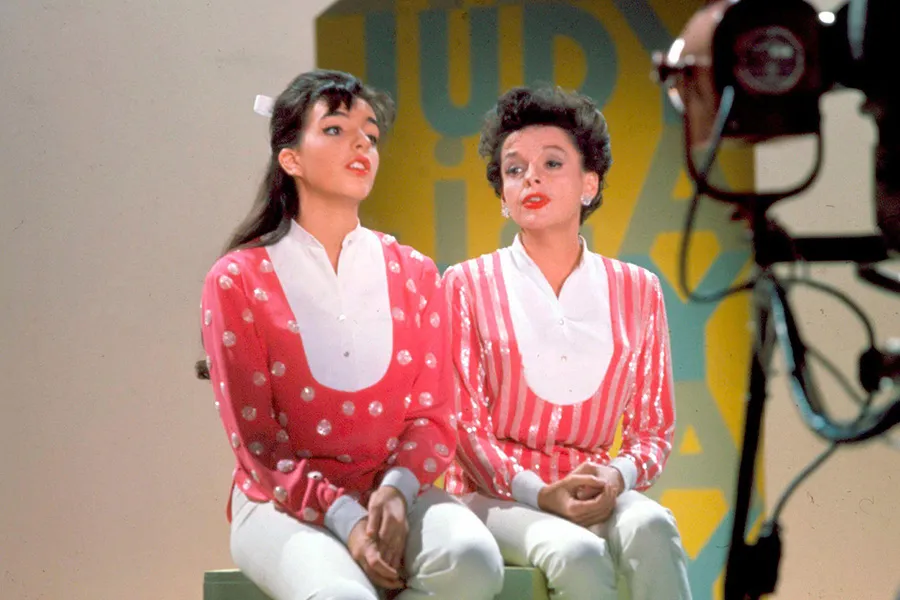
On the night of November 8, 1964, five years before her death at age forty-seven from an “incautious self-overdosage” of sleeping pills, Judy Garland costarred with Liza Minnelli in a concert at the London Palladium. It had been a difficult year for Garland, to put it mildly. On January 22 The Judy Garland Show was canceled after only one season, and on February 8 she was taken to Mount Sinai Hospital after being found on the floor with cuts on her face. In March she was sued by a hotel for an unpaid bill dating back to 1959, and in April she was charged $69,000 in legal fees for renovations to her house on Rockingham Drive in Brentwood, California.Her agent David Begelman, with whom she was having an affair, was embezzling from her, and she was divorcing her third husband, Sidney Luft, while fighting for custody of her two younger children, Lorna and Joey. “Sid Luft is an animal,” she said in tape-recorded notes toward an autobiography she did not write. “I will tell the world whenever I can that he is a thief, a blackmailer, a sadist and a man who doesn’t even care one bit one way or the other about any other living soul, let alone his nice children.” Luft’s lawyers, in turn, described Garland as “an unfit mother” with a barbiturate-related “mental illness”; his accusation that during their relationship she had tried to kill herself no fewer than twenty times became headline news.To avoid further damaging publicity Garland went on a three-concert tour of Australia, accompanied by Mark Herron, a gay gigolo with whom she had become infatuated and whose acting career she had decided to promote. When they landed in Sydney on May 11 her barbiturates and amphetamines were confiscated by customs officers; they were later replaced, according to Garland’s biographer David Shipman, by a “Chinese backstreet abortionist” whose doses were far stronger than what she was used to. On May 20 she was booed off the stage at Melbourne’s Festival Hall after arriving over an hour late and struggling through her set in a state of disorientation.On May 28, two days after the body of her eldest sister, Suzy, was found in her Las Vegas home, Garland took an overdose in Hong Kong’s Mandarin Oriental hotel. She was in a coma for more than fifteen hours, and the tabloids excitedly reported the star’s death. On June 12, her divorce from Luft not yet finalized, Garland married Herron in a ceremony presided over by a Buddhist priest. On July 20 she cut her wrists in London, and on July 23, only hours out of the hospital, she sang—against medical advice—at the Palladium for the charity gala Night of a Hundred Stars. The applause was rapturous. The Palladium saved her, and she was determined to return. That November, no longer able to do a show on her own, she invited her eighteen-year-old daughter to join her. “A lot of people have tried to explain the history of this concert,” Minnelli says in Kids, Wait Till You Hear This!, her riveting new memoir. “Here’s what really happened.”Two years earlier Minnelli had dropped out of school to become an actor in New York City. Her father, Vincente Minnelli, was supportive, and Garland discouraging. “You’re going to make it on your own, baby,” she warned. “There will be no money from me.” Unable to pay her hotel bills, Minnelli slept some nights in Central Park and crashed on various sofas until she was taken in by her mother’s assistant Stevie Phillips, who became her friend and agent. Modeling gigs paid for her acting classes, and in 1963 she was given the part of Ethel Hofflinger in a revival of the musical Best Foot Forward, for which she later won a Theatre World Award. On the show’s opening night, Minnelli saved front-row seats for Garland, Luft, Lorna, and Joey—who, to her devastation, did not appear. “I mixed up the dates,” her mother lied on the phone, speaking with the accompaniment of what Minnelli calls “a violin section of Judy Garland tears.” Best Foot Forward (which ran from April to October that year) was a box office hit, and later that April Minnelli made her debut appearance on The Ed Sullivan Show: “Millions got to see me for the first time. Life was beautiful…. Then, as I should have expected, Mama had other plans.”Taping for the doomed Judy Garland Show began on June 24, 1963 (prerecording was essential, owing to Garland’s volatility). She now demanded that Minnelli drop her New York commitments in order to support her: “Darling, I’m just trying to help you. This will be the biggest show in history!” Minnelli duly left Best Foot Forward in the middle of the run and flew to Los Angeles. “I loved my mother. I still do,” she reflects more than sixty years later. “Still, I could never forget the feelings of hurt—abandonment, even—when Mama made it clear that her needs were more important than my feelings…. I was wounded to the core.” The episode of The Judy Garland Show that aired on November 17 was a celebration of the bond between Garland and Minnelli. It opened with Garland, surrounded by billboard-size photographs of Liza as a child, singing the Gershwin song “Liza (All the Clouds’ll Roll Away),” and it closed with mother and daughter hugging and weeping. It’s now too mawkish to watch, but Minnelli describes her mother’s achievement as a triumph: “Surely, we told ourselves, the network would see the beauty and rich artistry she brought to her Sunday-night show.”After The Judy Garland Show hit the skids—“destroying Mama’s last hope of security and assured stardom”—Minnelli was offered the starring role of Lili in Carnival, which meant a return to New York. “When I told Mama the news, she exploded with anger,” Minnelli writes. “She threatened me in every possible way. I had no idea how far she’d go to get me to back out.” Ten days before the musical opened in January 1964, Garland sent out a press release saying that Minnelli (who was still a minor) would not be appearing. Minnelli then told the press that she would be appearing, and Garland’s lawyers threatened to sue the producers. “As much [as] I loved her,” says Minnelli, “I would not, could not, give in again.” Garland eventually backed down, and the reviews of Carnival “were raves.”That May, days after Garland’s disastrous Melbourne show, Minnelli recorded her first album, Liza, Liza, with Capitol Records (Garland’s own label). “Some heard echoes of Mama in my voice,” Minnelli writes. “Fair enough. Others heard something new, current, and different.” Now able to afford the rent on her own apartment, she had achieved independence. In August, when Garland phoned her from London to say that it was “time to make another comeback,” they both laughed. She was the “queen of the comeback,” Garland liked to say; she couldn’t go to the powder room without making a comeback. She then added “the killer line”: “I want you to do it with me. And Liza, you’ve accomplished so much on your own, I want you to have equal billing.” Minnelli was “confused, to say the least. Also wary.” She declined the offer, and Garland said, “Okay,” before phoning the newspapers with the news that Judy Garland and Liza Minnelli would be performing together at the London Palladium in November. “There was nothing I could do,” Minnelli says. “I was stuck.”Garland opened the show with five songs, and then Minnelli, looking and feeling like a “scared teenager,” was introduced to “polite applause.” She began her own set with “The Travelin’ Life,” and “the audience, which had seemed mildly curious about me, woke up in a hurry. They cheered!” So did Garland. “Yeah, baby!” she shouted from the wings. “Go get ’em!” After the second song, Garland again shouted, “Yeah!”—but, Minnelli notes, “not quite as strong. By the third song, let’s just say she was losing enthusiasm.” As Minnelli exploded into her final number, Garland was “freshening her lipstick. Like she was putting on armor and getting ready for battle.” While singing through “wild applause,” Minnelli somehow heard Garland whisper to the producer, “‘Get her off my fucking stage!’ I heard it!”Garland then joined Minnelli for a duet of “Hello, Dolly!,” retitled “Hello, Liza!,” during which she repeatedly jerked Minnelli’s mic down from her mouth, as if “showing the crowd I was still a novice.” After taking their final bows, they returned together to the dressing room, before Garland “raced back onto the stage by herself for another final bow! I turned around, saw this, and raced back to stand with her.”The audience had been watching, as Minnelli describes it, the battle of a lifetime compressed into two hours. “A daughter says: ‘I’m gonna do what I’m gonna do, and you can’t stop me—don’t even try.’ The mother fights it at first…. Then she realizes that her little girl is now a woman.” But in a sense they’d been watching a remake of A Star Is Born (1954), one of Garland’s last successful films.“It’s remarkable, really,” wrote Lorna Luft in her own memoir, Me and My Shadows (1998), “how much of our life begins before we’re even born.” The history of the Palladium concert did not start with Minnelli’s rise in 1963 or Garland’s fall in 1964. It might be traced back to 1924, when Frances “Baby” Gumm, age two, performed in a vaudeville act with her older sisters in their father’s movie theater in Grand Rapids, Minnesota; or 1935, when Judy Garland, as she was now known, signed with MGM and was pumped full of uppers to keep her going for seventy-two-hour stretches, downers to knock her out at night, and Benzedrine to make her thinner; or 1939, when, already an addict, she played Dorothy in The Wizard of Oz; or 1943, when she worked with Vincente Minnelli on the set of Meet Me in St. Louis (he was directing, she was starring); or March 1946, when she named their newborn daughter after the Gershwin song (“Liza Minnelli! It’ll look terrific on a movie marquee!”); or 1950, when she was fired by MGM and cut her throat with broken glass; or 1951, when she divorced Vincente Minnelli and, as Liza saw it, “destroyed the one truly stable relationship in her life”; or 1955, when the Academy Award for Best Actress went not to Judy Garland for A Star Is Born but to Grace Kelly for The Country Girl. “That still stings,” writes Minnelli. “My mother never recovered.”In 1966 Garland met Mickey Deans when he impersonated a physician to deliver pills to her from a street dealer. Deans, says Minnelli, was “the last in a long line of men who claimed they could ‘save’ Mama from herself, revive her career, and create their own.” In 1968, to escape the IRS, Garland and Deans moved to London, where she staggered through a five-week run of slurred performances at the Talk of the Town nightclub, and in March 1969 they married. The last time Garland called Minnelli was to invite her to the wedding, but Minnelli, filming Tell Me That You Love Me, Junie Moon, couldn’t spare the time. Her mother’s death a few months later, in the bathroom of her rented house in Belgravia, takes place on page 107 of Kids, Wait Till You Hear This! Minnelli is twenty-three, and soon she will pop her first Valium; there are fifty-seven years and three hundred pages still to go: Garland’s ghost is felt on every one of them.Minnelli, now age eighty, is eleven years sober, and Kids is presented as a recovery “journey” aimed at others afflicted with substance use disorder. More than one hundred hours of recorded conversations between her and the singer and pianist Michael Feinstein, and “decades of personal papers,” have been whittled down and whipped into shape by Josh Getlin and Heidi Evans, making the memoir a team effort not unlike the construction of a musical. At times it feels like we are in a musical, because Minnelli’s world is built from show songs and the book is filled with her favorite lyrics. “I never sing to an audience,” she says of her performances. “I’m singing to you. And as I reach out, I’m asking—have you ever been through this?”The “shared emotional moment” she creates onstage is replicated in her intimacy with the reader: “My prayer is that my story might help you—or anyone you love—if you’re battling this insidious problem.” Minnelli even gives us a national help line number and suggests we “reach out” to her “directly at www.LizaMinnelli.com/recovery” for support and advice. But despite being loaded with gratitude and twelve-step wisdom, Kids is less about addiction than matrophobia. The term, coined by the poet Lynn Sukenick and developed by Adrienne Rich in Of Woman Born (1976), describes not the fear of one’s mother but the fear of becoming her, and Minnelli’s battle against this horror results in a surprisingly complex and involving read. It is to the credit of Getlin and Evans that they have kept the contradictions in Minnelli’s character when other cowriters might have ironed them out. The woman talking to us is a living, breathing, fully dysfunctional human being.What we learn from Kids is that Minnelli lived Garland’s life to the full. She loved and revered her, but she also loathed and resented her. She protected and continues to protect her, and she felt for many years responsible for her death. While she carved out for herself an opposing personality—Garland played the victim, Minnelli the survivor; Garland asked for sympathy, Minnelli offers empathy—she could never separate from her mother because she inherited her addictive tendencies, the “disaster burned into [my] DNA.” She also inherited Garland’s genius for live performance, blind trust in crooks, attraction to gay men, and capacity to fall in love instantly, as though hypnotized. She wants Garland to be remembered as “one of the world’s most celebrated, beloved, and iconic performers,” but she also wants to be greater than Garland, and more celebrated. She fears that her ambition reflects badly on her, so when she triumphs over Garland, she enjoys the moment only briefly before stepping back in line.We watch this dynamic play out in the prologue, which begins with Minnelli, age nineteen, winning the Tony for Best Actress in a Musical for her Broadway debut, Flora the Red Menace. Her name is called out by Bert Lahr, who played the Cowardly Lion in The Wizard of Oz: “I’m Dorothy’s daughter, the youngest person ever to win this honor.” Garland, meanwhile, is hospitalized at UCLA, having had an “allergic reaction” to her pills, although she will be well enough to perform the next night at the Thunderbird Hotel in Vegas. Garland “didn’t think I had a chance to win,” Minnelli tells us, adding:
Mommie Dearest | Frances Wilson
In Liza Minnelli’s riveting memoir, the ghost of Judy Garland is felt on every page.
4,874 words~22 min read