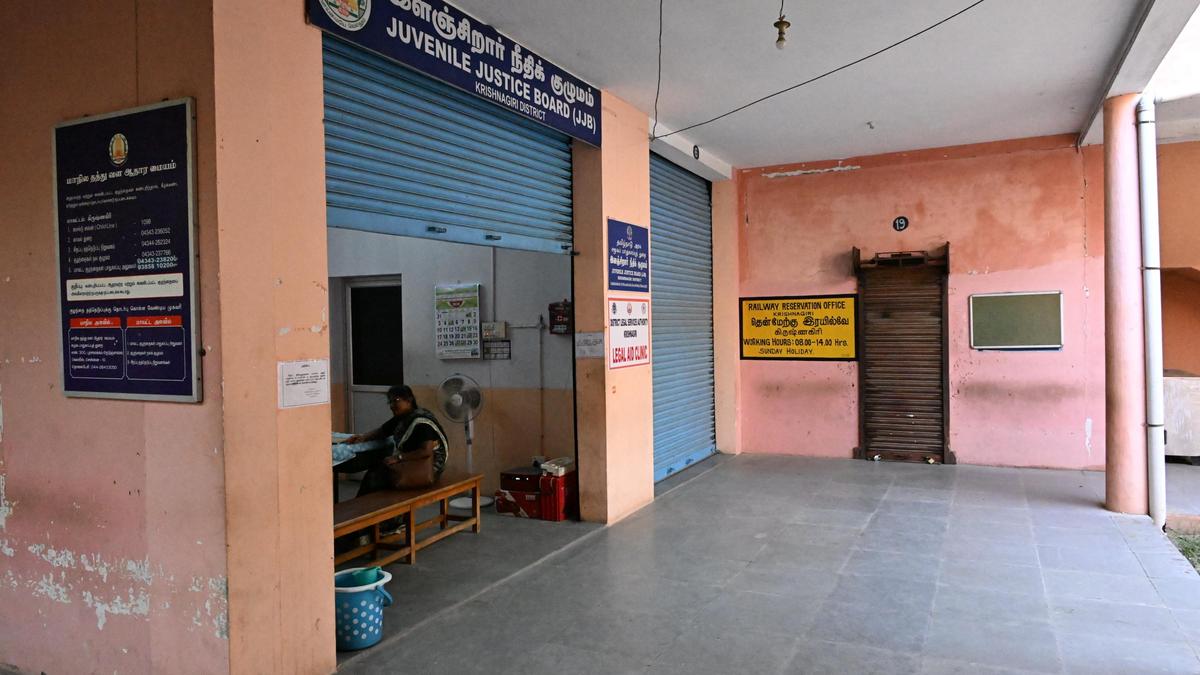
Juvenile Justice Board abutting the railway reservation counter at the commercial complex near the new bus stand in Krishnagiri.
| Photo Credit: N. BASHKARAN
Inside the run-down commercial complex across the new bus stand in Krishnagiri function two critical institutions that are supposed to be the pillars of justice and support for survivors of child abuse. They are supposed to shield the children from prying public glare and offer them the anonymity and privacy they desperately need.But in the bustling corridors of the DRDA-owned commercial complex, which also happens to house a railway booking counter and a mechanic shop that draws a steady stream of people, privacy is non-existent.For the past 14 years since 2012, offices of the Juvenile Justice Board (JJB) and the Child Welfare Committee (CWC) have been functioning from two shop rooms, with their shutters painted in dull blue and entrances that don’t bother to be discreet.A recent case can shed light on why the right location for these institutions matters. Last week, a 14-year-old girl’s photos were stolen off her social media account and morphed into obscene images allegedly by three juveniles, all under 15 years of age. The child was then coerced into recording and sharing her private video with the trio. When the matter came out, the three juveniles were apprehended and sent to an observation home in Salem.At some point, the case will come up for hearing before the JJB as it deals with crimes committed by underage offenders. When that happens, it is likely that the survivor and the offenders will come face-to-face at the narrow waiting area or will have to share the seating bench overlooking the railway booking counter, causing another episode of trauma to the girl, opined an activist working with child survivors of sexual abuse.This begs the question as to how much of a “safe space” can these offices be if they expose particularly vulnerable children to public eye. It also underlines why an enabling environment is key to the experience of justice delivery for child sexual abuse survivors, added the activist - working with children of abuse and child witnesses - wishing to be anonymous.“What happens to survivors when there is peer-to-peer involvement in a crime, and the child survivor and the offenders are forced to share the same cramped corridors? “Why should child survivors assaulted by children be treated any differently than the children assaulted by adults?” asked the activist.Storing evidenceA JJB member, who didn’t wish to be named, said the chamber housing critical evidence such as mobile phones and cameras is also at the same complex with zero security.What’s more, a poorly kept public restroom serves both the victims and the officials.“There have been times when we requested the survivor and the family to wait at the CWC chamber next door,” added the official source.According to an official of the CWC, who also sought anonymity, this has been the only building they have known. “The DCPU [District Child Protection Unit] was also located here before it was shifted to the Collectorate. We need an additional room where police personnel and family members of the survivors can wait. District Collector C. Dinesh Kumar said a stand-alone building has already been allocated to the JJB at Kattiganapalli, and they were planning to shift the JJB there after the vacation.According to the JJB source, however, the new location, a Village Poverty Reduction Committee (VPRC) building, needed compartments to house the JJB. “The hall can only be used after partitions are put up, and we are waiting for the funds to set up the compartments and cabins.”When contacted, the District Collector said he was not informed about the fund requirement. “If funds for the partition is the only issue, I will take it up; it was not brought to my attention. We will allot funds and set it up. If the CWC can also be moved to the same location, arrangements can be made for that as well,” he said.As of March, there were 191 cases pending at the Krishnagiri JJB, which has its magistrate sitting on every Thursday. Of these, 32 cases are POCSO cases. Published - May 19, 2026 07:07 pm IST