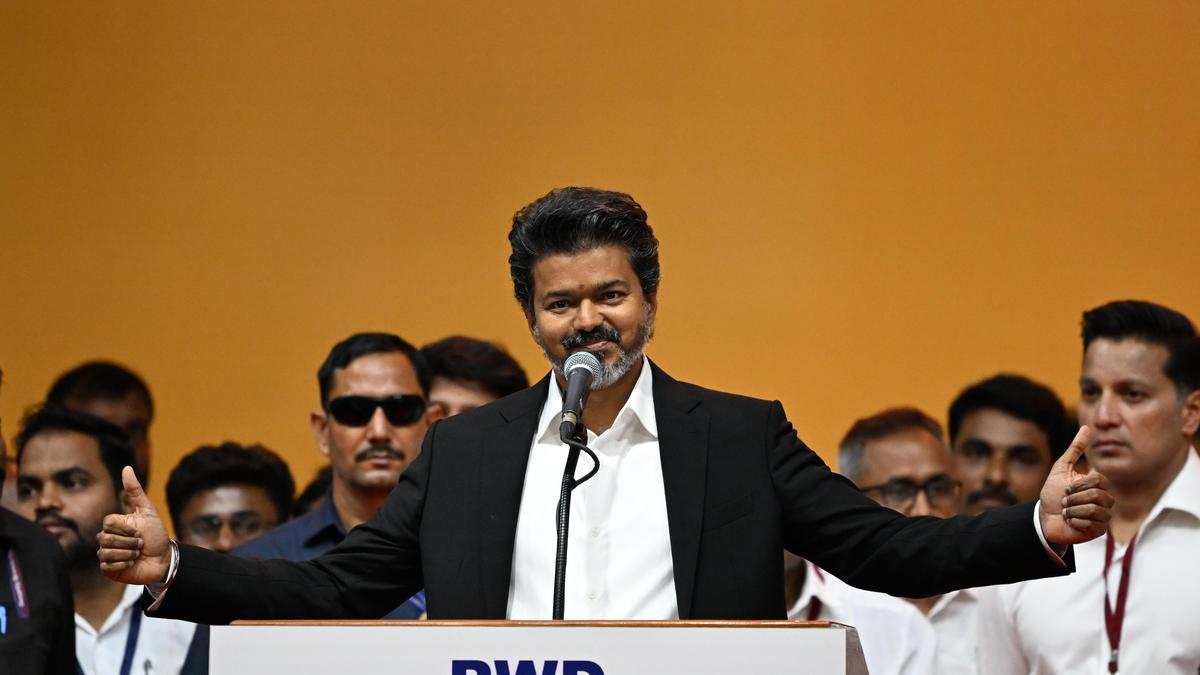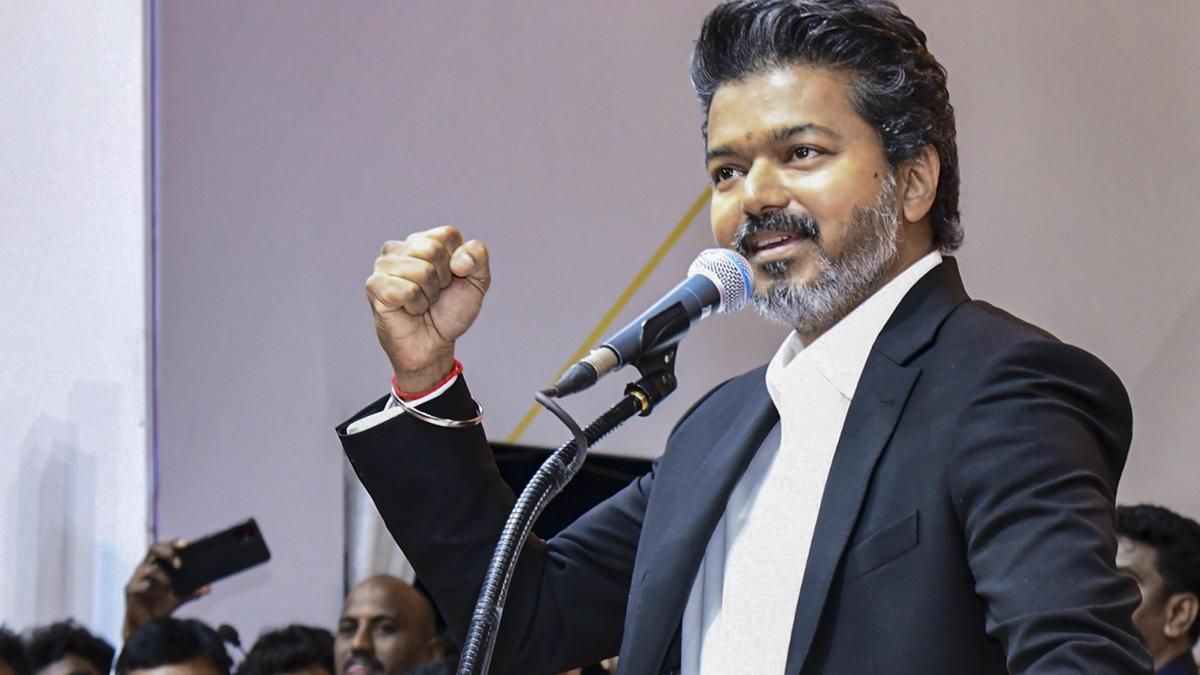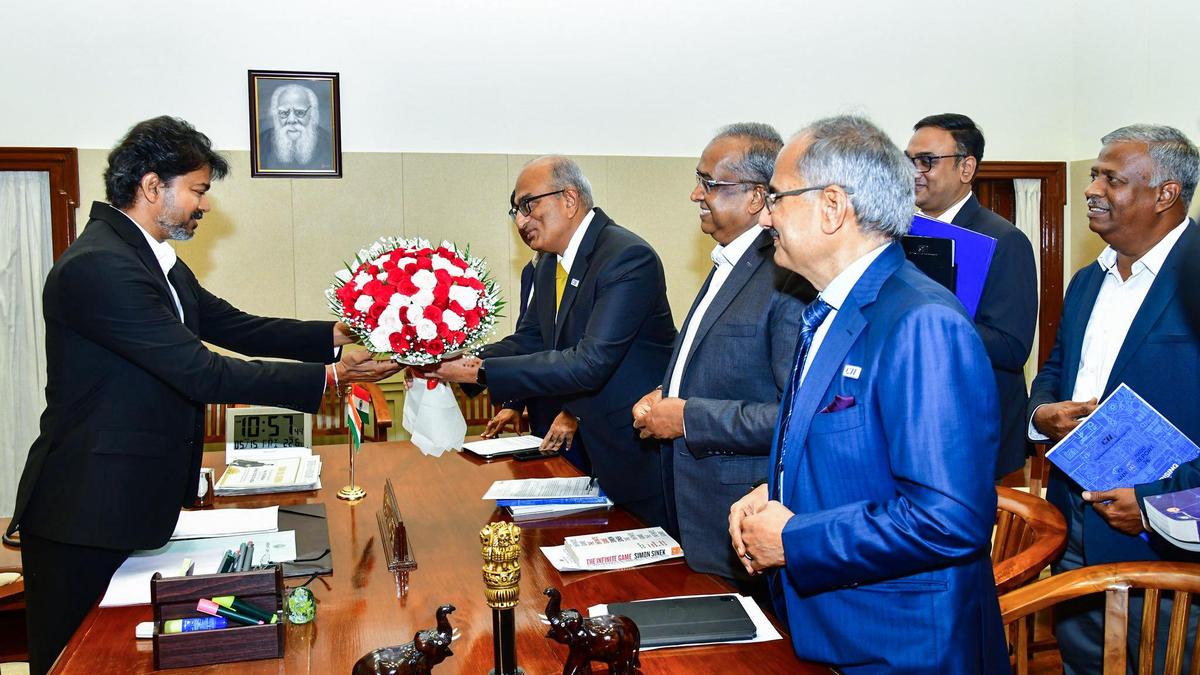
Tamil Nadu Chief Minister Vijay at a meeting with Chairman of the Southern Region of the CII, P. Ravichandran and the executives, in Chennai (file photo)
| Photo Credit:
Vijay’s Tamilaga Vettri Kazhagam, in existence only since February 2024, created history by ending 59 years of unbroken Dravidian dominance shared between the DMK and the AIADMK, by winning 108 Assembly seats and forming a government with post poll allies.Political disruption is extraordinary by any measure. However, for investors, analysts, and policymakers watching from Tamil Nadu’s financial corridors, the more consequential story is now unfolding on a very different stage: the State’s balance sheet.Tamil Nadu is not an average Indian State but rather one with a unique identity. With only 4 per cent of the country’s land and 6 per cent of its population, it contributes roughly 9.4 per cent of India’s GDP. Its economy crossed ₹31 lakh crore in FY25, growing at 11.19 per cent in real terms, the fastest rate of any State that year. It is the country’s automobile manufacturing capital, a rising electronics powerhouse, and an increasingly attractive destination for foreign investment.The welfare wagerTVK’s election manifesto is unapologetically redistributive. The party promised ₹2,500 every month for women heading households, ₹3,000 per month for senior citizens and widows, ₹4,000 monthly unemployment allowance for graduates, a complete crop loan waiver for small farmers, 200 units of free electricity per year, six free LPG cylinders annually, and a ₹15,000 crore dedicated fund for MSMEs.These are not narrow or niche pledges but broad commitments. They cut across virtually every demographic segment of Tamil society, from the paddy farmers in Thanjavur to the unemployed engineering graduates in Coimbatore. Estimates based on the TVK manifesto and existing State budget data suggest that Tamil Nadu’s welfare expenditure could rise by more than 52 per cent, pushing the total annual bill to ₹1 lakh crore.If this expansion is financed without building significant new revenue streams, the State’s fiscal deficit could climb from the currently budgeted 3 per cent of GSDP to nearly 4 per cent. This one-percentage-point gap may seem manageable in isolation. In practice, for an economy the size of Tamil Nadu, this translates to tens of thousands of crores in additional market borrowings.State bondsThe most immediate financial signal to watch will come from the State’s bond market. Tamil Nadu raises money from capital markets through State Development Loans (SDLs). Tamil Nadu ranks among India’s most active SDL issuers. If the new government’s spending ambitions push annual borrowing significantly higher without a corresponding lift in revenues, the spread on Tamil Nadu’s paper could widen.This would raise the cost of debt servicing and gradually crowd out capital expenditure on roads, ports, and industrial infrastructure that sustained growth depends on.There is a real irony embedded in this dynamic: welfare spending that is intended to uplift families today can, if poorly calibrated, chip away at the economic vitality that makes welfare affordable in the future.The talent trapIf the fiscal math is TVK’s first flashpoint with the business community, the proposed private sector job reservation policy is likely to be its second. TVK’s manifesto includes a pledge to reserve 75 per cent of private sector jobs for Tamil Nadu residents.On the surface, it sounds like a straightforward nod to local pride. IT firms anchored in Chennai, including large employers such as TCS, Infosys, Cognizant, and Wipro, have grown by drawing on a national talent pool without restrictions.A hard localisation quota would introduce exactly the kind of friction that competing destinations such as Telangana, Karnataka, and Maharashtra would be happy to exploit. Similar legislation in Andhra Pradesh and Haryana was struck down in the courts, and the same outcome seems probable in this case.Staying optimisticThe general consensus within the business community is that the State’s manufacturing momentum and investment pipeline are unlikely to reverse. According to most credible estimates, Tamil Nadu is on track to become a $1- trillion economy by 2031. It is embedded in the State’s industrial geography, workforce, port infrastructure, and decades-long culture of policy continuity.The State’s per capita income stood at ₹3.62 lakh in FY25, nearly 1.77 times the national average. The party’s manifesto includes an ambitious long-term target of building a ₹1.5-trillion Tamil Nadu economy by 2036, a goal that can only be reached if the investment climate remains compelling.Every election manifesto is, at its core, a document of aspirations. The real test of governing intent comes when a government sits down to write its first budget.Vijay won this election on the promise of change, on the energy of a generation that felt unrepresented by the old Dravidian duopoly, and on the credibility of a man who walked away from one of Indian cinema’s most lucrative careers to make a different kind of mark. The political achievement is genuine and historic. However, the financial test is just beginning.Saravanan is a professor of finance and accounting at IIM Tiruchirappalli and Williams is the Head of India at Sernova FinancialPublished on May 19, 2026