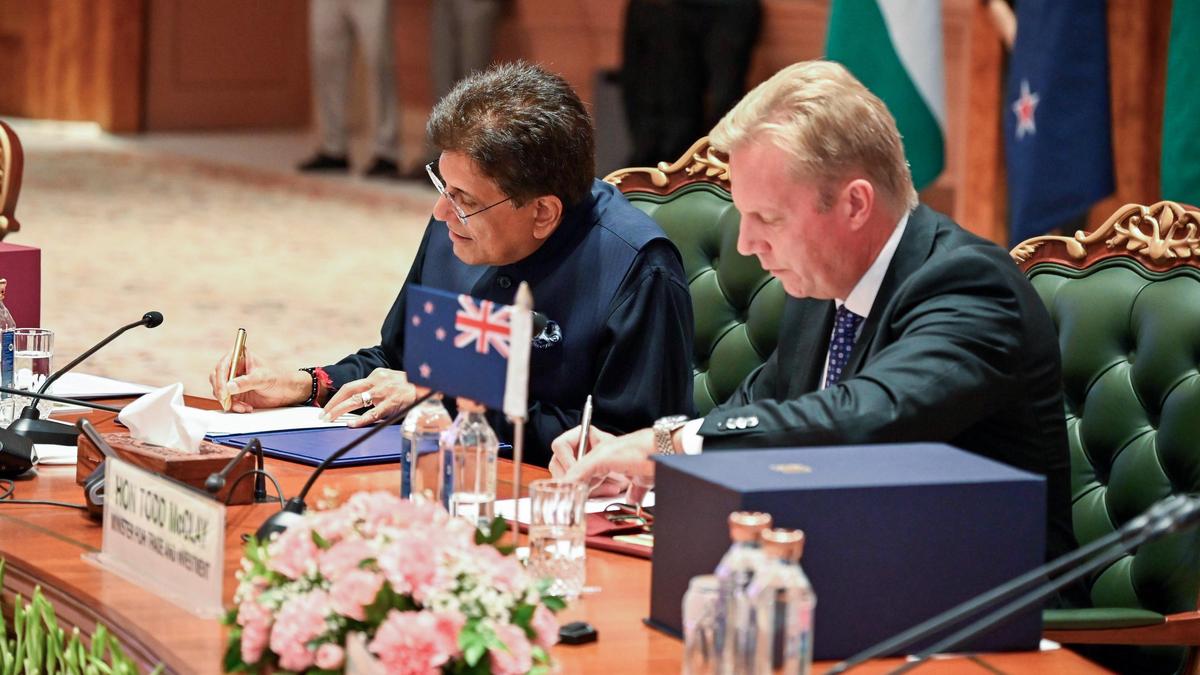
India and New Zealand signed their bilateral Free Trade Agreement on April 27, adding another partner to India’s steadily expanding FTA network, which now covers all RCEP countries except China.By itself, New Zealand may not appear a large market. With a population of just 5.3 million and annual imports from India of only around $700 million — barely 1.8 per cent of New Zealand’s imports — the commercial gains may seem modest.Yet, at a time when India urgently needs to diversify and expand exports — merchandise exports in 2025-26 financing only about 57 per cent of imports — every additional market matters. The presence of a 3,00,000-strong Indian diaspora in New Zealand and the scope for expanding services exports further strengthen the case for the agreement.The FTA grants duty-free access from day one for all Indian products entering New Zealand. While New Zealand’s average MFN tariff is low at around 2 per cent, and nearly two-thirds of its tariff lines are already duty free, some labour-intensive sectors important for India face significantly higher tariffs.Garments, for instance, attract average duties of nearly 10 per cent, while several footwear and textile items also face higher rates. Indian exporters in these sectors will now obtain parity with competitors from China and ASEAN countries that already enjoy preferential access to the New Zealand market. Penetrating that market will still require sustained export promotion, but tariff-free access certainly helps.Advantage pharmaIndian generic pharmaceuticals, currently accounting for exports of around $60 million, stand to benefit as well. Side letters accompanying the FTA confirm that New Zealand recognises approvals granted by regulators in Australia, the EU, Canada, Singapore, the UK, Switzerland and the US as comparable to their own. This could significantly expedite regulatory approvals for Indian prescription medicines, including generics and biosimilars, as well as medical devices already cleared by those regulators.Other important Indian exports to New Zealand include shrimps, spices, tea, coffee, rice, gold jewellery, electrical machinery, auto components and refined petroleum products. Tariffs on these products vary, particularly for processed agricultural items such as spices. The move to zero tariffs across the board should therefore improve competitiveness for Indian exporters.On the import side, New Zealand exports mainly primary products to India — wood and wood pulp, steel and aluminium scrap, coal and wool — many of which serve as industrial inputs. New Zealand is also a major agricultural exporter. Fresh fruits are among its leading exports to India, and the FTA provides limited tariff-rate quota access for apples, kiwifruit, albumins and Manuka honey.Interestingly, the agreement incorporates seasonal safeguards reflecting New Zealand’s geographical advantage. Apple imports under the tariff quota will be permitted only from April to August, and kiwifruit from April to mid-October — periods that largely do not coincide with the Indian harvest season. Minimum import price conditions will also apply.As in India’s recent FTAs with other partners, wine tariffs will be reduced gradually depending on price bands. Dairy products, however, remain fully excluded. Overall, around 29 per cent of tariff lines have been kept outside tariff liberalisation, broadly similar to the exclusion levels under India’s ECTA with Australia.Services potentialServices trade presents another important dimension. According to New Zealand’s figures available at disaggregated levels, its services exports to India amounted to NZ$1.14 billion in 2025 (1 US$ equals around 1.68 NZ$) somewhat exceeding its merchandise exports. Nearly 95 per cent of this comes from travel services, especially education-related travel spending by Indian students.India’s own services exports to New Zealand are considerably smaller at around NZ$470 million, and computer and business services account for around only NZ$110 million. This area offers substantial growth potential. The FTA provides greater certainty regarding visas for intra-corporate transferees, installers and servicers, independent professionals, and accompanying dependants.Additionally, the agreement creates a new Temporary Employment Entry visa pathway with an annual quota of 5,000 visas for skilled Indian professionals for stays of up to three years. Covered sectors include IT, engineering, healthcare, education and construction, while professionals such as AYUSH practitioners, yoga instructors, Indian chefs and music teachers are also eligible. There is also an Annex on student mobility and post study work visa and a separate understanding on holiday work visas.One particularly noteworthy provision is New Zealand’s commitment to facilitate $20 billion in FDI inflows into India over a 15-year period, echoing a similar feature in India’s FTA with the EFTA countries. Achieving this target, however, will not be easy. New Zealand’s cumulative FDI into India since 2000 amounts to only around $88 million. Considerable effort from both governments and industry bodies will be required to generate investor interest.Two additional provisions could nevertheless create useful opportunities. First, the agreement provides for economic and technical cooperation in sectors such as horticulture, apiculture, livestock, fisheries, wines and organics — areas where New Zealand possesses significant expertise.Second, India has committed to a fast-track arrangement allowing duty-free imports from New Zealand for products used exclusively for further processing and re-export. This facility could potentially extend even to dairy inputs otherwise excluded from the FTA.The dedicated New Zealand investment desk that India is required to establish under the agreement should therefore work proactively to integrate these various provisions into concrete investment initiatives. There may be significant opportunities, for instance, for New Zealand investors and Indian partners to collaborate in export-oriented agro-processing ventures using duty-free New Zealand inputs for value-added exports from India.Ultimately, FTAs are only enabling frameworks. Their success depends on the quality of follow-up — export promotion, investment facilitation and business-to-business engagement. India’s mission in New Zealand can also play an important role in ensuring that this agreement evolves from a modest bilateral arrangement into a meaningful economic partnership. New Zealand’s leaders have already termed it a ‘once-in-a-generation pact’.The writer is former Ambassador and Senior Fellow, Delhi Policy GroupPublished on May 19, 2026
India-New Zealand trade pact: Beyond a small market
The FTA can boost Indian pharma and services, while New Zealand can gain in agri exports
959 words~4 min read