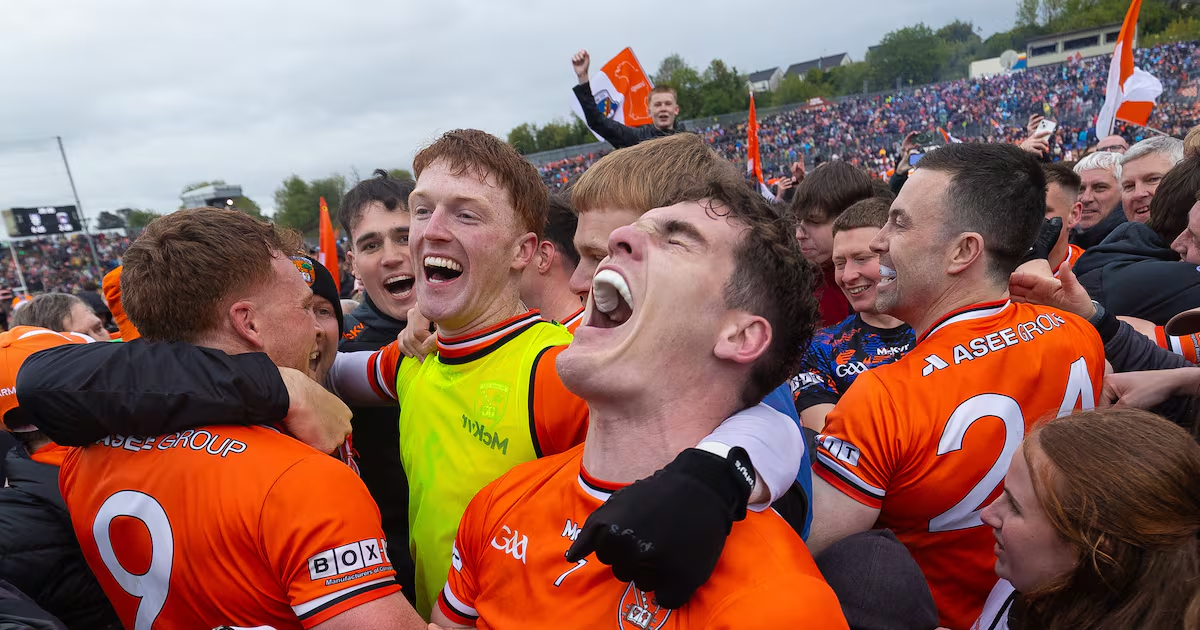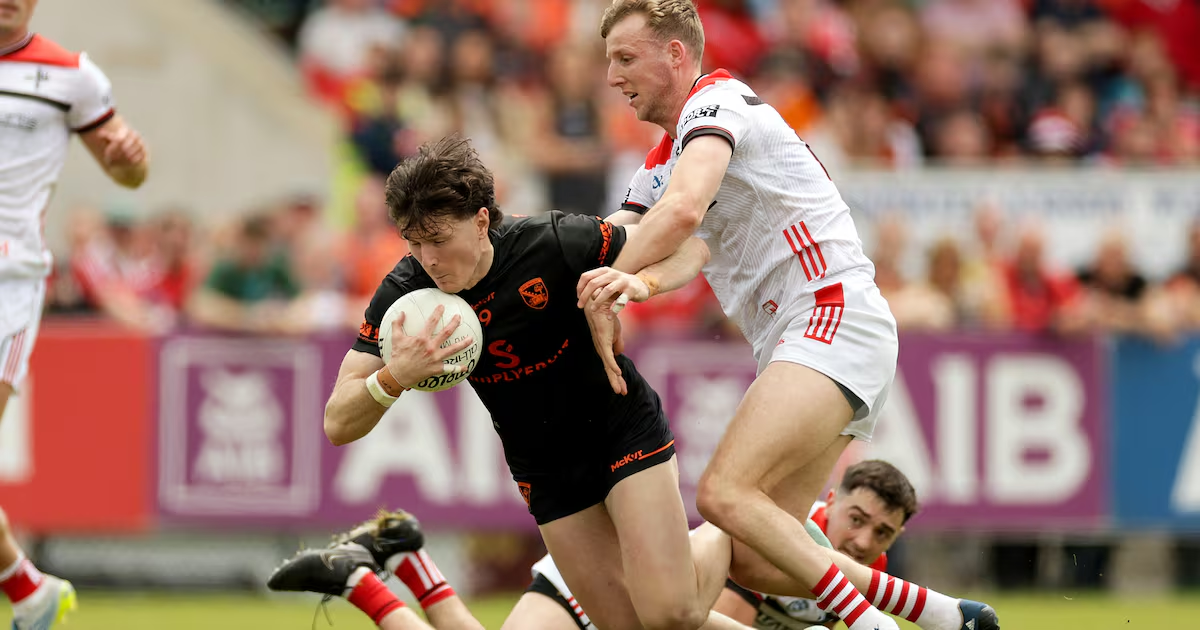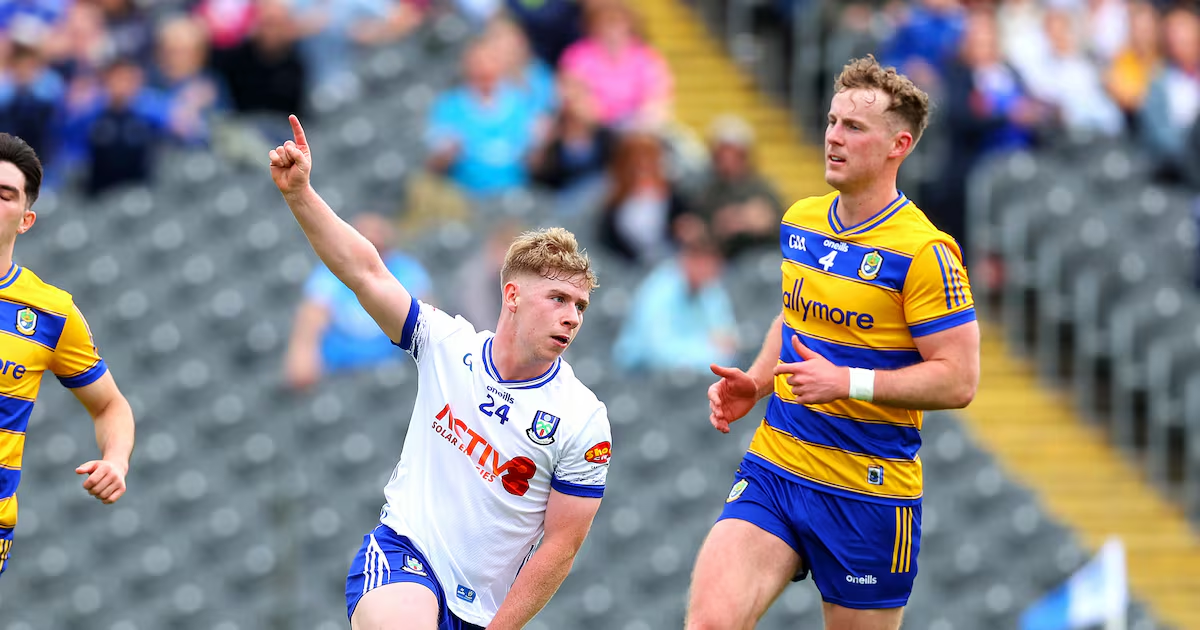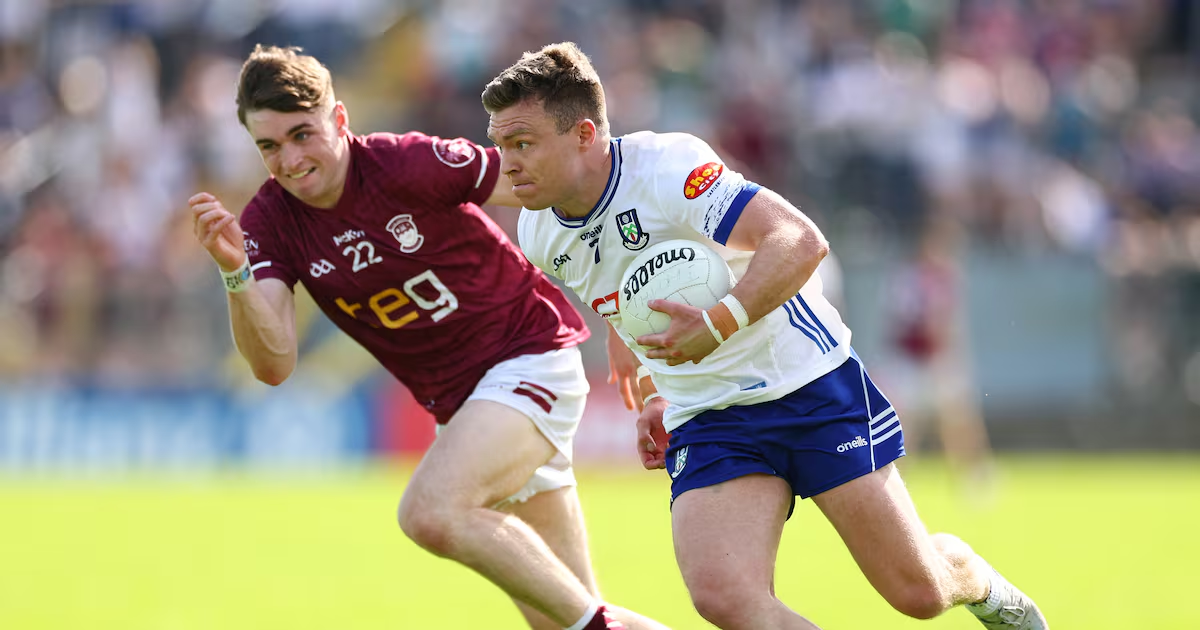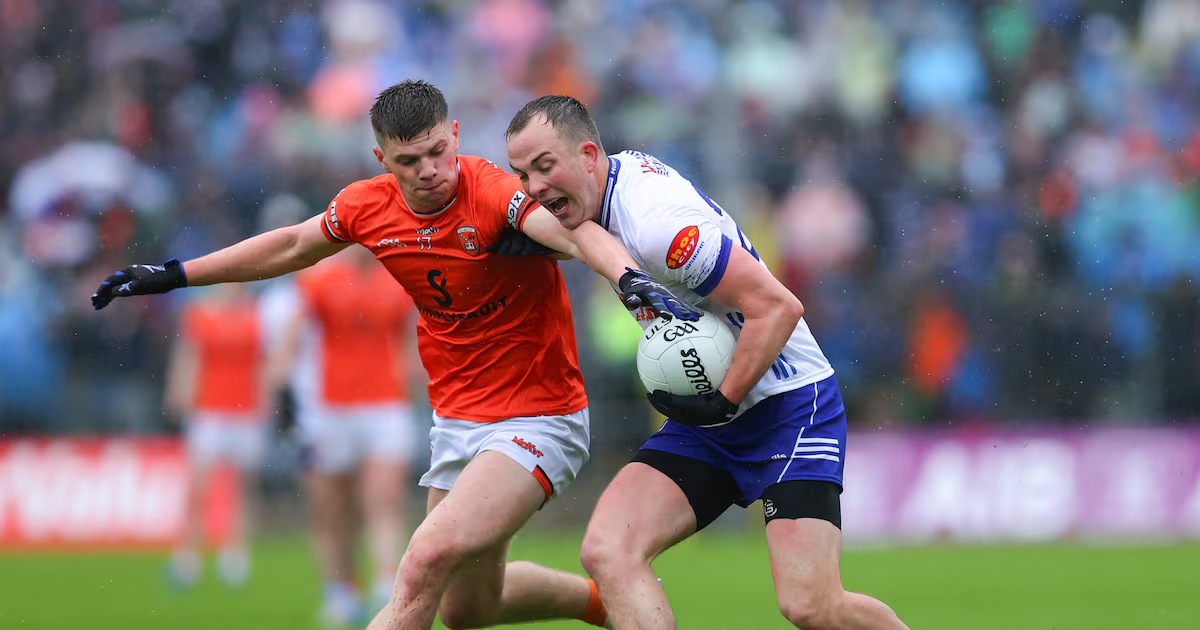
The orange surge came in extra-time at Clones as Armagh confirmed their billing as serious All-Ireland contenders. But the winning of the Ulster final might actually have taken place during Monaghan’s wave of dominance.Armagh controlled extra-time, outscoring Monaghan 1-7 to 0-1. However, it was during the last 10 minutes of normal time, as they were on the backfoot, when Armagh really demonstrated the priceless commodities of experience and composure.They led 1-19 to 0-15 with a quarter of an hour of normal time remaining when Monaghan’s comeback started. But it wasn’t 15 minutes of incessant Monaghan pressure – rather the Farney County’s rally was a whirlwind spell of four minutes and 13 seconds.From Stephen O’Hanlon’s score after 55 minutes and 23 seconds to the same player hitting a two-pointer after 59 minutes and 36 seconds, Monaghan scored seven points from five shots.That’s a 140 per cent conversion rate because of the two-pointers. But for the remaining 10 minutes of normal time Monaghan only managed four further shots on goal – resulting in two points and two wides, a 50 per cent return.They went from creating roughly one shot every 50 seconds to only creating four shots in the last 10 minutes. And that’s where Armagh’s experience won the game. They held the line, they refused to panic.Their bench made an impact during that spell too with Oisín O’Neill and Ross McQuillan keeping the scoreboard ticking over with a couple of points. At a time when Monaghan certainly seemed to have the momentum, Armagh didn’t leave themselves vulnerable to letting the game slip away. They never allowed Monaghan to take the lead coming down the stretch.In that rapid-fire spell where Monaghan scored seven points, Jack McCarron was the spark. He scored 0-3 of that tally, including one two-pointer, and McCarron was also involved in the build-up play to the other three scores.But thereafter Armagh were able to curtail his influence, especially in terms of allowing him two-point opportunities.Armagh's Aidan Forker and Aaron McKay pictured as they lift the Ulster title. Photograph: Tom O'Hanlon/Inpho There was also something wider at play in those last 10 minutes – and it provided us with an insight to the concept of fear versus bravery. In order to have bravery, you must have fear in there.There was no shot in the final two-and-a-half minutes of the Ulster final.Armagh played down the clock trying to engineer a buzzer beater but Conor Turbitt slipped inside the arc, coughed up possession and ultimately neither team got a shot off before the hooter.Such caution in the closing stages was in stark contrast to the gung-ho approach by Monaghan between the 55th-60th minutes. They just went for it at that stage of the match, throwing caution to the wind.They got off five shots in a little over four minutes because, well, quite simply, they had nothing to lose. The game was moving away from them, they were probably going to lose by nine or 10 points if they didn’t gamble. So that’s exactly what they did.But then a few moments later, when the game is level again, basic human emotion took hold. The fear then was that a mistake at that stage could be the losing of the match. Analysts and supporters often try to simplify results down to one thing or another – but it tends to be the case that we don’t look at mistakes in the first 10 minutes the same way we look at mistakes in the last 10 minutes.As a manager or coach on the sideline, in those frantic last moments of tight matches the truth is you have very little influence. You’ve probably used four or five subs already and nobody on the pitch can hear you unless they’re two metres away. It’s pandemonium.If you have possession, you’re trying to encourage your players to do something positive but when conditions were as difficult as they were in Clones on Sunday, where the ball is like a bar of soap, the pitfalls of being adventurous flash in front of players like a warning beacon.Nobody wants to be the player to make a match-deciding mistake. So, players who were willing to take a gamble and make a supporting run when you were seven points down, well they are no longer prepared to roll that dice with three minutes remaining and the game level.Armagh's Darragh McMullen with Rory Beggan of Monaghan. Photograph: Tom O'Hanlon/Inpho Armagh’s experience of such moments – the learnings from the paper-tight Ulster finals they lost over the last three years – made a significant difference when the pendulum of the game started to sway on Sunday.Also, they were so disciplined in the tackle throughout and refused to allow Rory Beggan to become both a crowd influencer and a scoreboard influencer. They didn’t gift him any straightforward dead-ball shots. Monaghan wanted that oxygen; Armagh were determined not to provide them with it. If Beggan was to hit a long-range effort, he’d have to do earn every metre of the score.Even the free Armagh conceded with four minutes remaining was way out the field between the 45 and 65 metre lines, over near the sideline. It was a very difficult kick for Beggan and he pulled it wide of the Armagh goal.They had probably learned from how St Brigid’s handled Beggan in their All-Ireland club semi-final against Scotstown in January. Take away that weapon and you limit the damage that can be done.Armagh also used their bench very astutely in extra-time on Sunday. Cian McConville and Jason Duffy were brought back on at the start of extra-time, while Rory Grugan had been introduced just before the end of normal time. Oisín O’Neill was on the field too.I think Armagh knew exactly what was going to happen. Monaghan won the toss and chose to play against the breeze but if Armagh had won the toss, I reckon they were going to play with the breeze anyway.They had resolved; “We can take control of this game at the start of extra-time.” That’s why they had their shooters on the pitch; they figured they could use McConville for frees – and he popped one over in the second minute of extra-time.The goal gave them a real cushion but I think Armagh were starting to take control before that so hats off Kieran McGeeney and the Armagh management for how they handled the start of extra-time.Armagh manager Kieran McGeeney. Photograph: Tom O'Hanlon/Inpho There is no doubt Armagh are genuine All-Ireland contenders. They were even before Sunday, but having finally collected that Ulster title their sole focus can now be on trying to get their hands on Sam Maguire again.Incidentally, the Ulster and Leinster finals also demonstrated how important a half-back line that can contribute to the scoreboard is in the current game.Positions are fluid but if you take it that Jarly Óg Burns (0-3), Tiernan Kelly (1-0), Joe McElroy (0-2) and Ross McQuillan (0-2) played in the Armagh half-back line at some stage – that’s 1-7 they got from that area of the pitch against Monaghan.Then you look at Westmeath at Croke Park against Dublin – they got 0-9 from their half-back line – Ronan Wallace (0-3), Shane Allen (0-2) and Matthew Whittaker (0-4).And just as Kieran McGeeney is rightfully receiving praise for leading Armagh to an Ulster title, Mark McHugh also deserves huge credit for what he has achieved with Westmeath.Because Westmeath’s victory was not some sort of fluke. They had a very strong National League – though the concession of a late goal against Wexford perhaps wrongly coloured opinion of the team.Before Sunday, they had already won three championship games this season – beating Longford, Meath and Kildare. Now, just like his father with Cavan in 1997, McHugh gets to become a hero in an adopted county.On a weekend when Armagh became kings of Ulster again, it is at least a silver lining for one corner of Donegal.
Stephen Rochford: Armagh’s ability to kill Monaghan’s momentum won them the Ulster final
The Orchard County’s experience made a significant difference when the pendulum of the game started to sway
1,319 words~6 min read