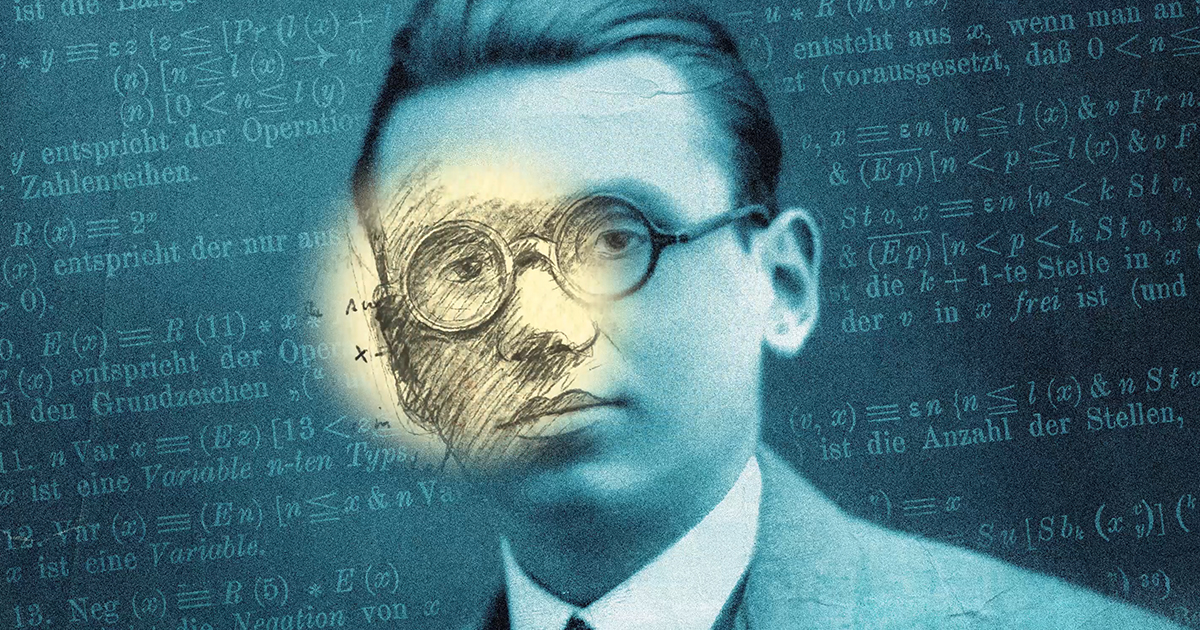
At 25, Kurt Gödel proved there can never be a mathematical “theory of everything.” Columnist Natalie Wolchover explores the implications.
In 1931, by turning logic on itself, Kurt Gödel proved a pair of theorems that transformed the landscape of knowledge and truth. These “incompleteness theorems” established that no formal system of mathematics — no finite set of rules, or axioms, from which everything is supposed to follow — can ever be complete. There will always be true mathematical statements that don’t logically follow from those axioms.
I spent the early weeks of the Covid pandemic learning how the 25-year-old Austrian logician and mathematician did such a thing, and then writing a rundown of his proof in fewer than 2,000 words. (My wife, when I reminded her of this period: “Oh yeah, that time you almost went crazy?” A slight exaggeration.)
But even after grasping the steps of Gödel’s proof, I was unsure what to make of his theorems, which are commonly understood as ruling out the possibility of a mathematical “theory of everything.” It’s not just me. In Gödel’s Proof (a classic 1958 book that I heavily relied upon for my account), philosopher Ernest Nagel and mathematician James R. Newman wrote that the meaning of Gödel’s theorems “has not been fully fathomed.”